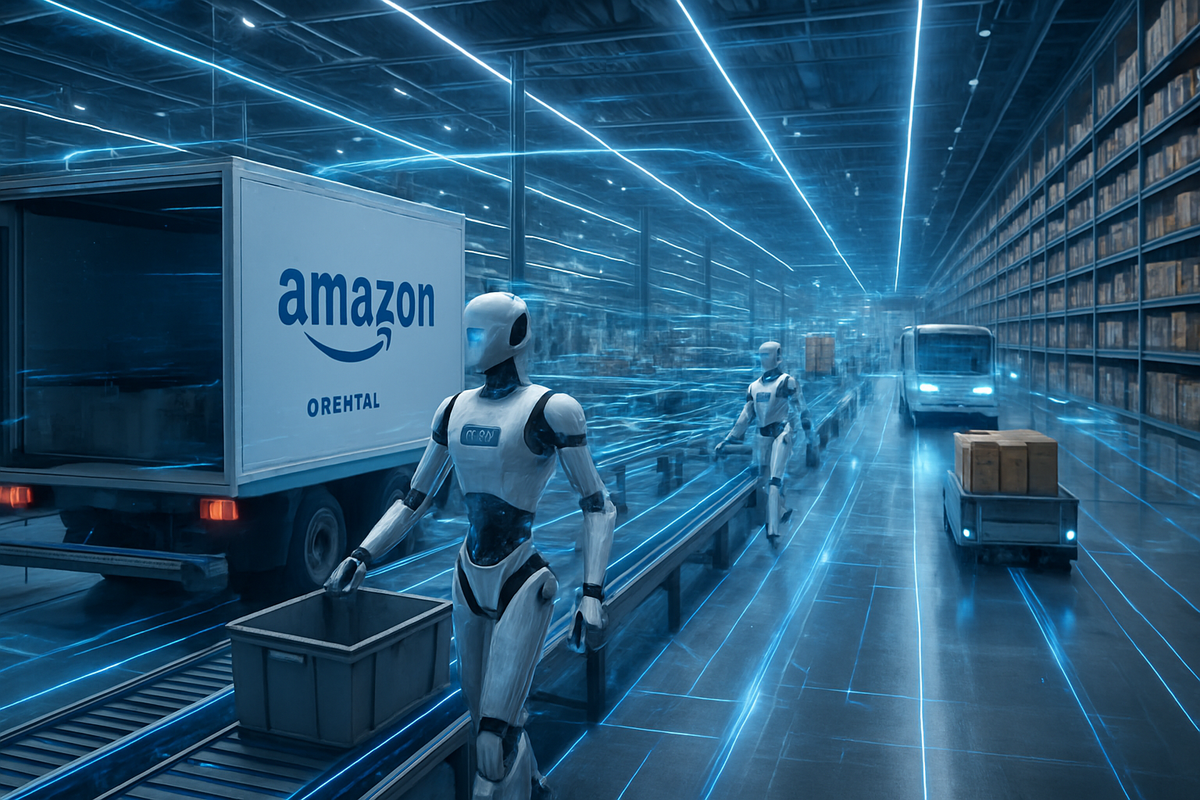
As of March 20, 2026, the global retail landscape has reached a definitive turning point. Amazon.com Inc. (NASDAQ: AMZN) has officially moved beyond the era of simple warehouse automation, fully integrating what it calls "Physical AI" across its vast fulfillment network. This strategic pivot—merging sophisticated generative AI "agents" with a new generation of adaptive hardware—is no longer a pilot program; it is the backbone of an operation that has seen the tech giant finally surpass its long-time rival in total annual revenue.
The immediate implications are profound. By shifting from pre-programmed robotics to "agentic" systems that can reason, learn, and adapt to shifting floor conditions in real-time, Amazon has significantly slashed its cost-per-package while simultaneously expanding its ultra-fast delivery capabilities. For the market, this represents the transition of logistics from a massive capital expense into a high-margin, tech-driven utility, forcing every other player in the commerce space to reconsider their own automation roadmaps.
The Dawn of Agentic Logistics
The transition to Physical AI accelerated sharply in late 2025 and early 2026, following a series of hardware breakthroughs and the discontinuation of older, more rigid systems. Most notable was the official commercial rollout of Digit, a bipedal humanoid robot developed by Agility Robotics. While early trials focused on simple tote movements, the March 2026 iteration of Digit is now tasked with "unstructured" roles—unloading trailers and navigating complex warehouse zones where human-robot interaction was previously considered too risky. This humanoid presence is supported by "Vulcan," a touch-sensitive picking robot that handles fragile items with human-like dexterity, and "Titan," a heavy-duty autonomous vehicle capable of moving pallets of oversized freight that once required a fleet of manual forklifts.
Behind the hardware lies the "brain" of the operation: Project Eluna. Launched in early 2026, Eluna is an agentic AI model that acts as a digital teammate for warehouse managers. Unlike traditional monitoring software, Eluna uses natural language processing to communicate with human supervisors, autonomously reassigning robotic fleets and human teams to prevent bottlenecks before they occur. This is paired with "DeepFleet," a generative AI foundation model trained on billions of hours of navigation data, which has improved overall robot travel efficiency by an estimated 10% this year alone.
The timeline of this evolution includes a major pivot in February 2026, when Amazon shuttered its "Blue Jay" ceiling-mounted sortation project in favor of "Orbital." Orbital is a modular, "plug-and-play" robotic fulfillment platform designed for flexibility. Its ability to be rapidly deployed in both massive distribution hubs and the smaller micro-fulfillment centers (MFCs) located within Whole Foods and Amazon Fresh stores has been the catalyst for Amazon's new nationwide "One-Hour Prime" delivery tier.
Furthermore, Amazon’s acquisition of the Swiss startup RIVR in early March 2026 has sent shockwaves through the industry. RIVR specializes in wheel-legged quadruped robots capable of climbing stairs and navigating urban obstacles. This acquisition signals Amazon’s intent to solve the "final meter" problem, moving beyond the van to deliver packages directly to a customer’s doorstep without human intervention, effectively closing the loop on a fully autonomous supply chain.
Winners and Losers in the Autonomous Era
Amazon (NASDAQ: AMZN) stands as the primary victor in this technological shift. By reaching a record $716.9 billion in annual revenue, it has officially overtaken Walmart Inc. (NYSE: WMT) as the world's largest retailer by sales. Investors have rewarded this efficiency with a "Strong Buy" consensus, as analysts from major firms like Morgan Stanley project that Physical AI could save the company between $12.6 billion and $16 billion annually by the end of the decade. The ability to charge a $9.99 premium for one-hour delivery has turned their logistics prowess into a lucrative revenue stream rather than a cost center.
Conversely, the "AI-Have-Nots"—mid-tier retailers who lack the multi-billion dollar capital expenditure budgets required to build proprietary Physical AI—face an increasingly bleak outlook. These companies are finding themselves forced to choose between eroding margins by attempting to compete on speed or paying ever-increasing fees to use "Fulfillment by Amazon" services. This dependency creates a consolidated market where Amazon essentially tax-collects on its competitors' sales.
In the robotics sector, Symbotic Inc. (NASDAQ: SYM) has emerged as a crucial winner for the rest of the market. As Walmart’s primary automation partner, Symbotic’s high-density warehouse systems are being fast-tracked across hundreds of Walmart distribution centers to keep pace with Amazon. However, traditional logistics giants like United Parcel Service Inc. (NYSE: UPS) and FedEx Corp. (NYSE: FDX) are feeling the heat. As Amazon masters the "final meter" with its RIVR acquisition, the volume of packages flowing through third-party carriers continues to dwindle, forcing these legacy firms to accelerate their own autonomous vehicle investments or risk obsolescence.
The labor force remains the most complex variable in this equation. While Amazon maintains that these robots take over "dull, dirty, and dangerous" tasks, internal projections suggest the company aims to avoid hiring over 160,000 workers by 2027 through automation. This has already led to renewed friction with organizations like the International Brotherhood of Teamsters and the Amazon Labor Union, who argue that the rapid pace of "Physical AI" deployment is outpacing the creation of new, high-quality jobs for the humans who remain in the system.
A Wider Significance: Logistics as a Software Problem
The integration of Physical AI at this scale marks a departure from the "Global Supply Chain" model toward what experts are calling "Local Autonomous Loops." Historically, logistics was a game of regional hubs and long-haul trucking. Today, Amazon is proving that with enough AI-driven efficiency, the warehouse can be brought into the neighborhood. This fits into the broader industry trend of "hyper-localization," where the goal is no longer just moving goods across the country, but predicting what a customer wants and having a robot deliver it from three miles away within the hour.
This event also signals a shift in how the tech industry views AI. For the past few years, the focus has been on "Digital AI"—chatbots and image generators. Amazon’s 2026 strategy proves that the next frontier is "Physical AI," where the intelligence must interact with the messy, unpredictable physical world. This has significant ripple effects on the semiconductor industry, as the demand for "edge-AI" chips capable of running complex models on a moving robot has skyrocketed, benefiting hardware manufacturers across the board.
Regulatory scrutiny is the inevitable shadow of this progress. As Amazon’s robots become more prevalent on city sidewalks and in public spaces, local and federal authorities are scrambling to catch up. Issues of "robotic right-of-way," data privacy (given the myriad of cameras on every RIVR and Digit unit), and AI liability are becoming central topics in Washington. Historically, whenever a company gains this much control over a critical infrastructure like logistics, antitrust regulators are not far behind, and the "Physical AI" era will likely be the next battleground for the Federal Trade Commission.
The Road Ahead: Scaling and Strategic Pivots
In the short term, the market should expect Amazon to aggressively scale the "Orbital" platform to its grocery and pharmacy divisions. By mid-2026, the company is expected to have automated micro-fulfillment centers operational in over 500 Whole Foods locations, enabling 30-minute grocery delivery in major metropolitan areas. This is a direct shot at the "Quick Commerce" startups that dominated the early 2020s, most of which have already been absorbed or shuttered.
Long-term, the focus will shift toward "Multi-Agent Coordination." This is the concept where different types of robots—drones, humanoids, and sidewalk rovers—all communicate through a single AI hive-mind to optimize delivery routes in real-time. The strategic pivot required here is one of culture; Amazon is transforming from a retail company into a robotics and AI company that happens to sell retail goods. The challenge will be maintaining the reliability of this complex "system of systems" as it scales to billions of packages annually.
Market opportunities will also emerge in the form of "Robotics-as-a-Service" (RaaS). There are growing rumors that Amazon may eventually license its "Project Eluna" and "DeepFleet" software to other industries, such as manufacturing or healthcare, much like it did with Amazon Web Services. If Amazon can successfully monetize its Physical AI stack, it could unlock a new multi-billion dollar business unit that is completely decoupled from consumer spending habits.
Summary and Investor Outlook
Amazon’s embrace of Physical AI in early 2026 represents a landmark moment in industrial history. By moving beyond static automation and into the realm of adaptive, agentic systems, the company has secured a dominant lead in the race for fulfillment efficiency. The introduction of Digit, Orbital, and the RIVR acquisition collectively demonstrate a strategy aimed at total control of the supply chain—from the warehouse shelf to the customer's front porch.
For investors, the key takeaway is Amazon’s successful transition of its logistics network from a cost burden into a competitive moat. While the capital expenditure is massive, the projected savings of over $12 billion annually and the ability to capture high-margin delivery premiums provide a clear path to continued profitability. Moving forward, the market should watch for two critical indicators: the pace of "final meter" robot deployment in urban areas and the potential for any regulatory pushback regarding labor displacement or robotic safety.
The era of the human-centric warehouse is drawing to a close, replaced by a symphony of silicon and steel. As Amazon (NASDAQ: AMZN) continues to widen the gap between itself and traditional retailers, the message to the market is clear: in the age of Physical AI, speed and efficiency are no longer just goals—they are the only way to survive.
This content is intended for informational purposes only and is not financial advice.