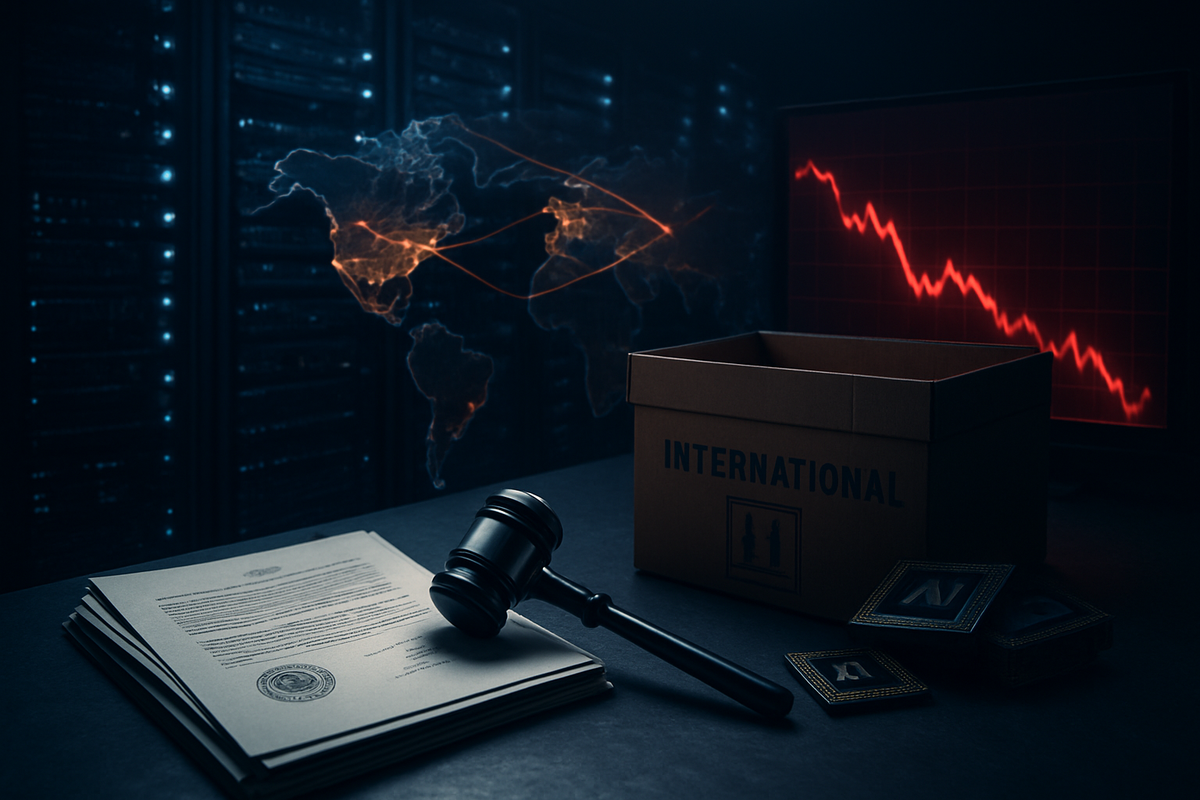
The artificial intelligence sector was rocked on Friday, March 20, 2026, as shares of Super Micro Computer (Nasdaq: SMCI) plummeted by more than 28%, wiping out nearly $6 billion in market value in a single trading session. The catastrophic sell-off followed the unsealing of a federal indictment by the U.S. Attorney’s Office for the Southern District of New York, which charges a co-founder and several high-ranking associates with orchestrating a massive, multi-year scheme to smuggle restricted Nvidia (Nasdaq: NVDA) AI chips to sanctioned entities in China.
This development marks a definitive turning point for a company that was once the "darling" of the generative AI boom, but has since become a cautionary tale of corporate governance failures. The market reaction was swift and merciless, with investors fleeing the stock amid fears of massive federal fines, potential export bans, and the risk of being permanently "de-prioritized" by its primary chip supplier, Nvidia, which also saw its shares dip 1.6% on the news due to its deep operational exposure to Super Micro.
A "Sophisticated and Brazen" Criminal Enterprise
The indictment, titled "Operation Gatekeeper," paints a damning picture of a "sophisticated and brazen" criminal enterprise operating within the highest echelons of Super Micro’s leadership. Federal prosecutors allege that between 2024 and 2025, the group diverted approximately $2.5 billion worth of advanced AI servers—specifically those containing Nvidia’s highly restricted Blackwell (B200) and Hopper (H200) chips—to Chinese buyers. Among the key defendants named is Yih-Shyan "Wally" Liaw, a co-founder and Senior VP of Business Development, who was arrested in California. Two others, including a sales manager from the company's Taiwan office, remain fugitives.
The timeline leading up to this moment suggests a "trust deficit" that has been building for years. In August 2024, a scathing report from Hindenburg Research first alleged "accounting manipulation" and "sanctions evasion" at the company. This was followed by a preliminary Department of Justice (DOJ) probe in September 2024 and the high-profile resignation of independent auditor Ernst & Young (EY) in October 2024, who stated they were "unwilling to be associated" with the firm’s financial statements. While Super Micro managed to maintain high revenue growth through late 2025, the March 20, 2026, indictment confirms the darkest suspicions of market skeptics, detailing tactics such as routing shipments through shell companies in Southeast Asia and using "dummy servers" to deceive Department of Commerce auditors.
The Flight to Quality: Winners and Losers in the AI Server Race
The immediate fallout from the Super Micro scandal has created a stark divide in the server market, triggering a massive "flight to quality" among enterprise and cloud customers. The primary beneficiaries have been Dell Technologies (NYSE: DELL) and Hewlett Packard Enterprise (NYSE: HPE), both of which are being viewed as "safe harbors" with superior corporate governance and compliant supply chains. By early 2026, Dell had already emerged as the undisputed leader in the branded AI server market, reporting an unprecedented $43 billion AI backlog and capturing large enterprise contracts that were previously contested by Super Micro.
Conversely, Super Micro is facing what analysts call a "radioactive" investor sentiment. Its share of the AI GPU server market—which peaked near 50% in 2024—is projected to erode toward 30% by late 2026 as customers prioritize stability over Super Micro's traditional "speed-to-market" advantage. Meanwhile, Nvidia faces its own set of challenges. While not accused of wrongdoing, the chip giant is now forced to radically alter its allocation strategy. Nvidia has reportedly begun redirecting its most advanced Blackwell and "Vera Rubin" chip allocations away from Super Micro toward Dell, HPE, and Taiwanese manufacturing partners like Foxconn and Quanta Computer, in an effort to insulate itself from further regulatory "contagion."
The End of the "Wild West" in AI Export Controls
The Super Micro indictment is more than just a corporate scandal; it is a watershed moment for the U.S.-China tech war and the enforcement of export controls. For years, the rapid pace of the AI boom outstripped the ability of regulators to fully monitor global supply chains. The details of "Operation Gatekeeper"—which included the alleged use of industrial hair dryers to swap regulatory stickers from restricted servers onto non-functional "dummy" units—highlight the desperate measures taken to bypass federal oversight. This case is now being compared to historical sanctions-evasion precedents involving major international tech firms, signaling a new era of aggressive enforcement.
The broader industry significance is already manifesting in new regulatory policies. Following the Super Micro revelations, the U.S. government reportedly placed Nvidia under a "heightened federal audit" status, necessitating unprecedented transparency into its "Know Your Customer" (KYC) protocols. Furthermore, the 2026 launch of "OpenShell"—a proprietary software layer developed by Nvidia that allows for real-time monitoring and remote disabling of AI workloads that violate export policies—is a direct response to the loopholes exploited in the Super Micro scheme. The "Wild West" era of AI server distribution appears to be coming to a close, replaced by a "sovereign-grade" secure supply chain model.
What Lies Ahead: Delisting, Overhaul, or Obsolescence?
Looking forward, Super Micro Computer faces a gauntlet of short-term and long-term existential threats. In the immediate future, the company risks a second delisting from the Nasdaq exchange if it cannot provide audited financial statements that are untainted by the current smuggling allegations. A complete management overhaul, including the possible departure of long-time CEO Charles Liang, may be the only path to regaining the trust of institutional investors and regulators. However, even with new leadership, the company's financial health is precarious; its gross margins have already collapsed to a "survival pricing" level of 6.3% as it fights to retain its remaining customers.
Strategic pivots will be required for Super Micro to survive. There is growing speculation that the company could become an acquisition target for a private equity firm or a larger tech conglomerate looking to pick up its liquid-cooling intellectual property at a "distressed" price. Alternatively, if Nvidia permanently cuts off its chip allocations, Super Micro could be relegated to a secondary player in the low-end server market, effectively ending its run as a major force in the AI revolution. Investors will be watching closely for the next round of SEC charges and any further arrests that could indicate the depth of the conspiracy.
The Verdict: A Harsh Lesson for the AI Era
The 28% plunge in Super Micro’s stock on March 20, 2026, serves as a grim reminder that in the high-stakes world of artificial intelligence, technical prowess is no substitute for corporate integrity. The key takeaway from the "Operation Gatekeeper" indictment is that the "governance discount" is a real and devastating force in the market. While Super Micro was instrumental in the early years of the AI boom, its alleged decision to prioritize illicit growth over national security and regulatory compliance has left it on the brink of collapse.
As the market moves forward, the focus will shift toward "compliance-first" manufacturing and the software-level enforcement of export controls. For investors, the lesson is clear: in an era of geopolitical volatility and strict regulatory scrutiny, the "boring" metrics of transparency and governance are just as critical as revenue growth and GPU allocations. In the coming months, all eyes will be on the federal courts and Nvidia’s next allocation cycle to see if Super Micro can find a way to stay relevant, or if it will be remembered as the first major casualty of the AI sector’s "governance crisis."
This content is intended for informational purposes only and is not financial advice.