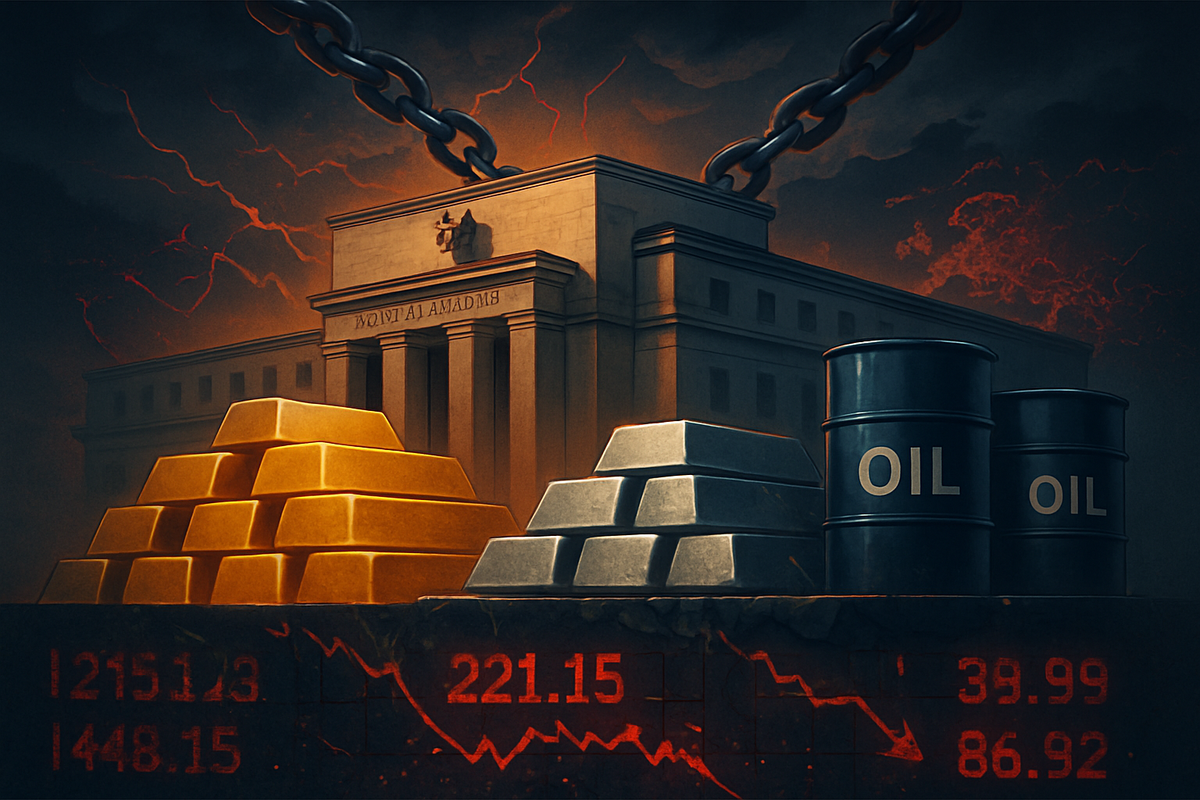
As of March 20, 2026, the global financial landscape is undergoing a seismic shift as investors flee traditional paper assets in favor of hard commodities. A volatile combination of the Trump administration’s aggressive new "bridge tariffs" and an escalating war of nerves with the Federal Reserve has ignited fears of dollar debasement and a return to 1970s-style stagflation. With the U.S. dollar’s status as a stable reserve currency under scrutiny, capital is pouring into gold, silver, and energy at a pace not seen in decades.
This flight to commodities is not merely a hedge against inflation but a direct response to what many analysts are calling a "crisis of institutional confidence." The administration's recent implementation of a 15% global tariff under the Trade Act of 1974, coupled with a highly public attempt to sideline Federal Reserve Chair Jerome Powell, has convinced markets that the era of central bank independence may be nearing an end. Consequently, the "debasement trade"—the practice of selling fiat currency to buy physical assets—has become the dominant strategy on Wall Street.
The Section 122 Pivot and the DOJ Subpoenas
The current turmoil reached a boiling point in late February 2026, following a landmark judicial setback for the administration. After the Supreme Court struck down previous tariff measures enacted under the International Emergency Economic Powers Act (IEEPA), the White House pivoted within 96 hours to Section 122 of the Trade Act of 1974. This move established a 10% global "bridge tariff" on nearly all imports, which was quickly adjusted by early March to the statutory maximum of 15%. This 150-day temporary measure is intended to serve as a placeholder while the Office of the U.S. Trade Representative (USTR) conducts sweeping Section 301 investigations into over 60 economies, including the European Union, Mexico, and India.
Simultaneously, the administration has intensified its pressure on the Federal Reserve. In a move that shocked the financial world, the Department of Justice recently served subpoenas on Fed Chair Jerome Powell and other top officials regarding a long-standing headquarters renovation project. Market participants largely view this as a "pretextual" investigation designed to intimidate the central bank into cutting interest rates to counteract the inflationary pressures of the new tariffs. The tension is further exacerbated by the nomination of Kevin Warsh to succeed Powell when his term expires on May 15, 2026, creating a "lame duck" period of extreme uncertainty for U.S. monetary policy.
The reaction across the commodities complex has been explosive. In January 2026, Gold touched a historic peak of $5,608 per ounce before stabilizing near the $5,000 mark this month. Silver followed suit, briefly eclipsing $120 per ounce. Beyond precious metals, Brent crude oil has spiked into the $110–$120 range as of mid-March, driven by both domestic trade friction and a deteriorating security situation in the Middle East that has hampered shipping in the Strait of Hormuz.
Winners and Losers in the Commodities Surge
The beneficiaries of this shift are found primarily in the natural resources and energy sectors. Mining giants have seen their margins expand to record levels as spot prices for their primary outputs soar. Newmont Corporation (NYSE: NEM) and Agnico Eagle Mines Limited (NYSE: AEM) have become the darlings of institutional investors seeking direct exposure to the gold rally. Similarly, Freeport-McMoRan Inc. (NYSE: FCX) is capitalizing on the surge in industrial metals, specifically copper, which is essential for the "Fortress America" push to rewire domestic supply chains.
In the energy space, the supply shocks and geopolitical instability have boosted the fortunes of major oil producers and transporters. Exxon Mobil Corporation (NYSE: XOM) and Chevron Corporation (NYSE: CVX) have reported windfall gains, while Scorpio Tankers Inc. (NYSE: STNG) has benefited from the increased demand for specialized fuel transport amid shifting trade routes. Exchange-traded funds like the SPDR Gold Shares (NYSE Arca: GLD) and the United States Oil Fund (NYSE Arca: USO) have also seen record inflows as retail and institutional investors alike scramble for protection.
Conversely, the losers in this environment are companies heavily dependent on global supply chains and imported components. Technology titans like Apple Inc. (NASDAQ: AAPL), NVIDIA Corporation (NASDAQ: NVDA), and Advanced Micro Devices, Inc. (NASDAQ: AMD) are facing an immediate margin squeeze from the 15% bridge tariffs and escalating export caps to China. The retail sector is arguably the hardest hit; Nike, Inc. (NYSE: NKE), Gap Inc. (NYSE: GPS), and Hasbro, Inc. (NASDAQ: HAS) are navigating a landscape where $175 billion in potential tariff refunds are currently tied up in litigation, while new costs are being passed directly to an already-strained American consumer.
Institutional Confidence and the Erosion of the Fed’s Mandate
The wider significance of this "flight to commodities" represents a fundamental realignment of the relationship between the executive branch and the nation's financial regulators. Historically, the independence of the Federal Reserve has been the bedrock of global trust in the U.S. dollar. By challenging this independence through DOJ subpoenas and attempts to fire Fed Governor Lisa Cook—a case currently before the Supreme Court—the administration is testing a precedent that has stood since the Fed’s founding. If the market perceives the Fed is being "packed" with political loyalists like Stephen Miran, who has advocated for the lower-for-longer rate environment the White House desires, the premium on the dollar may permanently erode.
This event fits into a broader global trend of "de-globalization" and the weaponization of trade policy. The 15% global tariff is a radical departure from the multi-lateral trade agreements of the late 20th century, signaling a return to a more protectionist, mercantile era. The ripple effects are already being felt by international partners; the EU and Mexico are reportedly preparing retaliatory measures that could further disrupt global agricultural and automotive markets. Historically, such trade wars, when combined with monetary uncertainty, have led to "lost decades" of growth, drawing comparisons to the stagflationary era of the 1970s.
Furthermore, the surge in industrial metals like platinum and uranium highlights a strategic shift toward resource nationalism. As the U.S. attempts to build a "Fortress America" manufacturing base, the demand for these critical minerals is outpacing supply, leading to severe deficits. Platinum, which hit $3,000/oz earlier this year, is now being viewed as much as a "hard asset" hedge as it is an industrial necessity.
The Road Ahead: Navigating a New Economic Order
Looking ahead, the next few months will be a crucible for the U.S. economy. In the short term, the market will be hyper-fixated on May 15, the date when the leadership transition at the Federal Reserve officially begins. If Kevin Warsh signals a move away from the Fed's traditional data-driven mandate in favor of the administration's political goals, we could see a secondary, even more aggressive spike in precious metals. Strategic pivots are already underway in the corporate world, with companies like Wayfair Inc. (NYSE: W) and others frantically diversifying their sourcing away from high-tariff regions to avoid the impending 33.9% effective tariff rate on Chinese goods.
In the long term, the U.S. may face a permanent shift in how it manages its debt and currency. If the "debasement trade" persists, it could lead to a self-fulfilling prophecy where the dollar’s purchasing power declines relative to commodities, forcing the Fed to choose between saving the currency or supporting the labor market. Market opportunities will likely remain in the commodities and domestic energy sectors, while the challenges for high-growth tech and consumer discretionary stocks will remain formidable as long as trade barriers are in place.
Summary: A Strategic Shift to Hard Assets
The key takeaways from this March 2026 update are clear: the dual pressures of aggressive trade protectionism and a direct challenge to central bank autonomy have broken the "lower-inflation" paradigm of the last few decades. The flight to commodities is a rational response to a world where the primary pillars of financial stability are being renegotiated in real-time. For the market moving forward, volatility is the only certainty, and the "hard asset" hedge has transitioned from a fringe strategy to a mainstream necessity for institutional survival.
As we look toward the summer, investors should watch the Supreme Court’s ruling on the firing of Fed Governor Lisa Cook and the USTR’s final Section 301 findings. These events will determine whether the current 15% bridge tariff is a temporary shock or the beginning of a permanent high-duty regime. In this new era, the strength of a portfolio may no longer be measured by its growth potential in paper assets, but by its weight in gold, oil, and copper.
This content is intended for informational purposes only and is not financial advice.