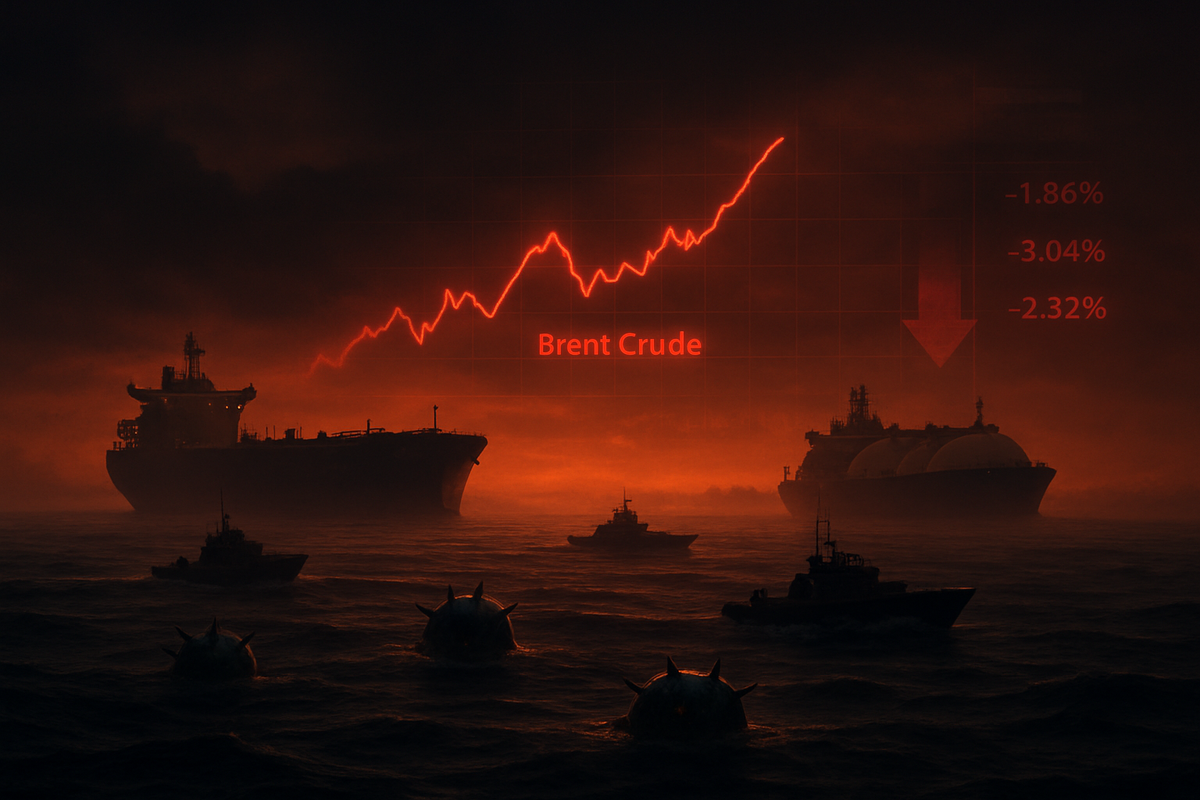
LONDON/NEW YORK — The global economy has entered a state of high alert as the Strait of Hormuz, the world’s most critical maritime energy chokepoint, remains effectively closed following a series of kinetic escalations by Iranian naval forces. On March 20, 2026, international shipping lanes in the narrow waterway—which typically see the passage of over 20 million barrels of oil per day—have fallen silent, replaced by a dense presence of Islamic Revolutionary Guard Corps (IRGC) fast-attack craft, naval mines, and sophisticated drone swarms.
The immediate implications are nothing short of seismic. Brent crude prices have surged past $145 per barrel in early trading, while regional "war risk" insurance premiums have skyrocketed to levels not seen since the "Tanker War" of the 1980s. With 20% of the world’s liquefied natural gas (LNG) supply effectively stranded, energy-hungry economies in Asia and Europe are bracing for a period of mandatory rationing and record-breaking utility costs, threatening to derail a fragile global recovery.
The Flashpoint: A Calculated Escalation in the Gulf
The current crisis did not emerge in a vacuum but rather as the culmination of a tense 18-month "shadow war" between Tehran and Western-aligned interests. Following the direct missile exchanges of late 2024 and early 2025, the IRGC began a systematic campaign of "grey zone" tactics, including the seizure of commercial vessels and GPS jamming in the Persian Gulf. The situation reached a breaking point on March 15, 2026, when Iran announced a "total maritime exclusion zone" in response to intensified Western sanctions and alleged sabotage of its nuclear infrastructure.
By March 18, the effective closure was solidified through the deployment of advanced naval mines and persistent drone harassment of tankers attempting to navigate the Omani coast. Key stakeholders, including the United States Navy's 5th Fleet and regional partners like Saudi Arabia, have been forced into a defensive posture, as any attempt to clear the mines risks a full-scale regional conflict. The timeline of the last 72 hours shows a complete cessation of commercial traffic, with over 150 tankers currently anchored in the Arabian Sea, awaiting orders that may never come.
Initial market reactions have been characterized by blind panic. In New York, the S&P 500 Index dropped 4.2% on the news, while European indices, more sensitive to LNG disruptions, saw even steeper declines. The primary concern is no longer just the price of energy, but its physical availability, as major ports in Jebel Ali and Dammam are now essentially cut off from global supply chains.
Corporate Fallout: Winners, Losers, and the High Cost of Risk
In the high-stakes world of global energy and logistics, the closure has created a stark divide between those with exposure to the Gulf and those with diversified, non-regional assets. ExxonMobil (NYSE: XOM) and Chevron (NYSE: CVX) have seen their shares resilient or even rising, as their massive investments in the Permian Basin and Guyana become the "safe havens" of the energy market. As global supply tightens, these U.S.-based majors are positioned to reap record profits from production far removed from Iranian drone reach.
Conversely, the outlook for European giants like Shell (NYSE: SHEL) and TotalEnergies (NYSE: TTE) is far bleaker. Both firms are heavily integrated into Qatar’s North Field LNG expansion projects. With the Strait closed, this massive LNG production is effectively "bottled up," leading to potential multi-billion-dollar write-downs and a collapse in projected cash flows for 2026. Similarly, global shipping behemoth A.P. Møller – Mærsk A/S (CPH:MAERSK-B) has been forced to reroute all Asia-Europe traffic around the Cape of Good Hope, adding 10 to 20 days to transit times and millions in fuel costs per voyage.
The shipping sector is witnessing extreme volatility. Frontline PLC (NYSE: FRO) and Scorpio Tankers Inc. (NYSE: STNG) have seen their daily charter rates for "clean" vessels outside the Gulf surge to $200,000 per day as traders scramble for any available hull to move Atlantic Basin crude. Meanwhile, marine insurers like Beazley PLC (LSE:BEZ) are facing a dual crisis: the potential for massive claims from seized or damaged vessels and the administrative nightmare of canceling "war risk" coverage for the entire region.
Wider Significance: The Return of the Stagflation Trap
This crisis represents more than a temporary supply disruption; it is a fundamental restructuring of global energy geopolitics. Historically, the 1973 oil embargo and the 1979 Iranian Revolution serve as the only comparable precedents. However, the 2026 crisis is unique due to the world's heavy reliance on Middle Eastern LNG, which is far harder to replace than crude oil. This event fits into a broader trend of "de-globalization" and the weaponization of trade routes, signaling that the era of cheap, reliable maritime transport may be over.
The ripple effects on global policy are profound. Central banks, led by the Federal Reserve and the European Central Bank (ECB), are now caught in a "stagflation trap." Just as inflation was beginning to normalize in late 2025, this energy shock is expected to add 2.5 to 3 percentage points to global CPI. Central bankers must now decide whether to hike rates to combat energy-driven inflation—risking a deep recession—or hold steady and allow price expectations to de-anchor.
Furthermore, the crisis has highlighted the limits of existing infrastructure. While the Saudi East-West Pipeline and the UAE’s Habshan-Fujairah pipeline are running at maximum capacity, they can only handle roughly 25% of the volume lost through the Strait. The systemic failure of these "bypass" routes to fully mitigate the closure suggests that the global economy's "safety net" is thinner than previously believed.
The Path Forward: Strategic Pivots and Scenarios
In the short term, the market will look to the U.S. Strategic Petroleum Reserve (SPR) for relief. On March 11, the Department of Energy announced a historic release of 172 million barrels, but this is a finite resource that is expected to drop the reserve to its lowest level since 1982. The long-term pivot will likely involve an accelerated transition toward nuclear and renewable energy in Europe and North Asia, as the national security risks of fossil fuel dependency become impossible to ignore.
Potential scenarios for the coming months range from a negotiated diplomatic "thaw"—which seems unlikely given the current rhetoric—to a prolonged blockade lasting six months or more. If the blockade persists, we may see the emergence of a "two-tier" energy market: a high-priced, transparent market for Western-aligned crude, and a "dark" market where sanctioned Iranian and Russian oil is traded at steep discounts to non-aligned nations using non-dollar currencies.
Market participants should prepare for a period of extreme volatility. Strategic adaptations will include the "on-shoring" of energy-intensive manufacturing and a massive investment in North American energy infrastructure. The "Hormuz Premium" is no longer a theoretical risk; it is a permanent fixture of the 2026 investment landscape.
A Global Economy Under Pressure
The effective closure of the Strait of Hormuz is a "black swan" event that has rewritten the rules of the global economy in a matter of days. As of late March 2026, the takeaway is clear: the world's energy security is far more fragile than the relative stability of the 2010s suggested. The inflationary risks are real, immediate, and likely to persist even if the Strait is reopened tomorrow, as the cost of insuring and financing Middle Eastern trade has permanently shifted higher.
Moving forward, the market will be defined by energy balkanization. Investors should closely monitor the physical flow of oil through bypass pipelines and the depletion rates of global strategic reserves. The resilience of public companies will no longer be measured by their growth alone, but by their ability to navigate a world where the most critical waterways are no longer guaranteed to stay open.
This content is intended for informational purposes only and is not financial advice.