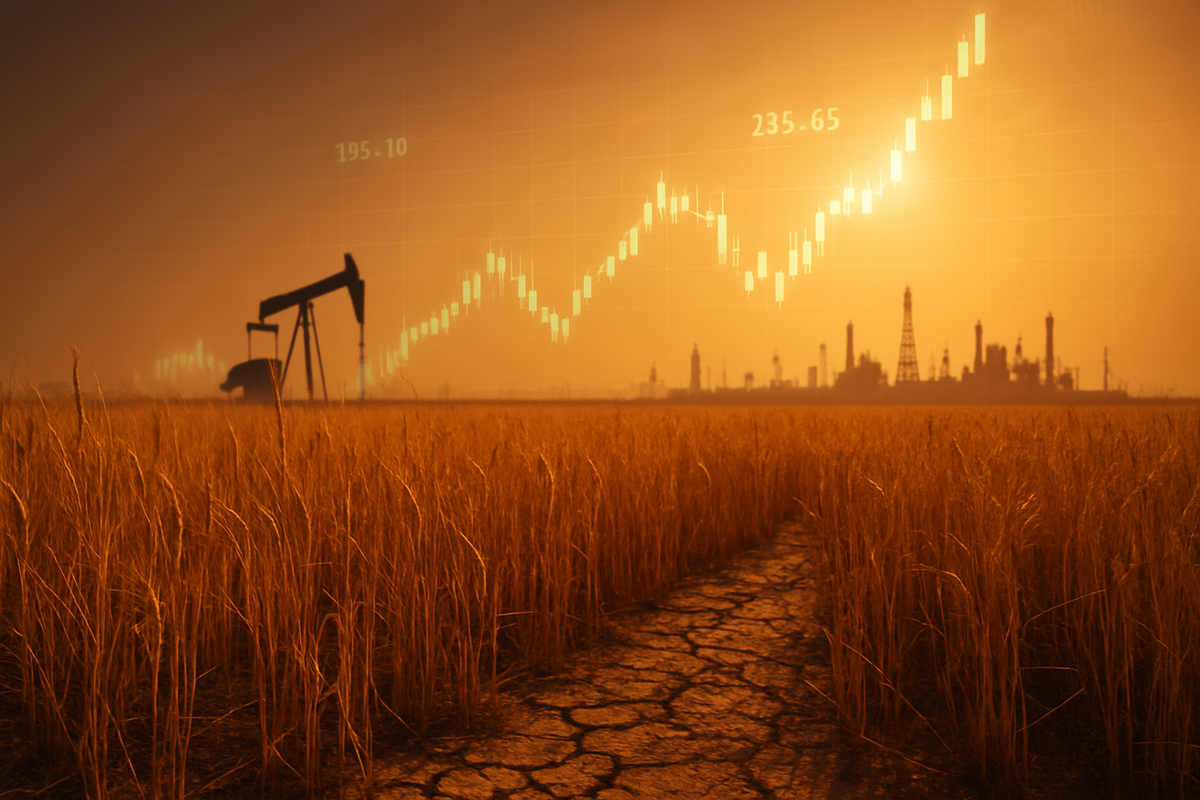
In a dramatic shift for global agricultural markets, Kansas Hard Red Winter (HRW) wheat futures surged more than 19 cents today, March 19, 2026, as a volatile mix of geopolitical instability and deteriorating environmental conditions sent shockwaves through the commodities complex. The rally, which has pushed wheat to nine-month highs, is being fueled by an unprecedented 98% correlation with crude oil prices and a worsening drought across the U.S. "Wheat Belt" that threatens to decimate yields before the spring harvest even begins.
The immediate implications are stark: with crude oil breaching the $100 mark following escalations in the Middle East, wheat has transitioned from a mere agricultural staple to a critical food security hedge for institutional investors. As the cost of energy-intensive inputs like nitrogen fertilizer skyrockets alongside grain prices, the global market is bracing for a sustained period of "agriflation" that could reshape food supply chains for the remainder of the decade.
A Convergence of Geopolitical and Atmospheric Crises
The rally reached a fever pitch during today’s trading session as May 2026 KCBT Wheat futures closed up 19 1/4 cents to settle at $6.26 per bushel. The momentum was largely driven by a realization among traders that the U.S. winter wheat crop is in its worst condition in years. A persistent La Niña weather pattern has left the Southern Plains—specifically Kansas, Oklahoma, and Texas—parched since the previous autumn. According to the latest USDA reports, winter wheat ratings plummeted by 22% over the last month alone, with the Brugler500 index for Kansas dropping to a dismal 339.
The timeline for this spike traces back to early March, when military escalations involving Iran led to a partial blockade of the Strait of Hormuz. This geopolitical choke point handles a significant portion of the world's oil, and its disruption sent West Texas Intermediate (WTI) crude surging toward $120 per barrel. Because modern industrial agriculture is so deeply tied to energy—from the natural gas used in fertilizer production to the diesel used in transport—the grain markets reacted in lockstep. Analysts noted that the 21-day correlation between crude and Kansas HRW wheat has reached a staggering 98%, a level rarely seen outside of major global conflicts.
Market participants, including large hedge funds and institutional desk traders, responded by aggressively covering short positions. As prices breached key technical resistance levels, the "short squeeze" added fuel to the fire, pushing intraday gains as high as 33 cents in some contracts. For many, the move was a defensive play; Bank of America recently identified wheat as the primary "food security hedge," leading fund managers to stockpile futures as a protection against the broader inflationary impact of the energy shock.
Corporate Winners and Losers in the Volatility
The surge in prices has created a bifurcated landscape for the giants of the agricultural sector. Archer-Daniels-Midland (NYSE: ADM) saw its shares close at $70.87, as the company stands to benefit from increased origination volumes. With prices spiking, farmers who had been holding onto "old-crop" supplies from the previous season are finally beginning to liquidate, providing ADM with a steady flow of grain to process and export. Similarly, The Andersons (NASDAQ: ANDE) reached a high of $70.73, with management noting that the massive influx of speculative capital into the grain markets has bolstered their origination margins.
Bunge Global (NYSE: BG) has also positioned itself to weather the storm, utilizing its recently expanded Viterra logistics network to navigate the supply chain disruptions caused by the unrest in the Middle East. Executives have characterized the current environment as one "built for complexity," where Bunge’s global footprint allows it to source grain from unaffected regions to fulfill contracts. However, the volatility is a double-edged sword; while trading margins are high, the cost of logistics and insurance for maritime freight is climbing rapidly.
The fertilizer sector is seeing the most dramatic gains. CF Industries (NYSE: CF) hit an all-time high of $137 this week. As a North American producer, CF benefits from access to relatively low-cost domestic natural gas while global urea prices have soared to $600 per ton—an 80% increase from last fall. Meanwhile, The Mosaic Company (NYSE: MOS) saw its stock jump 10.1%, though its outlook is more tempered by rising costs for sulfur, a key ingredient in phosphate production that is now harder to source due to the Hormuz blockade.
Historical Precedents and Macro Significance
This market event mirrors some of the most turbulent periods in economic history, drawing comparisons to the "Great Grain Robbery" of 1973 and the stagflationary era of the late 1970s. In those instances, as in 2026, a combination of Middle Eastern instability and poor weather led to a multi-year cycle of rising food costs. While the 2008 and 2022 crises were driven by economic sanctions and supply shocks, the current situation is unique because of the physical blockade of a primary maritime chokepoint and the speed of modern algorithmic trading, which has compressed years of price action into mere weeks.
The broader industry trend is a shift toward "protectionist agriculture." Governments are increasingly viewing wheat reserves as strategic assets, much like petroleum reserves. This shift suggests that the historical 98% correlation between energy and food may become the "new normal" rather than a temporary anomaly. As energy-driven inflation becomes embedded in the price of bread and other staples, the ripple effects will likely be felt by consumer-facing companies, who may struggle to pass these rapidly rising input costs on to an already inflation-weary public.
The Road Ahead: Short-Term Pain, Long-Term Adaptation
In the short term, all eyes remain on the sky and the Strait. If the Southern Plains do not receive significant rainfall within the next 14 to 21 days, the "yield destruction" phase of the rally will intensify, potentially pushing wheat prices toward all-time highs. Simultaneously, any further escalation in the Middle East could keep crude oil—and by extension, wheat—in a high-volatility regime. Market analysts suggest that if the conflict extends into the second quarter of 2026, wheat could see another 15–20% upside.
Strategic pivots are already underway. Food producers are likely to begin reformulated products to use alternative grains where possible, though the versatility of wheat makes it difficult to replace at scale. For the grain traders like ADM and Bunge, the focus will shift toward securing "new-crop" supplies from the Southern Hemisphere to offset the expected shortfall in the U.S. harvest. This could lead to a significant realignment of global trade routes, with increased reliance on South American and Australian exports.
Conclusion and Investor Outlook
The wheat market rally of March 19, 2026, serves as a stark reminder of the interconnectivity of the modern global economy. What began as a regional weather concern in the U.S. Plains has been amplified by geopolitical strife thousands of miles away, resulting in a market where food and energy prices are virtually inseparable. The 19-cent gain in Kansas HRW wheat is not just a number on a ticker; it is a signal of a deepening global concern over food security and the inflationary power of energy.
Moving forward, investors should closely monitor crop progress reports and energy benchmarks. The ability of the "Big Three" grain traders—ADM, Bunge, and The Andersons—to manage the increased cost of capital and logistics will be a key indicator of their quarterly performance. While the current rally offers opportunities for those in the origination and fertilizer sectors, the lasting impact will likely be a more expensive and volatile food landscape. For now, wheat remains the ultimate hedge in an uncertain world.
This content is intended for informational purposes only and is not financial advice.