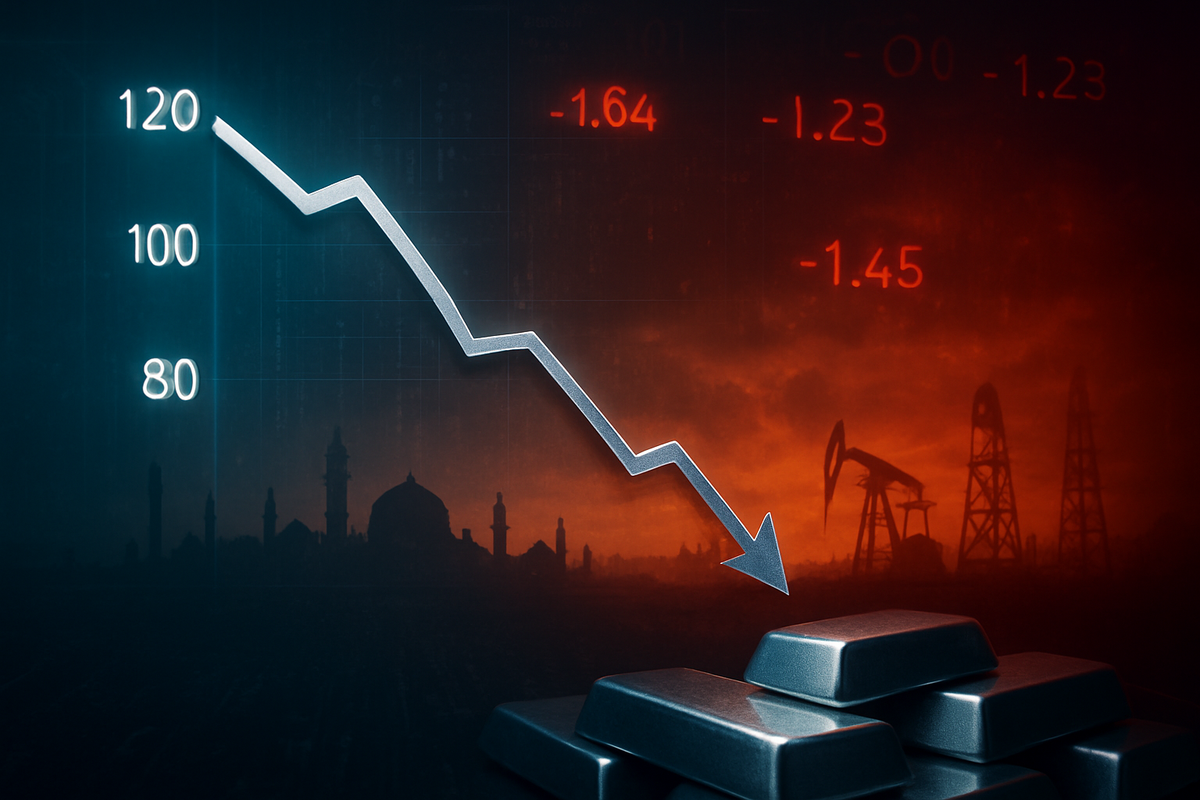
NEW YORK — As of March 19, 2026, the global silver market is grappling with a jarring new reality. After a historic, parabolic ascent that saw spot prices breach the $120 mark in late January, the "white metal" has undergone a brutal 35% correction, settling near $80.50 per ounce. This precipitous decline has left investors reeling, particularly as it defies the traditional logic that precious metals serve as a primary hedge during times of extreme geopolitical instability.
The current market environment presents a profound paradox. Despite a full-scale regional conflict in the Middle East and a direct military confrontation involving major world powers, silver has failed to maintain its safe-haven status. Instead, a lethal combination of a surging US Dollar, aggressive algorithmic liquidations, and a fundamental shift in Federal Reserve expectations has stripped the metal of its early-year gains.
The "Warsh Shock" and the End of the Parabolic Run
The seeds of the current correction were sown on January 29, 2026, when silver hit an all-time high of $120.45 per ounce. At the time, the rally seemed unstoppable, fueled by a 30-million-ounce physical supply deficit and explosive demand from the AI hardware and solar sectors. However, the momentum shifted overnight following the nomination of Kevin Warsh as the next Chair of the Federal Reserve. Markets immediately priced in a "hawkish pivot," anticipating a regime of higher-for-longer interest rates and a aggressively strengthening US Dollar.
The reaction was immediate and structural. On January 30, the CME Group (NASDAQ: CME) announced a massive hike in maintenance margins for silver futures, raising them to 15-16.5%. This move effectively forced leveraged speculators out of their positions, triggering what traders now call the "Margin Massacre." Within 24 hours, silver plummeted to $74.50 before beginning a slow, volatile crawl back toward its current $80 level. The suddenness of the move was exacerbated by the "Reuters Rumor"—an unverified report suggesting the US might scale back subsidies for silver-heavy "green" technologies—which sent systematic trading programs into a selling frenzy.
Winners and Losers in a Volatile Landscape
The correction has created a sharp divergence among industry players. On the losing side, the iShares Silver Trust (NYSE Arca: SLV) has faced its most challenging quarter since 2011. The ETF saw record outflows throughout February and March, at one point trading at a significant discount to its Net Asset Value (NAV) as institutional investors scrambled for liquidity. Retail investors who entered the market near the $100 level have seen their portfolios eroded by a third in less than eight weeks.
Mining companies have also felt the sting, though some remain better positioned than others. First Majestic Silver (NYSE: AG), which recently integrated its $970 million acquisition of Gatos Silver, has seen its share price retreat from January highs, yet it maintains a robust production profile of over 30 million silver-equivalent ounces. Similarly, Pan American Silver (NASDAQ: PAAS) continues to leverage its 44% stake in the high-grade Juanicipio mine, reporting that its all-in sustaining costs (AISC) remain well below the current $80 spot price. Conversely, industrial consumers such as Tesla (NASDAQ: TSLA) and Samsung Electronics (KRX: 005930) may find a silver lining in the correction, as the lower input costs for solar panels and high-end electronics provide a much-needed reprieve from the supply-chain inflation seen in 2025.
The Geopolitical Paradox and the Algorithmic Vacuum
Perhaps the most confusing element for market observers is silver’s weakness in the face of the escalating conflict in the Middle East. Following a major Israeli operation in Tehran and subsequent retaliatory strikes by Iran, traditional "flight-to-safety" behavior would typically favor silver and gold. However, the "War of 2026" has instead driven capital toward the energy complex and the US Dollar. As Brent crude oil surged past $120 per barrel, the liquidity required to fund energy hedges appears to have been pulled directly from the precious metals markets.
This shift was accelerated by high-frequency trading (HFT) algorithms. Institutional "risk-parity" funds are currently programmed to treat the US Dollar (DXY), which recently hit a peak of 106.50, as the ultimate safe haven. When the dollar rose, silver’s negative correlation was triggered automatically. Stop-loss orders clustered at the $100 and $90 psychological levels were hit in milliseconds, creating a "liquidity vacuum" that human traders were unable to fill. This technical breakdown suggests that in the modern era, algorithmic mandates often override historical geopolitical correlations.
What Lies Ahead for the White Metal
As the market stabilizes around $80, the short-term outlook remains clouded by technical resistance. Many analysts believe that until the US Dollar Index shows signs of topping out, any recovery in silver will be met with selling pressure from the very algorithms that drove it down. However, the fundamental supply-demand gap remains; the industrial need for silver in 5G infrastructure and renewable energy has not vanished, even if the speculative froth has.
Strategic pivots are already underway. Many bullion dealers and institutional desks are shifting their focus from "price appreciation" to "physical accumulation," betting that the $80 floor will eventually hold as the long-term industrial deficit reasserts itself. Investors will be watching the upcoming Fed meetings closely to see if Kevin Warsh’s actual policy matches the hawkishness the market has already priced in. If the Fed proves less aggressive than feared, a "relief rally" could be on the horizon.
Navigating the New Silver Reality
The dramatic events of the last two months serve as a stark reminder of the silver market's inherent volatility. From the $120 peak to the $80 floor, the transition has been a masterclass in how monetary policy and algorithmic trading can rapidly decouple an asset from its geopolitical environment. The key takeaway for the market is that silver is no longer just a "poor man's gold"; it is a complex industrial and financial instrument subject to the whims of global liquidity.
Moving forward, the silver market will likely remain in a period of consolidation. The "bubble" of early 2026 has popped, but the underlying structural demand remains a potent force. Investors should keep a close eye on SLV outflow data and the DXY’s movements over the coming months. While the $120 days may feel like a distant memory, the current $80 level represents a critical battlefield that will define the metal's trajectory for the remainder of the decade.
This content is intended for informational purposes only and is not financial advice.