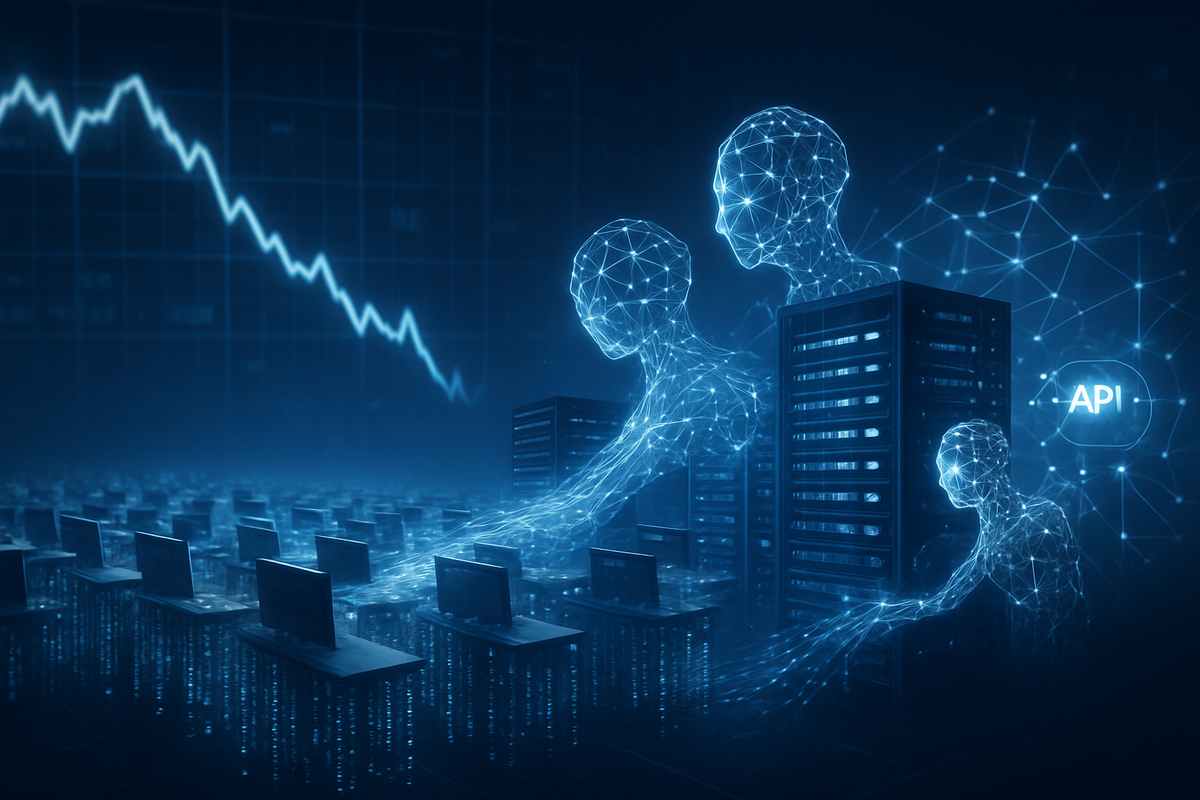
The long-standing honeymoon period between Silicon Valley and Artificial Intelligence has officially come to a turbulent end. As of March 11, 2026, the financial markets are grappling with a fundamental repricing of the software sector, driven by a narrative shift that has transformed AI from a helpful "productivity booster" into an existential threat to the traditional Software-as-a-Service (SaaS) business model. The catalyst for this correction, which some analysts are calling the "SaaSpocalypse," was the rapid evolution of autonomous AI agents—most notably Anthropic’s Claude Code—which have proven capable of performing complex white-collar tasks without the need for traditional software interfaces.
For years, investors rewarded software companies that integrated AI, assuming these features would drive higher "per-seat" pricing and stickier contracts. However, the reality of 2026 has proven the opposite: as AI agents become more autonomous, enterprises are realizing they need significantly fewer human employees to operate their businesses, leading to a massive contraction in license counts. This "seat compression" has wiped nearly $2 trillion in market capitalization from the software sector over the past year, as the market realizes that an AI agent doesn't just help a worker—it often replaces the need for the software the worker was using in the first place.
The Rise of the Agent: How We Reached the Breaking Point
The current market volatility traces its roots back to February 24, 2025, when Anthropic released Claude Code. While earlier tools like GitHub Copilot, owned by Microsoft (NASDAQ: MSFT), acted as advanced "autocompletion" for developers, Claude Code introduced a "terminal-first" agentic approach. It didn't just suggest code; it planned, executed, and tested multi-file refactors across entire codebases with minimal human intervention. By July 2025, the introduction of "Subagents" allowed the system to spawn parallel AI teams, effectively doing the work of entire junior engineering departments.
The timeline of this disruption accelerated throughout late 2025. By the time the latest Opus 4.6 model was benchmarked in early 2026, it achieved a staggering 80.8% score on the SWE-bench Verified test, a industry standard for software engineering tasks. This leap in capability moved AI from the "co-pilot" seat into the "pilot" seat. Initial market reactions were optimistic, focused on the potential for massive corporate cost savings. However, that optimism soured as the first quarter of 2026 earnings reports began to trickle in, revealing a sharp decline in seat-based renewals across the enterprise landscape.
Key stakeholders, including major venture capital firms and institutional investors, have begun shifting their focus from "Interface Providers" to "Intelligence Providers." The realization that an AI agent can interact directly with a database or an API, bypassing the expensive graphical user interfaces (GUIs) of traditional SaaS, has left many industry giants scrambling. The narrative has shifted from "How can AI help our users?" to "How do we survive when our users are AI agents that don't need our software?"
Winners and Losers: The Battle for the Enterprise Stack
The "SaaSpocalypse" has not affected all players equally, creating a stark bifurcation in the market. Among the hardest hit has been Atlassian (NASDAQ: TEAM), which has seen its valuation slide by more than 35% since the beginning of 2025. Atlassian’s core business—driven by Jira and Confluence—relies heavily on the volume of developers and project managers. As Claude Code and similar agents automate the "ticketing and documentation" lifecycle, the need for hundreds of individual seats has evaporated, leaving Atlassian’s per-seat model in a precarious position.
Similarly, Salesforce (NYSE: CRM) has faced significant headwinds, with its stock down roughly 28% from its 2024 highs. The threat here is "seat destruction" in the sales and customer support sectors, where autonomous agents are now handling lead qualification and tier-one support with higher efficiency than human staff. While Salesforce has attempted a strategic pivot with "Agentforce"—moving toward outcome-based pricing where they charge per "conversation" rather than per user—the transition has been painful, causing significant near-term revenue volatility that has unnerved the street.
ServiceNow (NYSE: NOW) has also seen a dramatic repricing, with its valuation fluctuating wildly as investors weigh its potential as an "AI orchestrator" against the risk of its core IT Service Management (ITSM) business being commoditized. On the winning side, Microsoft (NASDAQ: MSFT) has remained remarkably resilient. As the primary provider of the underlying AI infrastructure and the Azure cloud, Microsoft benefits from the increased compute demand required to run these autonomous agents, regardless of whether the software sitting on top of that cloud is traditional SaaS or a new AI-native agent.
The 'Business Model Debt' and a New Industry Paradigm
This event marks a turning point in the broader history of computing, comparable to the shift from on-premise software to the cloud in the late 2000s. The industry is currently struggling with what analysts call "Business Model Debt"—the burden of legacy per-seat pricing structures that are incompatible with an AI-driven workforce. In the past, software growth was a function of headcount growth; in 2026, software value is becoming a function of autonomous output. This has rendered the traditional "Rule of 40" (the sum of a company's growth rate and profit margin) less relevant than "Revenue per Employee."
The ripple effects are extending into the regulatory sphere as well. As AI agents begin to "employ" other AI agents, questions of liability, data ownership, and digital labor are reaching a fever pitch. Historically, software was a tool used by a human; now, software is becoming the entity performing the labor. This shift mirrors the industrial revolution's impact on manual labor, but it is moving at the speed of silicon, leaving little time for companies or regulators to adapt to the new reality where "software is eating the software industry."
The Path Forward: Strategic Pivots and New Metrics
In the short term, expect a wave of consolidation. Traditional SaaS companies that cannot pivot to consumption-based or outcome-based pricing models will likely be acquired by larger platform plays or private equity firms looking to strip them for their data moats. For these companies to survive, they must move "below the GUI," offering deep integrations and proprietary data that AI agents need to be effective, rather than just providing a dashboard for human eyes.
Long-term, we are likely to see the emergence of "Lean Giants"—companies that reach $1 billion in annual recurring revenue (ARR) with fewer than 50 employees. This will require a complete rethinking of corporate structure and venture capital. The market will stop rewarding companies for the size of their sales force and start rewarding them for the efficiency of their agentic workflows. Strategic pivots, like those seen from Salesforce, suggest that the future of software lies in "AI Labor as a Service," where the software company is essentially a digital staffing agency.
Wrap-Up: What Investors Must Watch
The current valuation crisis serves as a stark reminder that in the technology sector, the tool of today can easily become the obsolescence of tomorrow. The key takeaway for the market is that the "AI-as-a-feature" era is over; we have entered the "AI-as-an-entity" era. Investors should move away from companies that rely on high-headcount growth in their client bases and instead look for those with robust APIs and "agent-friendly" architectures.
Moving forward, the primary metrics to watch will be "churn by seat" versus "expansion by API call." The transition will be messy, and the "SaaSpocalypse" is likely not over yet. However, for those who can identify the platforms that will act as the "brains" of the new autonomous economy, the current correction may represent a generational entry point into the next era of computing.
This content is intended for informational purposes only and is not financial advice.