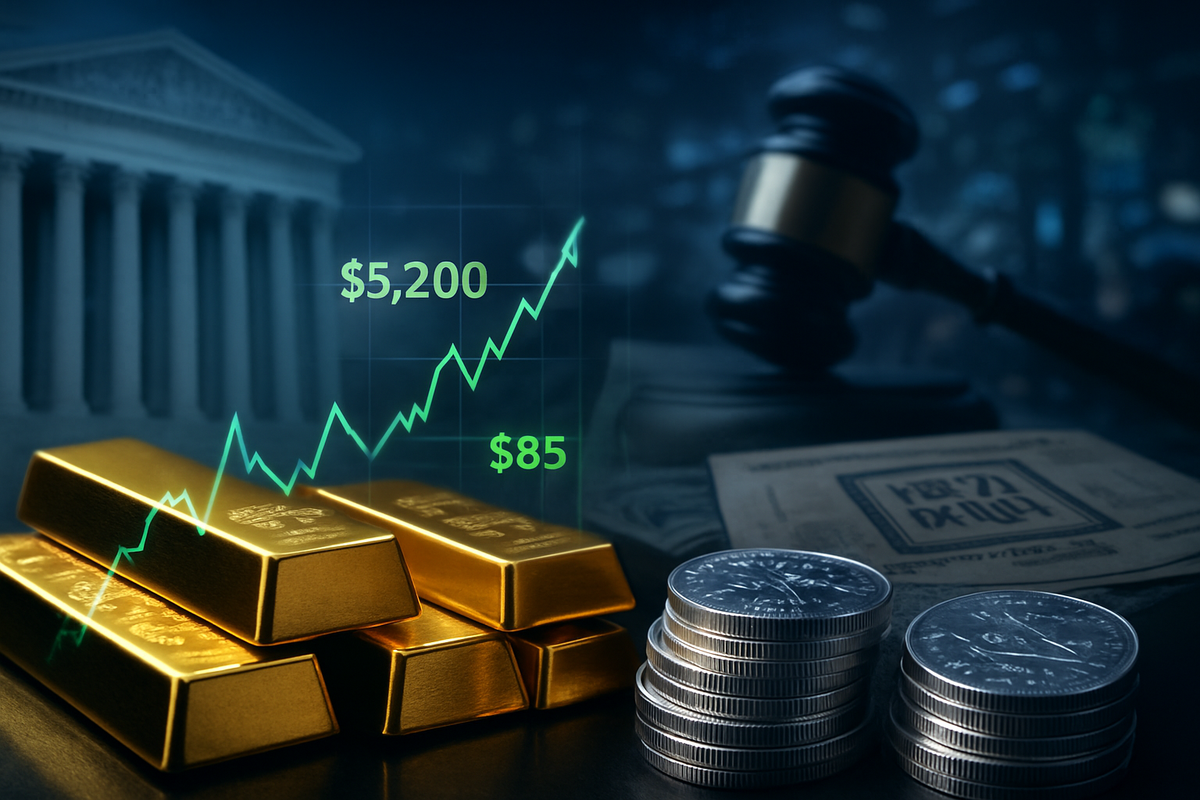
In a week defined by unprecedented institutional friction and market volatility, precious metals have surged to historic highs as investors flee toward safe-haven assets. The catalyst for this dramatic rally was a dual-pronged shock to the global trade system: first, a monumental U.S. Supreme Court ruling that stripped the executive branch of its primary tool for imposing emergency tariffs, followed immediately by the Trump administration’s defiant announcement of a new 15% global "bridge tax." The resulting "policy chaos" has sent shockwaves through Wall Street, driving gold futures above the $5,200 per ounce threshold and propelling silver past $85 per ounce.
This sudden flight to quality reflects a deep-seated anxiety regarding the stability of U.S. trade policy and the potential for a renewed, more aggressive global trade war. As the legal battle between the judiciary and the White House intensifies, market participants are dumping risk-on assets in favor of the SPDR Gold Shares (NYSE: GLD) and the iShares Silver Trust (NYSE: SLV), which have seen record-breaking inflows over the last 48 hours.
The Legal Fault Lines: IEEPA vs. The Bridge Tax
The turmoil began on February 20, 2026, when the U.S. Supreme Court delivered a 6–3 decision in Learning Resources, Inc. v. Trump. The Court ruled that the International Emergency Economic Powers Act (IEEPA) of 1977 does not grant the President the authority to unilaterally impose tariffs, asserting that the power to "lay and collect taxes and duties" is a constitutional prerogative reserved strictly for Congress. This ruling effectively invalidated several tiers of "reciprocal tariffs" and emergency duties that had been a cornerstone of the administration’s economic platform since 2025.
However, the victory for free-trade advocates was short-lived. In a swift response that caught many by surprise, President Trump invoked Section 122 of the Trade Act of 1974. This rarely used provision allows the President to impose temporary import surcharges of up to 15% for a period of 150 days to address large and serious balance-of-payments deficits. By rebranding the invalidated duties as a 15% "global bridge tax," the administration effectively circumvented the SCOTUS ruling in the short term, plunging the business community into a state of legal and operational limbo.
Initial market reactions were characterized by extreme confusion. While the SCOTUS ruling initially suggested a removal of trade barriers—traditionally a bearish signal for gold—the subsequent move to Section 122 signaled that the administration is willing to test every legal boundary to maintain its protectionist agenda. This "policy chaos" has evaporated investor confidence in the predictability of the U.S. regulatory environment, making the non-partisan, non-fiat nature of gold and silver increasingly attractive.
Winners in the Mine, Losers on the Shelf
The primary beneficiaries of this instability have been the major precious metals producers, whose margins are expanding rapidly as the spot prices of their core products soar. Newmont Corporation (NYSE: NEM) and Barrick Gold Corp. (NYSE: GOLD) have seen their share prices climb double digits this week, as the leverage these miners have to the price of gold turns them into high-beta plays on the metal’s ascent. In the silver space, First Majestic Silver (NYSE: AG) and Hecla Mining Company (NYSE: HL) are outperforming the broader market, fueled by silver's industrial demand and its newfound status as a high-velocity safe haven.
Conversely, the losers are becoming clear among the large-scale importers and retailers. Companies like Walmart Inc. (NYSE: WMT) and Target Corporation (NYSE: TGT) are now facing a 15% surcharge on a vast majority of their imported inventory with almost no lead time to adjust supply chains. The uncertainty of whether this "bridge tax" will last the full 150 days or be extended by a divided Congress makes it nearly impossible for these firms to set long-term pricing strategies, leading to fears of margin compression and consumer price spikes.
Furthermore, streaming and royalty companies like Wheaton Precious Metals (NYSE: WPM) are benefiting from the price surge without the direct operational risks of mining, providing a lower-risk entry point for institutional investors looking to capitalize on the $5,200/oz gold environment.
A New Paradigm for Global Trade and Inflation
The broader significance of this event cannot be overstated. We are witnessing a fundamental shift in how trade policy is conducted in the United States. For decades, the executive branch enjoyed broad, unquestioned authority to manage trade under the banner of national security. The SCOTUS ruling in Learning Resources marks the end of that era, yet the administration’s pivot to Section 122 suggests a move toward a "permanent state of emergency" in trade relations.
This event mirrors the "Nixon Shock" of 1971, when the gold standard was abandoned and temporary 10% surcharges were applied to imports. The historical precedent suggests that such "temporary" measures often have long-lasting effects on global currency valuations. As trade partners like the EU and China weigh retaliatory measures, the risk of global stagflation—stagnant growth combined with high inflation—grows. Gold and silver are the traditional hedges against such an environment, explaining why Pan American Silver (NYSE: PAAS) and other diversifed miners are seeing such intense interest.
The ripple effects are also being felt in the currency markets. The prospect of the U.S. government potentially having to refund billions of dollars in previously collected tariffs (now deemed illegal by SCOTUS) suggests a massive injection of liquidity into the economy, which is inherently inflationary. This potential "liquidity bomb" is perhaps the strongest fundamental driver behind gold’s march toward $5,500.
The 150-Day Countdown: What Lies Ahead
The immediate future will be dominated by the 150-day clock attached to Section 122. Under the law, this 15% surcharge will expire unless Congress acts to extend it. This sets up a high-stakes legislative showdown during an election cycle, where the administration will likely pressure lawmakers to codify the "bridge tax" into permanent law. Investors should expect extreme volatility as each side of the aisle stakes out their position.
Strategically, multinational corporations will likely accelerate the "de-risking" of their supply chains, moving away from offshore manufacturing to avoid the unpredictable nature of U.S. import duties. However, such shifts take years, not months. In the interim, the demand for hedging instruments will remain at fever pitch. If the 15% tariff is successfully challenged again or expires without a replacement, we could see a sharp correction in metals; however, as long as the "policy chaos" remains the status quo, the floor for gold and silver appears to have moved significantly higher.
Scenarios for the second half of 2026 range from a full-blown trade war if the 15% tax becomes permanent, to a massive market relief rally if a bipartisan trade deal is reached. Until then, the "safe-haven" trade remains the dominant narrative on the floor of the COMEX.
Final Thoughts: Navigating the Uncertainty
The surge in gold to $5,200 and silver to $85 represents more than just a price move; it is a barometer of institutional distrust. The conflict between the Supreme Court's mandate and the administration's trade ambitions has created a vacuum of certainty that only tangible assets seem able to fill. For investors, the takeaway is clear: the era of "predictable" trade is over, and the premium for safety has been permanently re-rated.
Moving forward, the market will be hyper-sensitive to any communication from the Treasury Department regarding tariff refunds and any legislative movements regarding Section 122. Watch the performance of the GLD and SLV as proxies for broader retail sentiment; if these ETFs continue to see record volume, the momentum could carry silver toward the psychologically significant $100 mark.
Ultimately, the "policy chaos" of 2026 has reminded the market of an old truth: when the rules of the game are being rewritten in real-time, there is no substitute for the oldest forms of money in history.
This content is intended for informational purposes only and is not financial advice.