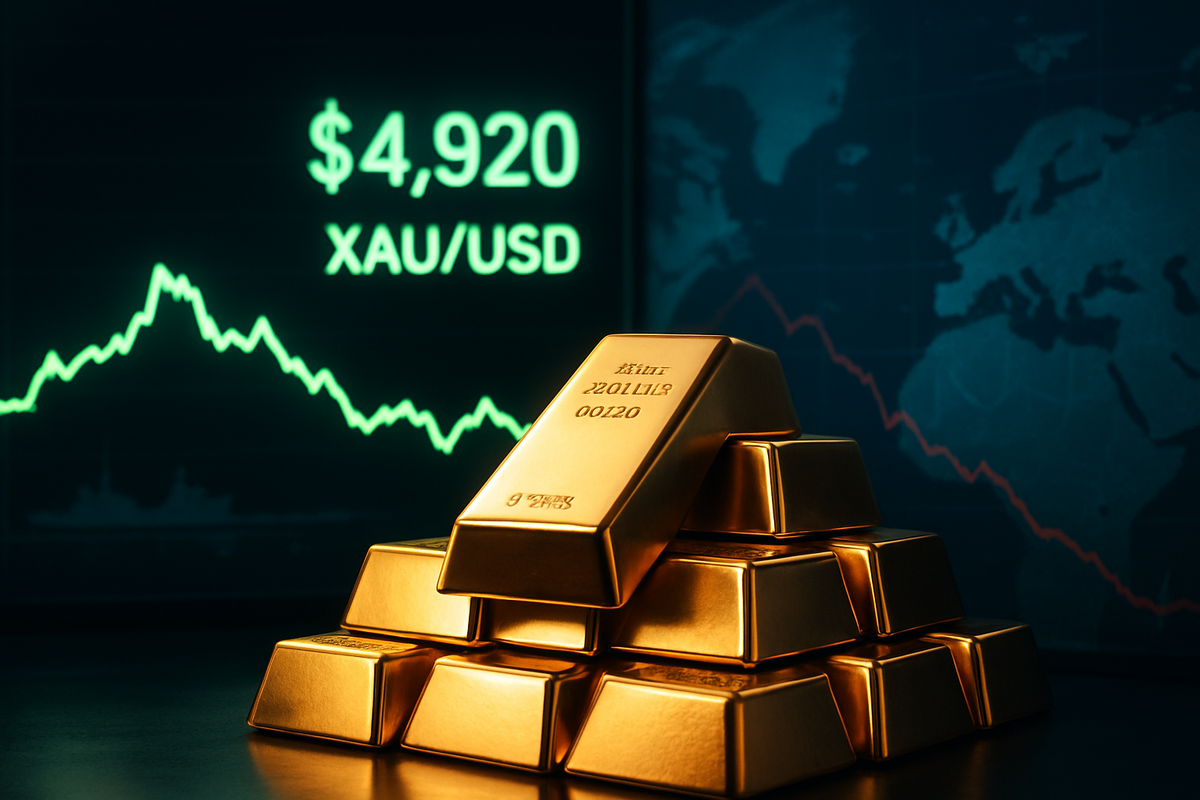
In a historic trading session that has sent shockwaves through global financial markets, gold futures surged to a staggering all-time high of $4,920 an ounce today, January 22, 2026. This meteoric rise represents a paradigm shift in the perceived value of hard assets, as a "perfect storm" of geopolitical brinkmanship, central bank diversification, and a weakening U.S. dollar forces investors out of traditional fiat currencies and into the ultimate safe haven.
The immediate implications of this price spike are profound. With bullion prices nearly doubling in the span of less than two years, the global inflationary outlook has shifted dramatically. Central banks that failed to diversify their reserves early are now scrambling to acquire physical gold at extreme premiums, while the broader market faces a "crisis of trust" in the institutional frameworks that have governed global trade for decades. As the $5,000 threshold looms, the traditional inverse relationship between gold and risk-on assets has broken, with gold now serving as both a hedge and a primary driver of speculative momentum.
The journey to $4,920 was not an overnight phenomenon but the culmination of a volatile 18-month trajectory. The rally accelerated in late 2025 when Goldman Sachs revised its long-term forecast to $4,900, citing an irreversible trend in central bank acquisitions. By early January 2026, the metal was trading near $4,600, but the spark that ignited the final leg of this rally was a sharp escalation in transatlantic tensions. The "Greenland Standoff"—a diplomatic and military crisis triggered by renewed U.S. demands for control of the Arctic territory—led to a military build-up by Denmark and threats of 10% to 25% tariffs on major European allies by the U.S. administration.
On January 20, 2026, a high-stakes speech at the World Economic Forum in Davos confirmed the U.S. stance on trade protectionism, pushing gold to $4,725. The final surge to $4,920 occurred during today's intraday trading as reports surfaced of naval movements in the North Atlantic. Investors, fearing a complete fracture of the Western alliance, liquidated positions in European and American equities, funnelling billions into the gold futures market. The U.S. Dollar Index (DXY), meanwhile, plummeted to the 98.00 level, its lowest point in years, as the currency's "exorbitant privilege" faced its most significant challenge since the end of the gold standard.
Key stakeholders, including the National Bank of Poland—which has emerged as the world's most aggressive gold buyer with nearly 100 tonnes added in 2025—and the central banks of China and Brazil, have fundamentally altered the demand floor for the metal. Initial market reactions have been characterized by extreme volatility; while the COMEX exchange saw record-breaking volume, liquidity in the physical market remains dangerously thin, with premiums on physical coins and bars reaching 15% over the spot price in major financial hubs like London and Singapore.
The primary beneficiaries of this gold rush are the major mining conglomerates, which have seen their profit margins expand at a pace rarely seen in the commodity sector. Newmont Corporation (NYSE: NEM) has emerged as a standout performer, recording a 168% return over the last 12 months as its all-in sustaining costs (AISC) remained relatively stable while its selling price skyrocketed. Similarly, Barrick Gold (NYSE: GOLD) has seen its stock price surge 180% year-to-date as of late January, driven by its aggressive expansion into high-yield tier-one assets and a commitment to massive dividend hikes funded by the gold windfall.
In the mid-tier and regional sectors, Agnico Eagle Mines (NYSE: AEM) has gained 116% over the past year, benefiting from its "low-risk" jurisdiction focus in Canada and Finland, which investors now value more than ever amidst global instability. In the Australian market, Evolution Mining (ASX: EVN) reached a record high of A$14.78 per share this week, buoyed by the dual tailwinds of record gold prices and a weakening Australian dollar against the U.S. benchmark. These companies are no longer just miners; they have become the proxy for the new global reserve asset, with many institutional funds using mining equities to gain leveraged exposure to bullion.
However, the surge is a double-edged sword for other sectors. Luxury retailers like Signet Jewelers (NYSE: SIG) are facing a collapse in consumer demand as the price of a standard 14-karat gold band becomes prohibitively expensive for the middle class. Furthermore, technology giants such as Apple Inc. (NASDAQ: AAPL) and Samsung Electronics (KOSPI: 005930) are grappling with rising input costs. While gold is used in small quantities in high-end electronics, the cumulative effect of a 100% increase in the price of a critical conductive component is beginning to compress margins in the consumer hardware space, potentially leading to price hikes for the next generation of smartphones and processors.
The significance of $4,920 gold extends far beyond a simple commodity rally; it marks a historic pivot toward "de-dollarization." For the first time in modern history, the total market value of gold held by foreign central banks has overtaken their total holdings of U.S. Treasuries. This shift suggests that the world's monetary authorities no longer view the U.S. dollar as the sole "risk-free" asset. The "weaponization" of financial infrastructure through sanctions and the erosion of the Federal Reserve’s perceived independence—highlighted by recent DOJ subpoenas of Fed Governor Lisa Cook—have incentivized a move toward neutral, non-sovereign assets.
This event mirrors the historical precedent of the early 1970s when the collapse of the Bretton Woods system led to a massive revaluation of gold. However, unlike the 70s, the current rally is fueled by a multi-polar world where the BRICS+ nations are actively piloting gold-backed settlement systems for international trade. The ripple effects are already being felt in the sovereign debt markets; as investors favor gold, the demand for long-dated government bonds has softened, leading to a steepening yield curve and rising borrowing costs for governments already burdened by record-high fiscal deficits.
Furthermore, the rise in gold is creating a new form of "resource nationalism." In regions like Mozambique and West Africa, where artisanal and industrial gold mines are frequent targets of insurgent activity, the soaring value of the metal has increased the intensity of local conflicts. Governments in these regions are increasingly seeking to renegotiate mining contracts or increase royalties, creating a complex regulatory environment for multinational miners. The "gold standard" is returning to the global stage, not by legislative decree, but through the sheer force of market demand.
In the short term, the market is bracing for a potential "blow-off top" or a period of intense profit-taking. Technical analysts suggest that while the fundamental drivers remain bullish, the $5,000 level represents a massive psychological barrier that could trigger significant automated selling. However, any pullback is likely to be met with aggressive buying from central banks that are still underweight in their gold allocations relative to the current geopolitical risk profile. The strategic pivot for many investors will be moving from "paper gold" (ETFs and futures) to "allocated physical gold" as concerns about exchange solvency and counterparty risk grow.
Long-term, the sustained high price of gold will likely force a restructuring of the global financial architecture. If gold remains above $4,500 for an extended period, it may become the "de facto" anchor for a new international trade currency. We may also see a surge in deep-sea mining exploration and the reopening of dormant, low-grade mines that were previously uneconomical at $2,000 an ounce. The challenge for the market will be the "crowding out" effect, where the capital flowing into gold starves other productive sectors of the economy of necessary investment.
The surge of gold futures to $4,920 is a clarion call for the end of the post-Cold War era of financial stability. The key takeaways are clear: the U.S. dollar's dominance is being actively contested, geopolitical "black swan" events like the Greenland Standoff are the new market drivers, and hard assets have reclaimed their throne in the global portfolio. For investors, the coming months will require a high degree of vigilance. While the gains in mining stocks have been extraordinary, the risks of government intervention, windfall taxes, and resource nationalism are rising alongside the price of bullion.
Moving forward, the market will be watching the Federal Reserve's response to its eroding credibility and the outcome of the U.S.-EU trade negotiations. If the "Greenland crisis" is resolved diplomatically, we could see a cooling of safe-haven demand; however, the structural move by central banks into gold suggests that the floor for the metal has permanently shifted higher. The era of "cheap gold" is over, and the world must now adapt to a financial reality where the "barbarous relic" is once again the most important asset on the board.
This content is intended for informational purposes only and is not financial advice