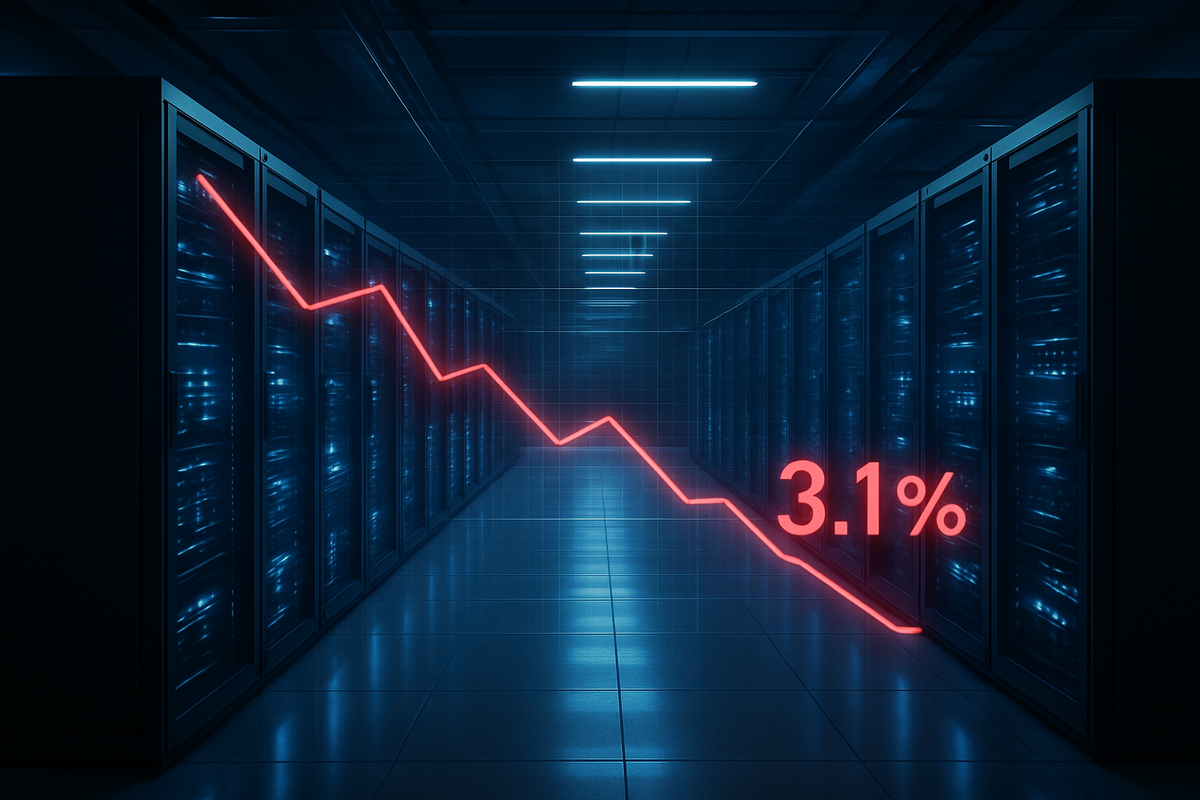
As the calendar turned to 2026, the artificial intelligence infrastructure sector faced a sobering reality check. CoreWeave (Nasdaq: CRWV), the specialized cloud provider that became the poster child for the AI gold rush, saw its stock slide 3.1% to close at $71.61 on the first trading day of the year. The dip follows a series of regulatory filings revealing that top executives and major institutional backers have offloaded more than $2.5 billion in stock over the final quarter of 2025, raising questions about the near-term valuation of high-growth AI "pure plays."
The immediate market reaction reflects a growing sensitivity to insider sentiment. While CoreWeave remains up significantly from its March 2025 IPO price of $40.00, the stock has retreated nearly 50% from its October highs. Investors are now weighing the company’s massive $55 billion revenue backlog against the stark reality of construction delays at key data center sites and a balance sheet burdened by a debt-to-equity ratio exceeding 360%.
A Winter Chill: Inside the CoreWeave Sell-Off
The 3.1% slide on January 1, 2026, was the culmination of a volatile three-month period defined by aggressive insider liquidation. According to SEC disclosures, the selling was led by the company’s highest-ranking officers. Co-founder Brian M. Venturo offloaded approximately $22.3 million in shares in late December, while CEO Michael Intrator and Chief Development Officer Brannin McBee also executed multi-million dollar trades. Perhaps most telling was the move by Magnetar Financial, a cornerstone investor, which liquidated roughly 77% of its position—a transaction valued at approximately $160 million—just as the stock began its descent from its peak.
The timing of these sales coincided with operational headwinds that have dampened investor enthusiasm. In late 2025, CoreWeave confirmed a 60-day construction delay at its flagship 260-megawatt facility in Denton, Texas. This site was specifically designed to house high-density clusters for major clients like OpenAI, and the delay has pushed back the timeline for revenue recognition. Consequently, the company was forced to revise its 2025 revenue guidance downward to a range of $5.05 billion to $5.15 billion, a move that shook the confidence of growth-focused momentum traders.
The narrative surrounding CoreWeave has shifted from "limitless scale" to "operational execution." Throughout 2024 and early 2025, the company was praised for its ability to secure massive quantities of H100 and Blackwell GPUs from Nvidia (Nasdaq: NVDA). However, the sheer cost of building the physical infrastructure to house these chips has led to extreme leverage. By the start of 2026, analysts began highlighting the "structural tension" of a company that must borrow billions to fund facilities that are not yet operational, creating a precarious gap between capital expenditure and cash flow.
The AI Hierarchy: Winners and Losers in the Infrastructure Pivot
The recent volatility in CoreWeave has created a clear divergence in the AI sector. The primary "winner" in this environment continues to be Nvidia (Nasdaq: NVDA). Despite the hiccups at the data center level, demand for Nvidia’s silicon remains insatiable. Investors have begun treating Nvidia as a "safe haven" within the AI space, preferring the chipmaker’s 70%+ gross margins and fortress balance sheet over the capital-intensive business models of specialized cloud providers. As CoreWeave struggled, Nvidia’s stock remained resilient, benefiting from its role as the universal arms dealer to both startups and established titans.
Conversely, specialized cloud competitors and "AI pure plays" are feeling the heat. Companies that followed CoreWeave’s lead in leveraging GPU assets to secure massive debt facilities are now being scrutinized by a market that is no longer satisfied with "capacity" alone; it demands "utilization" and "profitability." On the other hand, hyperscalers like Microsoft (Nasdaq: MSFT) and Alphabet (Nasdaq: GOOGL) stand to gain from this flight to quality. These giants possess the balance sheets to weather construction delays and interest rate fluctuations, making them more attractive to institutional investors who are rotating out of high-leverage mid-cap stocks and into stable, cash-flow-positive AI leaders.
From Hype to Harvest: The Broader Market Significance
The 3.1% slide in CoreWeave shares is more than a single-stock event; it signals a transition into the "operational phase" of the AI cycle. In 2023 and 2024, the market rewarded any company that could claim a partnership with Nvidia or a reservation for high-end compute. By 2026, the focus has shifted to the "CAPEX hangover." Regulators and market analysts are increasingly concerned about "circular capital"—a phenomenon where large tech companies invest in startups that then use that capital to rent cloud space back from the investors or buy hardware that fuels the investors' revenue.
This event mirrors the historical precedents of the telecommunications build-out in the late 1990s. Much like the fiber-optic providers of that era, CoreWeave is building the "pipes" for the next generation of the internet. While the long-term utility of the infrastructure is rarely questioned, the financial viability of the first movers often is. The massive insider selling at CoreWeave suggests that even those closest to the company recognize that the valuation had outpaced the physical reality of laying concrete and cooling systems in Texas and beyond.
The Road Ahead: Strategic Pivots and Scenarios
In the short term, CoreWeave must prove it can overcome its logistical hurdles. The successful commissioning of the Denton, Texas, facility in early 2026 will be the most critical catalyst for the stock. If the company can demonstrate that the delay was a one-time bottleneck rather than a systemic issue, it may be able to regain its footing. However, the high interest rate environment of 2026 makes its 363% debt-to-equity ratio a persistent "Sword of Damocles" hanging over its valuation.
Looking further out, CoreWeave may become a target for acquisition or a candidate for a significant debt restructuring. As hyperscalers like Meta (Nasdaq: META) look to bring more of their AI infrastructure in-house, acquiring a ready-made fleet of data centers and a $55 billion backlog could be an attractive strategic move. Alternatively, CoreWeave may need to pivot toward a more "asset-light" model, perhaps by partnering with traditional real estate investment trusts (REITs) to offload the heavy lifting of data center construction, allowing the company to focus purely on the software and orchestration layers of the AI stack.
Final Thoughts: A New Chapter for AI Investors
The correction in CoreWeave’s stock price serves as a vital reminder that even the most transformative technologies are subject to the laws of finance and physics. The transition from a private "unicorn" to a public entity has forced CoreWeave to move from a narrative of "unlimited potential" to one of "quarterly performance." For investors, the key takeaway is that the "easy money" phase of the AI infrastructure trade has likely concluded.
Moving forward, the market will likely reward companies that can demonstrate a clear path to self-funding growth. Watch for CoreWeave’s Q1 2026 earnings report, specifically looking for updates on the Denton site and any further revisions to revenue guidance. While the AI revolution is far from over, the era of rewarding high-leverage build-outs without immediate operational results is rapidly coming to an end. Investors should remain cautious of specialized providers and keep a close eye on insider trading patterns as a barometer for internal confidence in the face of mounting execution risks.
This content is intended for informational purposes only and is not financial advice.