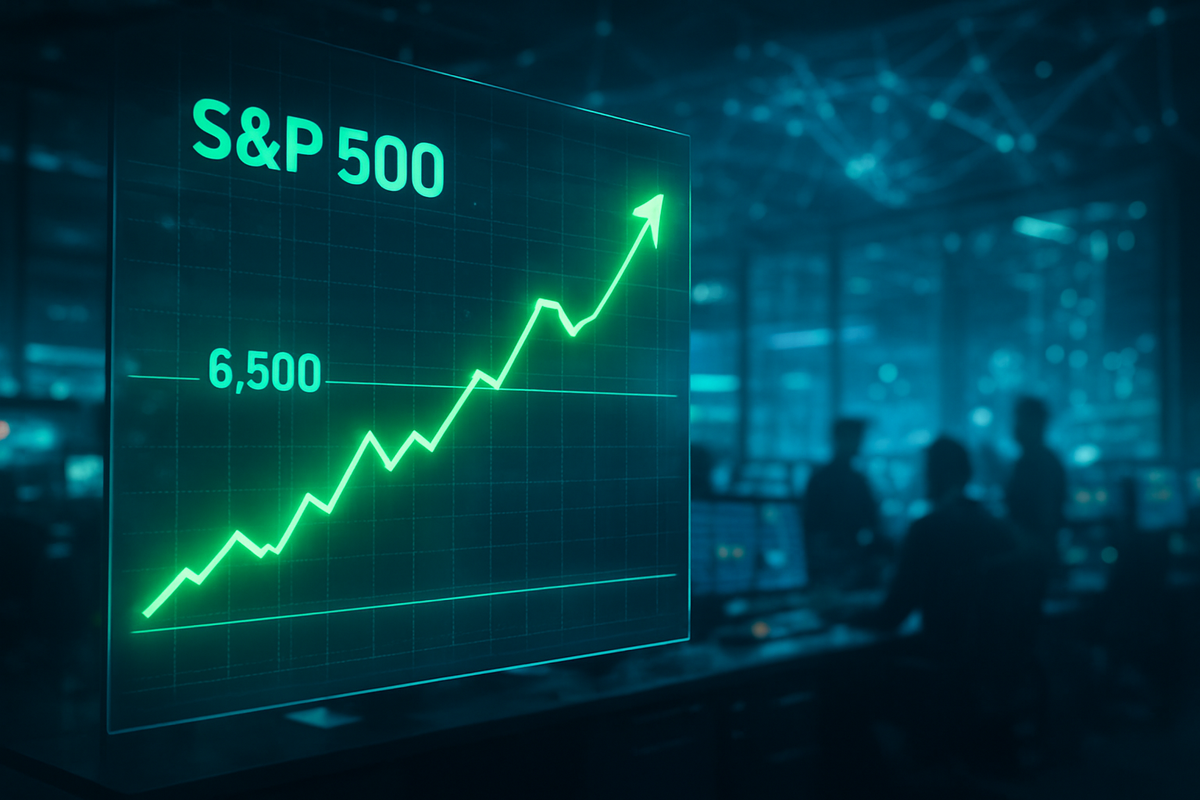
The S&P 500 index concluded 2025 on a high note, closing the final trading session of the year at 6,896.24. This performance marks a remarkable 19% annual gain, securing a rare "triple-peat" of double-digit returns for the third consecutive year—a feat not seen since the dot-com boom of the late 1990s. Despite a year marred by geopolitical friction and a volatile "April Tariff Storm," the index's ability to scale all-time highs in December underscores the resilience of the U.S. economy and the deepening maturity of the artificial intelligence (AI) revolution.
The year-end rally was characterized by a decisive technical breakout above the 6,500 mid-year pivot, fueled by a combination of Federal Reserve rate "normalization" and robust corporate earnings. While the index briefly flirted with the psychological 7,000 milestone in late December, a minor "Scrooge Dip" in the final days of trading kept the benchmark just shy of that historic mark. Nevertheless, the momentum heading into 2026 remains formidable, as investors pivot from pure AI speculation toward tangible infrastructure monetization and a "soft landing" economic reality.
A Year of Two Halves: From Tariff Shocks to the Santa Claus Rally
The trajectory of the S&P 500 in 2025 was anything but linear. The year began with high anxiety following the "DeepSeek" AI shock in late January, which sent semiconductor giants into a temporary tailspin. However, the true test of market mettle arrived on April 2, 2025—a day now etched in financial history as the start of the "April Tariff Storm." The announcement of a universal 10% tariff by the Trump administration triggered an immediate 10.5% correction, as markets grappled with the specter of renewed inflation and supply chain paralysis.
The recovery was as swift as the decline. On April 9, 2025, dubbed "Liberation Day" by floor traders, the administration announced a 90-day pause on the implementation of certain duties, sparking a historic 9.5% single-day gain for the S&P 500. This V-shaped recovery set the stage for a disciplined ascending channel throughout the summer and autumn. By September, the index decisively broke through the 6,500 resistance level as the Federal Reserve, led by Chairman Jerome Powell, executed the first of three 25-basis-point rate cuts, bringing the federal funds rate to a target range of 3.50%–3.75%.
The final leg of the journey was the "Christmas Breakout." Between December 10 and December 24, the index surged from 6,800 to an intraday all-time high of 6,952.84. This rally was underpinned by a blockbuster Q3 GDP report showing 4.3% growth and a surge in retail trading activity. The technical strength was confirmed by the 50-day moving average remaining firmly above the 200-day average, a "Golden Cross" that has persisted for nearly 18 months.
The AI Infrastructure Boom and the Retail Exodus
The 2025 market landscape created a stark divide between the "AI-enabled" winners and the "tariff-exposed" losers. The standout performers were the companies providing the literal and figurative "plumbing" for the next phase of the digital economy. Western Digital (NASDAQ: WDC) and its newly spun-off flash business, SanDisk, emerged as the year's darlings, with WDC returning over 260% as demand for AI data storage reached a fever pitch. Similarly, Micron Technology (NASDAQ: MU) saw its stock rise more than 175% on the back of record revenues from High-Bandwidth Memory (HBM) chips.
While the "Magnificent Seven" continued to provide a stable floor for the index, leadership broadened significantly. Apple (NASDAQ: AAPL) and Meta Platforms (NASDAQ: META) successfully transitioned from AI hype to AI monetization, integrating sophisticated agentic workflows into their consumer ecosystems. Beyond tech, Robinhood Markets (NASDAQ: HOOD) capitalized on the resurgence of retail participation, gaining over 230% as it expanded into international markets and high-yield fintech products.
Conversely, the year was punishing for sectors heavily reliant on global supply chains and discretionary spending. Lululemon Athletica (NASDAQ: LULU) saw its shares tumble over 53% as it struggled with massive tariff exposure on its Asian-sourced apparel. The retail sector at large faced a "Retail Exodus," with an estimated 15,000 store closures nationwide. Even industrial stalwarts like General Motors (NYSE: GM) and Caterpillar (NYSE: CAT) faced margin compression, with GM reporting a 32% tumble in operating profits due to the $1.1 billion in extra costs attributed to manufacturing duties.
The Macro Shift: AI Maturity and Trade Realignment
The wider significance of the 2025 rally lies in the fundamental shift of the market's primary drivers. We have moved beyond "AI Phase 1," which was characterized by the speculative hoarding of Nvidia (NASDAQ: NVDA) chips, into "AI Phase 2," where the focus is on energy, storage, and software implementation. This shift is evidenced by the rise of GE Vernova (NYSE: GEV), which became a top performer as the "AI-electrification" trade took hold, highlighting the massive power requirements of new data centers.
Furthermore, the 2025 breakout occurred against a backdrop of the most aggressive trade policy shift in nearly a century. The average effective U.S. tariff rate jumped from 2.5% in January to nearly 18% by December. The market's ability to reach all-time highs despite these headwinds suggests that investors are betting on domestic deregulation and tax incentives to offset the costs of protectionism. This mirrors the "Reaganomics" era of the 1980s, where high interest rates and trade tensions were eventually overshadowed by massive corporate productivity gains.
The Federal Reserve’s role in this breakout cannot be overstated. By executing "hawkish cuts"—lowering rates while maintaining a vigilant stance on inflation—the Fed provided the liquidity necessary to support a forward P/E ratio of 25.6x. This high valuation suggests that the market is pricing in a "Goldilocks" scenario for 2026: continued earnings growth without a resurgence of consumer price volatility.
Looking Ahead: The Road to 7,500
As we move into 2026, the primary question for investors is whether the S&P 500 can maintain its momentum or if the "Scrooge Dip" at the end of December was a precursor to a larger correction. Most Wall Street strategists have entered the new year with "guarded optimism," setting 2026 price targets in the 7,500 to 8,100 range. The technical path forward suggests that 6,900 will now act as a critical support level, while the 7,000 mark remains the "call-wall" that must be breached to trigger the next leg of the bull market.
Strategic pivots will be required for both companies and investors. For corporations, the focus will be on "onshoring" and supply chain diversification to mitigate tariff risks. For investors, the opportunity may lie in the "laggards" of 2025—specifically healthcare and consumer staples—which could see a mean-reversion rally if trade tensions ease or if the Fed continues its path toward a 3.0% terminal rate. However, the risk of "cautious greed" remains high; any signs of a cooling labor market or a spike in energy costs could quickly deflate the current valuation premiums.
A New Era of Market Dynamics
The S&P 500's performance in 2025 serves as a testament to the transformative power of technological innovation and the adaptability of the American corporate machine. The index has successfully navigated a landscape of shifting geopolitical alliances, a radical overhaul of trade policy, and a significant transition in monetary policy. The key takeaway for investors is that the "old rules" of market cycles are being rewritten by the rapid deployment of AI and a renewed focus on domestic industrial capacity.
Moving forward, the market will likely remain highly bifurcated. Investors should keep a close eye on Q1 2026 earnings reports to see if the AI infrastructure giants can maintain their blistering growth rates and if the retail sector can find a floor amidst the tariff-induced carnage. While the psychological barrier of 7,000 remains unbroken for now, the technical foundation laid in 2025 suggests that the "triple-peat" may just be the beginning of a much longer structural bull run.
This content is intended for informational purposes only and is not financial advice.