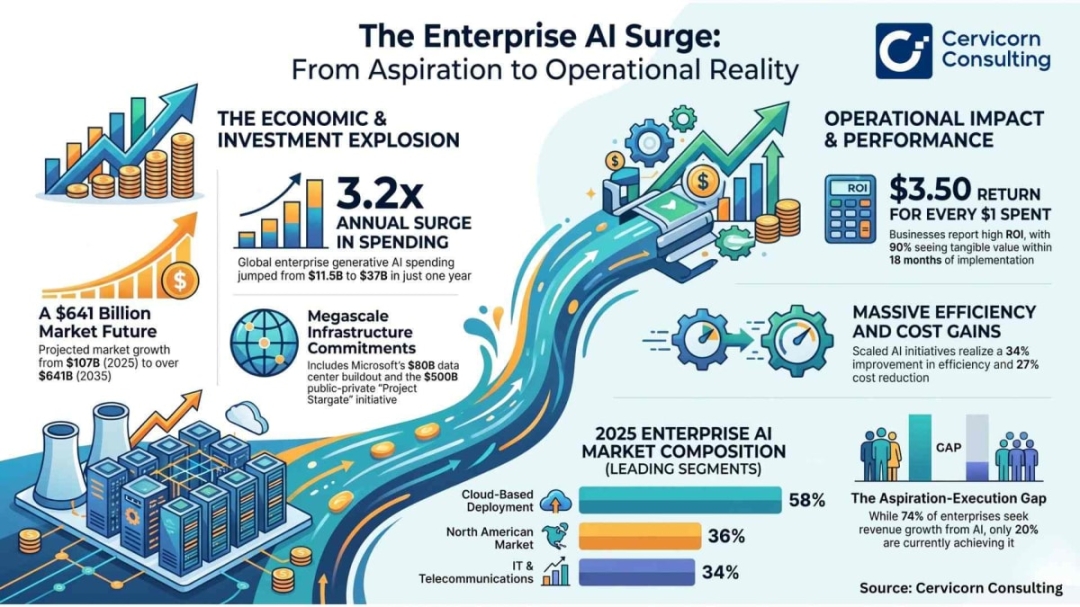
Launch of Databricks’ AI Accelerator Program last year acted as a comprehensive program offering a powerful solution to assist enterprises with quickly upscaling the latest AI generation applications. This was mainly focused on training staff, and swiftly implementing enterprise-ready solutions, was more than just a release of a product. It was an indication. A notice of how the enterprise AI market passed a barrier, evolving from hesitant trials to widespread operationalization. Businesses within financial services, healthcare, manufacturing, and telecoms are all posing the same equation of deploying AI for enterprises.
“This shift is backed by hard numbers. According to Cervicorn Consulting, Global Enterprise AI Market was valued at $107.16 Billion in 2025 and is projected to surpass $641.47 Billion by 2035, expanding at a compound annual growth rate CAGR of 19.6% over forecast period from 2026 to 2035.”
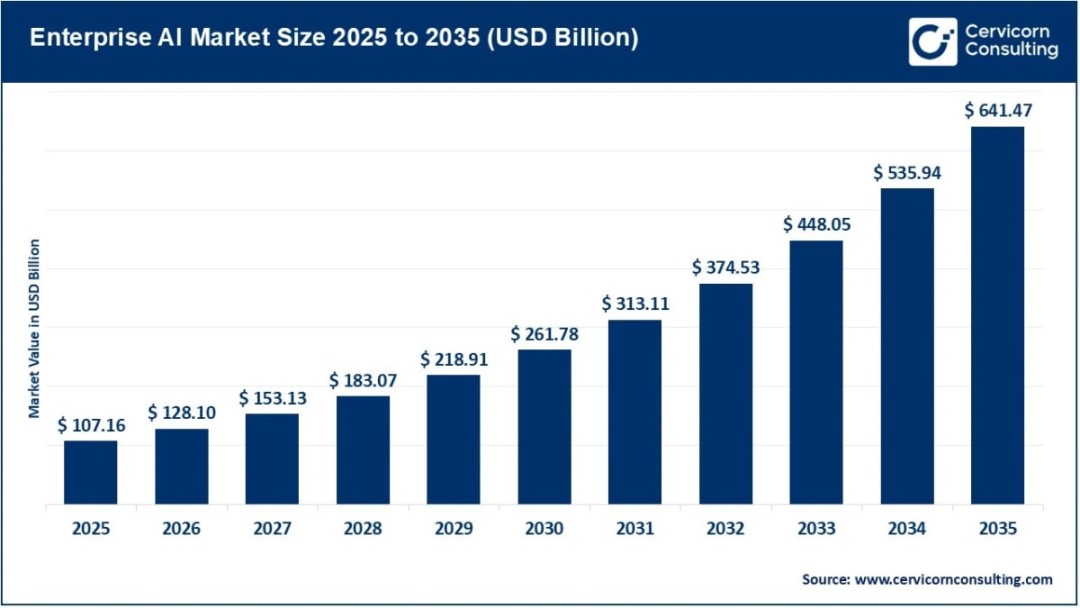
To put that in perspective, this is a market poised to add more than half a trillion dollars in value within a single decade, driven by a convergence of cloud infrastructure maturity, accelerating machine learning capabilities, and an unprecedented wave of enterprise-level commitment to AI-driven transformation.
How is the Investment Surge in Enterprise AI Market?
Corporate spending on AI is no longer a line item; it has become a strategic mandate. Enterprise companies spent $37 billion on generative AI in 2025, up from $11.5 billion in 2024, a staggering 3.2× year-over-year increase. According to analysts at Citi, $37 billion was invested by businesses in generative AI in 2025, an increase of a whopping 3.2-fold on $11.5bn invested by the same group in 2024.
Meanwhile, workers in enterprise are accessing AI rapidly, with 50% more workers getting access to the technology in 2025 compared to year prior, and nearly double the number of businesses expected to see at least 40% of their AI projects in production in the next six months, according to an analysis by Deloitte on data from over 3,200 senior executives in 24 countries.
In the United States alone, industry is seeing substantial investment such as Microsoft's $80 Bn investment in AI-compatible data center infrastructure by 2025, and a significant investment by the U.S. government in the Project Stargate Initiative, a $500bn public-private infrastructure program involving Oracle, OpenAI, SoftBank and NVIDIA that aims to secure the country’s leading role.
Recent Major Global Investments in Enterprise AI
-
SoftBank Group (Global/US): Strategic investment to scale enterprise AI models, AI agents, and global enterprise deployment capabilities
-
Oracle Corporation + OpenAI + SoftBank Group (U.S.) - AI infrastructure buildout including enterprise AI data centers and high-performance computing clusters
-
Glean Technologies, Inc. (U.S.) - Expansion of enterprise AI agents, workplace intelligence, and AI-driven enterprise search systems
-
Uniphore Technologies Inc. (U.S./India) - Scaling enterprise AI cloud platform for customer engagement, automation, and AI-native workflows
-
Arcee AI (U.S.) - Development of compact enterprise-grade AI models focused on secure and controllable AI infrastructure
Why Enterprises Are Doubling Down?
The ROI case has quickly become hard to beat in the global enterprises AI market. A study performed for Microsoft estimated businesses derive an average value of $3.50 for every dollar spent on AI, and over 90% report tangible business value within 18 months of implementation. The average enterprise worker saves between 40 and 60 minutes per day, and nearly three quarters of those workers say they now accomplish new tasks that they previously couldn’t.
“Among marketers, 85% report that their campaigns launch faster; for HR professionals, three quarters report increased employee engagement.”
The operational case makes a case in scenarios where complexity intersect scale. One telco leveraging AI identified specific patterns in usage that can predict customer satisfaction score 3 months in advance, allowing intervention time.
Despite the gap between aspiration and execution remains a hallmark for the enterprise AI. According to Deloitte’s 2026 State of AI in the Enterprise report, 74% of enterprises aspire to generate revenue growth from AI, yet only 20% are already doing so.
Enterprise AI Market Segments at a Glance:
According to the experts at Cervicorn Consulting, the market’s composition revealed under segmental valuation explains where the real economy of enterprise AI lies:
-
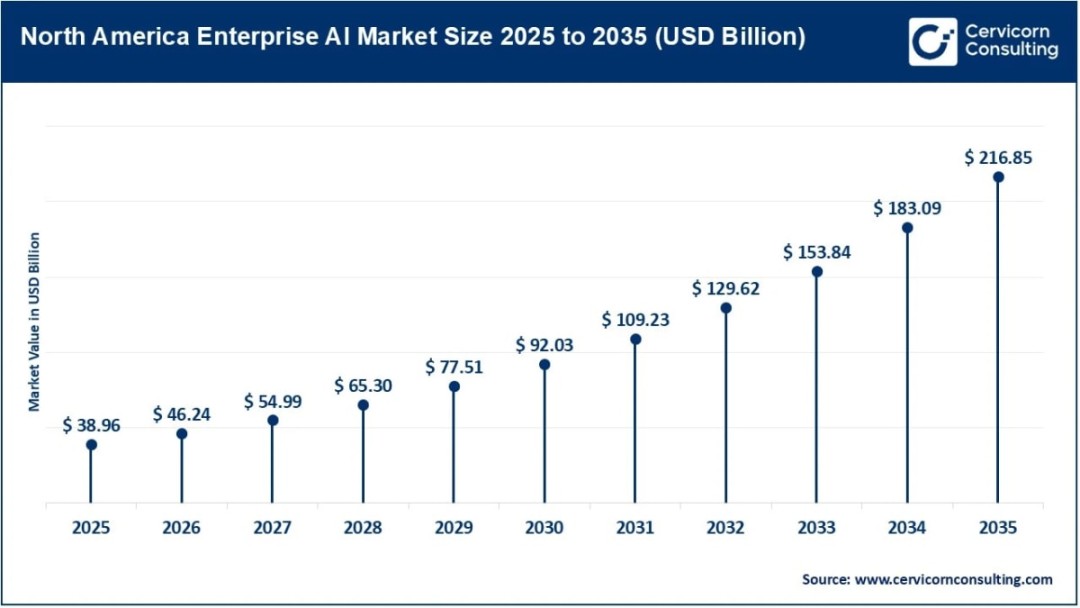
By region, North America was the leader with 36% share in 2025, anchored by hyperscaler data centers and venture capital density with deep research pipelines. On the other hand, Asia Pacific is expected to grow at a CAGR of 19.92% powered by government-backed sovereign AI programs and localized foundation models across countries.
-
By deployment mode, cloud-based AI captured 58% share in 2025 as cloud deployment eliminates upfront capital expenditure and enables remote access. As competitive pressure intensifies in the market, the cloud-native AI is expected to become the default architecture for innovation in businesses.
-
By technology, the machine learning and deep learning held 44% share in 2025, commanding the share with the expansion of ML & DL in clinical decision, finances, predictive analytics and majorly in automated quality control in manufacturing.
-
By application, business intelligence and analytics held 37% share in 2025 while reflecting the demand of real-time and data-driven decision making in almost every industry and enterprise.
-
By organization size, the large enterprises had a share of 60% by market share in 2025, driven by their financial capacity, data infrastructure mandates and other cross-functional requirements. On the other hand, SMEs are also adopting AI with a rapid pace, largely driven by improved cloud accessibility and as-as-service pricing models.
-
By industry vertical, the IT and Telecommunications segment held the share of 34% in 2025, driven by early adoption in cybersecurity and network optimization. Telecom operators are heavily deploying ML algorithms to manage complex 5G networks to ensure the quality of service and reduce the overall operational cost. On the other hand, healthcare is seen to position as fastest-growing projected at CAGR of 20.77% with the rapid adoption of AI-based devices. By 2024, the U.S. FDA alone approved 600+ AI-supported medical devices.
What to Expect Next in the Industry? Know it from the Leaders
The next era of enterprise AI is already coalescing. According to research from Deloitte, the heading toward an inflection point in the use of agentic AI-autonomous systems that can perform multi-step business processes without direct human supervision at each turn.
“Gartner, for its part, forecasts that by 2026, more than 40% of applications will be autonomous with self-learning AI agents, compared to less than 5% in 2025.”
The trend is supported by hardware, too; Google last week announced the new version of its TPUs, sixth generation Trillium delivers more than 4.7x more compute on 27% less power than its fifth gen, aiming for efficiency. At the enterprise data center scale, there is a growing number of chip alternatives to Nvidia's high-end GPUs. Both AMD'sMI300X and, Google's, third gen Trillium T2 processors for large models represent more affordable pricing per teraflop than NVIDIA.
The enterprise AI market is no longer in its formative years. Since 76% of firms worldwide currently utilize some form of AI, according to the International Data Center Authority (IDCA) of companies, 87% of enterprises cite AI as the top business priority (or in the top three), the dynamics have tilted considerably against laggards. AI initiatives that scale realize an average of 34% improvement in operational efficiency and 27 percent cost reduction in 18 months.
The Cervicorn Consulting forecast of a market growing from $107.16 billion to $641.47 billion is not an optimistic outlier, it reflects the structural momentum of a technology category with strong demand drivers, government tailwinds, accelerating ROI evidence, and hardware infrastructure finally capable of supporting enterprise-grade deployment at scale.
Media Contact
Company Name: Cervicorn Consulting
Contact Person: Vishal Agarwal
Email: Send Email
City: California City
Country: United States
Website: https://www.cervicornconsulting.com/enterprise-artificial-intelligence-market