In recent years, global financial markets have been undergoing a profound digital transformation. From the emergence of blockchain technology to the rapid development of digital assets and the increasing exploration of digital transformation by traditional financial institutions, the boundaries of the financial industry are continuously expanding.
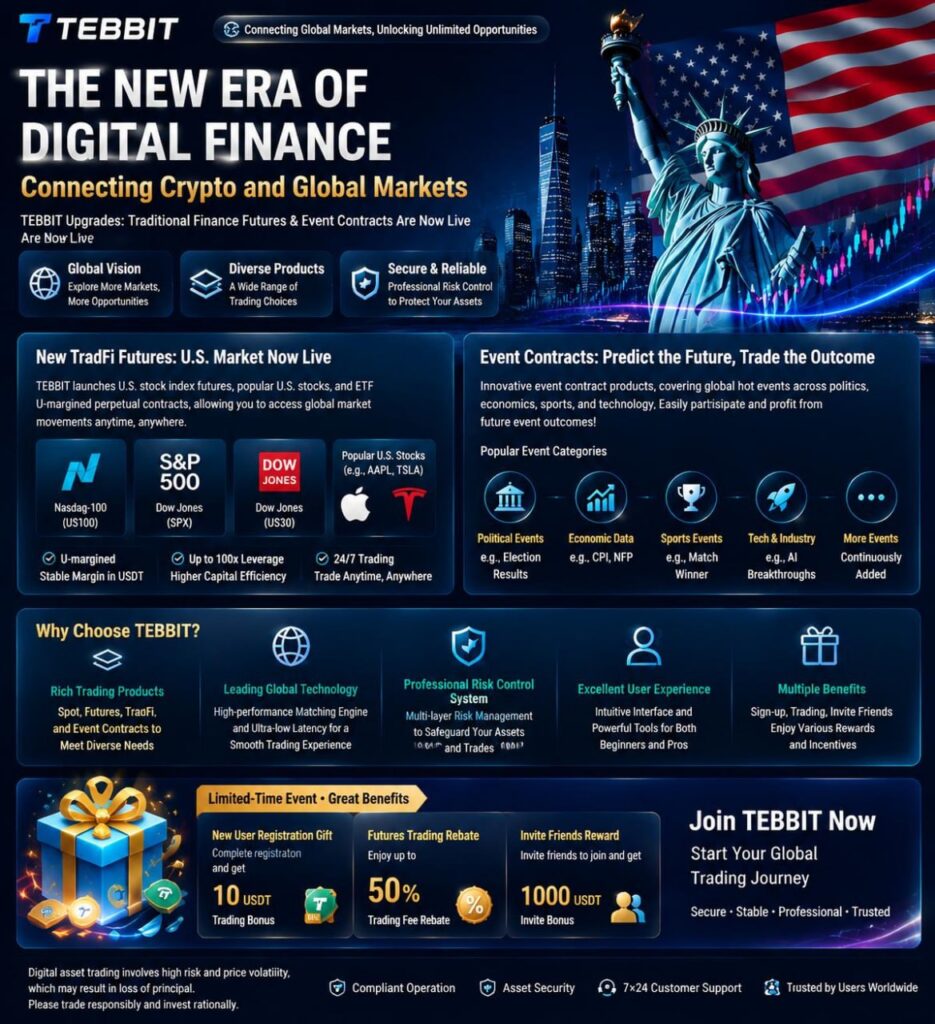
In the past, investors usually needed different financial channels to participate in different markets. However, with the rapid development of digital technology, more and more trading platforms are exploring ways to connect various markets and provide users with more diversified trading experiences.
Against this backdrop, digital asset trading platforms are continuously upgrading their positioning. They are evolving from simple cryptocurrency trading venues into more comprehensive financial ecosystems that integrate multiple markets, products, and trading tools.
TEBBIT is one of the platforms actively exploring this direction. By continuously improving its product ecosystem, expanding global market-related offerings, and exploring connections between digital assets and traditional financial markets, TEBBIT is working toward building a more diversified digital financial trading environment.
As market participants continue to evolve, user expectations for trading platforms have also changed significantly.
In the early stages of digital asset development, users mainly focused on price movements of individual cryptocurrencies. Today, more users are looking for broader market access, including digital assets, derivatives, traditional financial instruments, and innovative trading products.
This shift in demand is encouraging trading platforms to continuously innovate and expand their capabilities.
A modern trading platform requires more than just a wide range of assets. It also needs strong technology infrastructure, comprehensive risk management, user-friendly services, and continuous product innovation.
From an industry perspective, one of the most important future trends in digital finance is the integration of different markets.
Traditional finance has a long-established framework, while digital assets bring advantages such as global accessibility, 24/7 trading, and technology-driven innovation.
The combination of these two areas creates new possibilities for the future development of financial products.
TEBBIT’s expansion into TradFi (Traditional Finance) products reflects the broader trend of digital platforms exploring connections with global financial markets.
The U.S. financial market has long been one of the most influential markets worldwide.
From technology companies and artificial intelligence to semiconductor industries and innovative enterprises, developments in the U.S. market often influence global economic trends and investor attention.
In recent years, artificial intelligence has become one of the most important areas of technological development.
The rapid growth of AI, cloud computing, and data-driven technologies has transformed multiple industries and created new areas of market interest.
More investors are paying attention to U.S. technology companies and related industries, looking for flexible ways to understand and participate in global market movements.
Against this background, digital trading platforms are exploring how to introduce more global market-related products into digital financial ecosystems.
TEBBIT’s launch of U.S. market-related contract products represents one of the latest developments in this direction.
By expanding available products, the platform provides users with more diversified ways to engage with different market trends.
However, every financial product requires a clear understanding of risk.
Especially for derivative products, leverage mechanisms can create more flexible trading opportunities while also increasing exposure to market volatility.
Contract trading requires users to develop stronger risk management awareness.
Market movements are unpredictable, and no trading strategy can guarantee results. Therefore, users need to evaluate their own risk tolerance and develop appropriate trading approaches.
For experienced market participants, successful trading is not only about identifying opportunities but also about maintaining disciplined risk management.
This includes:
- Understanding market trends;
- Managing position sizes;
- Avoiding emotional decisions;
- Developing structured trading strategies;
- Continuously learning from market changes.
These principles are becoming increasingly important in modern financial markets.
Exploring New Trading Possibilities Through Event Contracts
In addition to traditional financial-related contract products, event contracts have also become an emerging area of exploration within the digital finance industry.
As information spreads faster and global markets become more interconnected, users are increasingly interested in future market developments and potential outcomes.
Event-based products provide another way for participants to engage with market expectations.
Unlike traditional asset trading, event contracts focus more on specific outcomes, future developments, or market scenarios.
The emergence of these products reflects how digital finance continues to respond to changing user demands.
In today’s market environment, information has become a key factor influencing financial decisions.
Economic data releases, industry developments, corporate announcements, and global events can all influence market sentiment.
Therefore, future financial participation will not only depend on asset price movements but also on the ability to understand information, technology, and market expectations.
The development of event contracts encourages users to strengthen their analytical capabilities.
Market participants increasingly need to consider multiple factors, including:
- Global economic conditions;
- Industry development trends;
- Market sentiment;
- Technical indicators;
- Capital flows.
This transformation means that future traders need more than trading tools—they need broader market understanding.
Building a More Comprehensive Digital Financial Ecosystem
From a platform development perspective, offering diverse products is only the foundation. Long-term competitiveness depends on comprehensive capabilities.
As the digital asset industry continues to mature, users are placing greater emphasis on overall platform performance.
Trading system stability has become a critical factor.
Digital asset markets operate continuously around the world, meaning platforms need reliable infrastructure to support users across different regions and time zones.
Product innovation is another important factor.
Market conditions and user needs continue to evolve, requiring platforms to introduce products that align with changing market trends.
Security and risk management are also essential.
A sustainable digital financial ecosystem requires strong protection mechanisms for accounts, transactions, and market operations.
A mature platform must balance innovation with responsible risk management.
It should provide users with diverse trading opportunities while also encouraging more rational participation.
The Future Direction of Digital Finance
From a global perspective, the digital asset industry is entering a more mature stage of development.
In the past, competition mainly focused on trading volume and user growth. Today, the focus is shifting toward ecosystem development.
Future digital financial platforms are likely to experience several major trends.
First, asset categories will continue to expand.
As traditional finance and digital technology become more integrated, more financial products may enter digital trading environments.
Second, global market connections will become stronger.
Technology will continue reducing barriers between markets, allowing users to access information and financial products from around the world more efficiently.
Third, trading experiences will continue improving.
Future competition will not only depend on product quantity but also on system performance, user experience, and service quality.
Fourth, user education will become increasingly important.
The more complex financial markets become, the more important it is for users to understand products and manage risks responsibly.
TEBBIT’s Role in the Evolving Digital Finance Landscape
TEBBIT’s development direction reflects a broader trend within the digital finance industry.
From digital asset trading to contract products and TradFi-related expansion, the platform is exploring a more diversified trading ecosystem.
The introduction of U.S. market-related contracts and event-based products represents the continued evolution of digital financial services and the exploration of new ways to connect global markets.
Looking ahead, the integration between digital assets and traditional finance is expected to deepen further.
Blockchain technology can improve asset digitalization efficiency.
Intelligent tools can enhance trading experiences.
Global connectivity can create stronger links between markets.
Together, these factors are driving the continued development of digital finance.
However, opportunities and challenges always exist together.
Platforms need to continuously improve technology, strengthen services, and enhance security capabilities.
Users need to maintain rational decision-making and choose trading methods that match their own circumstances.
Financial markets do not offer simple formulas for success. Every trading decision requires understanding, preparation, and responsible risk management.
Conclusion
Looking back at the development of the digital asset industry, it is clear that the market is moving from an early exploration stage toward a more diversified and mature ecosystem.
Trading platforms are evolving from simple transaction tools into important gateways connecting users, markets, and financial products.
As global financial digitalization continues, the future of digital finance will bring more innovation, more market connections, and more opportunities.
TEBBIT’s continued expansion of its product ecosystem and exploration of digital finance integration represents one approach toward the future development of global financial technology.
For the industry as a whole, the ability to balance innovation and risk management, improve technology, and build sustainable ecosystems will remain essential.
The digital finance era is continuing to evolve, and a new ecosystem connecting traditional markets with the digital world is gradually taking shape.