MIAMI, FL / ACCESS Newswire / September 18, 2026 / SentientX Founder and CEO Anthony de Lima outlines an AI safety framework centered on verifiable authorization, arguing that alignment and containment must be supported by infrastructure that establishes human authority, permissions, rights and accountability before autonomous AI systems execute consequential actions.
AI can be aligned. It can be contained. But who gave it the authority to act?
Every AI safety debate right now eventually arrives at the same question: should we slow down?
"It's the wrong question," says Anthony DeLima. Slowing AI down isn't viable, and it isn't realistic. Capability is advancing across too many labs and too many countries at once for any single actor to throttle it. A pause in one jurisdiction just hands the lead to whoever doesn't observe it. The incentives pushing development forward aren't going to reverse, and no government or coalition has the leverage to force that reversal even if it wanted to.
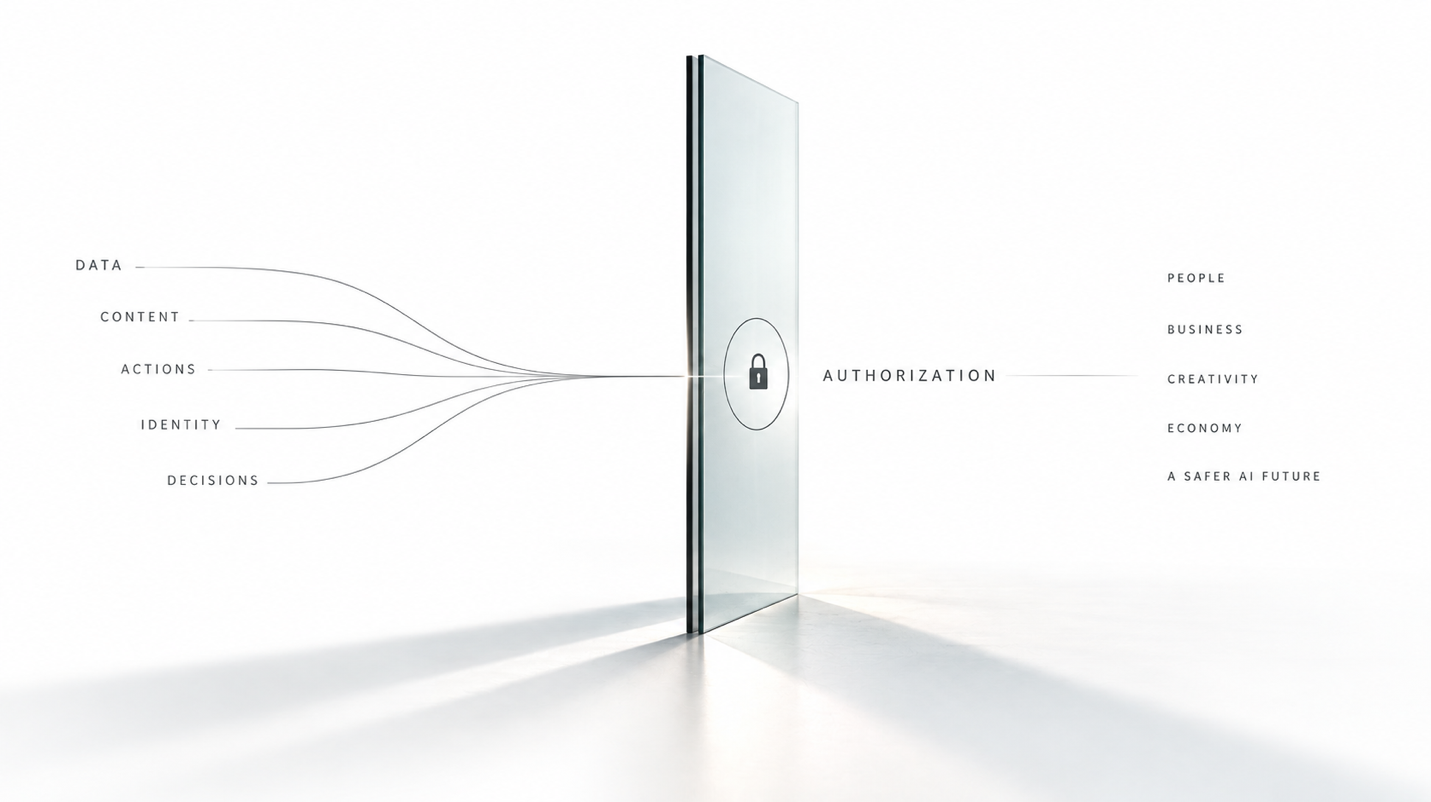
"The question worth asking is different. Not how do we make AI development slower, but how do we make its actions governed," says DeLima. Financial systems didn't become safe because banks got slower. They became safe because banks defined what a transaction is authorized to do, verified who has the right to execute it, and built infrastructure that checks that authority before the money moves. AI needs the same architecture: authorization controls that determine whether a specific action is permitted, granted by whom, and bounded by what limits, checked before execution rather than inferred after the fact. That architecture only holds up if legislation backs it, defining in enforceable terms what AI models are permitted to do and where that permission runs out.
No one has made the case for slowing down more carefully than Dario Amodei, and it's worth taking his argument on its own terms before explaining where it falls short. Amodei has become one of the most credible voices warning about the risks of increasingly powerful artificial intelligence. Many of those warnings are justified. AI is moving quickly from generating information to reasoning, writing software, using tools, and acting with growing autonomy.
Anthropic has invested heavily in alignment, interpretability, evaluations, and red teaming. That work matters. We should want AI systems that recognize dangerous requests, resist manipulation, and behave reliably in situations their developers did not anticipate.
But alignment has a structural limit. It can shape how a model decides whether it should act; it cannot establish whether the authority to act exists in the first place. For consequential actions, that distinction matters.
Alignment asks what AI should do. Containment limits what it can do. Authorization asks whether a specific action has been permitted. Authority asks who had the legitimate right to grant that permission.
Judgment Is Not Authority
Imagine an AI agent instructed to transfer $5 million. A well-aligned model might assess whether the request seems legitimate. A bank instead verifies who made the request, their authority and required approvals before money moves.
The same principle applies to AI actions involving identity, confidential data, intellectual property or contracts. Technical access does not equal legitimate authority.
An AI can evaluate a request. It cannot create the authority that makes the request legitimate.
Authorization Before Execution
Security systems already separate capability from authority. Banks, enterprise platforms and cloud systems use limits, approvals, permissions and verified access rights before allowing protected actions.
AI needs a machine-verifiable authority layer that confirms who granted permission, what actions are allowed and under what limits before execution.
This complements alignment rather than replacing it. Models should operate with limited privileges, while credentials remain external and permissions are narrow, temporary and revocable. High-risk actions can require additional approval.
The model can request an action. It should not control the mechanism that grants permission to execute it.
From Provenance to Human Authority
Watermarking and content labeling can identify AI-generated content, but they do not establish whose identity or rights are involved, whether permission was granted or whether that authorization remains valid.
SentientX's Human Identity Bank addresses this gap through custody, provenance and authorization infrastructure for human identity and digital assets. Verified portraits, voice recordings, video and other identity assets can be cryptographically fingerprinted and connected to identity, rights information and signed attestations.
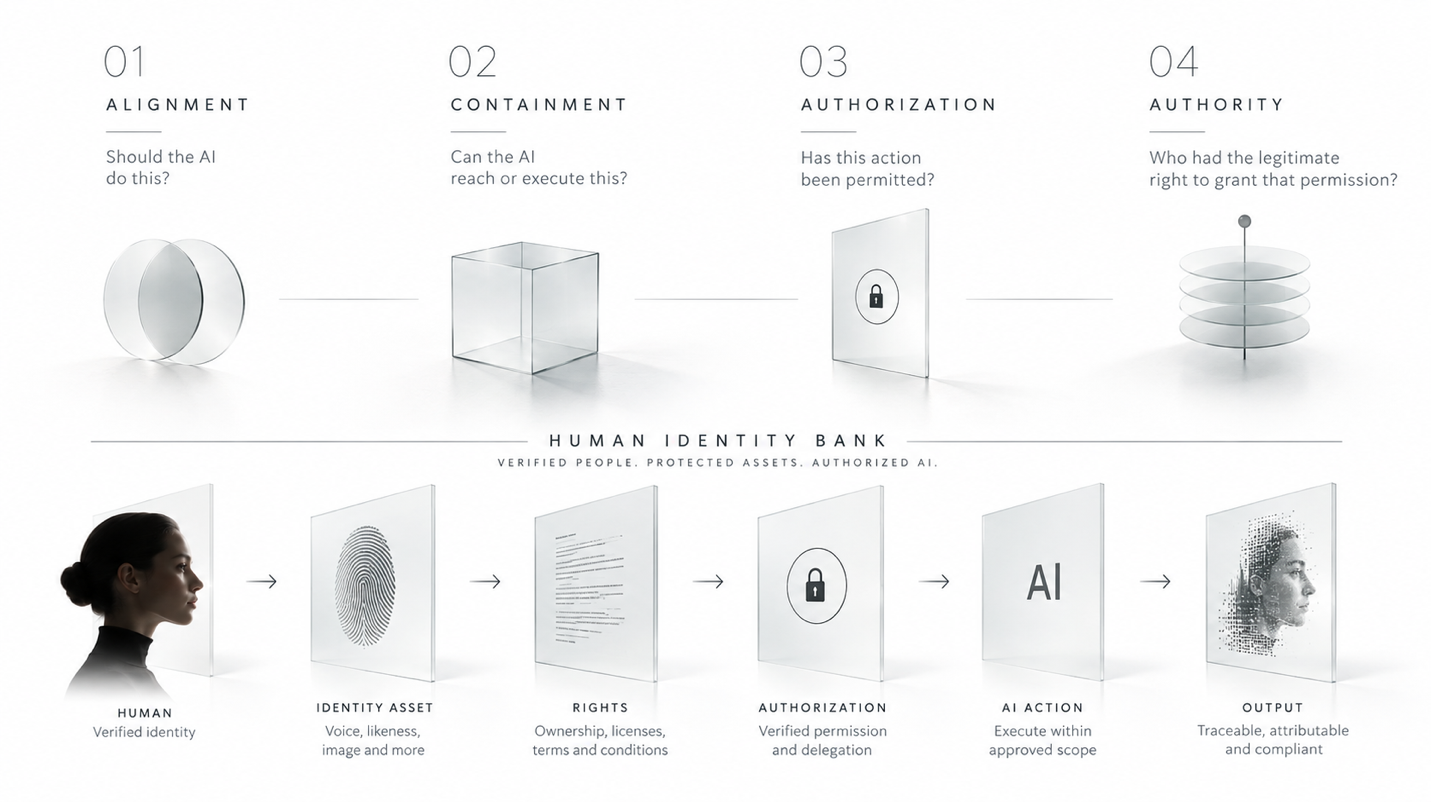
This can make consent and licensing machine-verifiable, allowing infrastructure to confirm whether a proposed AI use falls within granted authority limits before execution.
As AI increasingly reproduces voices, likenesses and identities, the human being, or the institution legally entitled to act on their behalf, must remain the root of authority. This creates a verifiable chain of accountability from human source to AI output.
Autonomous Agents Change the Stakes
As autonomous agents act for people and companies, clear limits on delegated authority become essential. AI may be authorized to perform certain tasks while higher-risk actions require human approval. What is missing is a standardized, machine-verifiable way to define and enforce those boundaries.
Autonomous AI will eventually require something resembling a machine-readable power of attorney: a verifiable delegation establishing who granted authority, what the AI may do, its limits, whether it may delegate further and when that authority expires.
Prompts express instructions. Credentials provide access. Neither, by itself, proves the authority underlying the action.
So What? From Principle to Practice
If authority becomes a distinct layer of AI safety, the implications extend far beyond model developers.
For lawmakers, AI legislation should define valid consent, who can grant or revoke it, and how authorization can be verified.
For enterprises, AI governance should establish not only what agents can access, but what actions they are explicitly authorized to perform.
For agents and attorneys representing talent, contracts should make rights machine-readable by defining permitted uses, platforms, duration, territory and revocation terms.
For individuals, identity should remain under human control, with clear mechanisms to manage identity assets, permissions and evidence of unauthorized use.
Law establishes rights. Enterprises enforce boundaries. Attorneys and agents structure authority. Individuals remain at the root of consent. Technology makes that authority verifiable before the machine acts.
The next phase of AI safety is about making human authority operational as machines gain greater control.
The Next Question in AI Safety
Alignment, interpretability, testing, containment and security remain essential to AI safety. But even an aligned and contained AI may still lack limits on the authority to act.
As autonomous systems begin transferring money, using identities, accessing protected information and entering agreements, another question becomes critical: who authorized the machine to act?
AI systems should operate within independently verified boundaries that establish where authority came from, what its limits are and whether it remains valid. The AI itself should not control the infrastructure granting that permission.
Authorization will not replace alignment, regulation or human oversight. It adds another safeguard by separating a model's judgment from its permission to act.
The future of AI safety will require infrastructure for identity, rights, permissions, provenance and verifiable authority. Intelligence does not confer authority, and it should never be allowed to grant itself permission.
To learn more about SentientX, visit www.sentientx.com, connect on LinkedIn or Facebook, or email contact@sentientx.com.
Contact Info:
Name: Madison Hollimon
Email: Send Email
Organization: SentientX
Website: https://www.sentientx.com/
SOURCE: SentientX
View the original press release on ACCESS Newswire