Vadzo's Falcon-544CRS is a 5MP enhanced dynamic range USB camera built on the Onsemi AR0544 5MP image sensor from the HyperLux LP eDR family delivering single frame extended tonal range output over USB 3.2 for embedded vision USB camera deployments in traffic monitoring, license plate recognition, ADAS, in-cabin monitoring and outdoor surveillance applications where a single exposure must simultaneously render bright highlights and deep shadow detail. As an AR0544 5MP USB camera it brings Onsemi's HyperLux LP eDR technology to standard USB deployments across Vadzo's USB camera series without the ghosting artifacts and frame latency that disqualify multi frame HDR compositing for scenes with fast-moving content.
FORT WORTH, TX / ACCESS Newswire / July 23, 2026 / Vadzo Imaging, a provider of embedded vision camera products today explains the enhanced dynamic range USB camera technology powering the Falcon-544CRS a 5MP USB 3.2 camera built on the Onsemi AR0544 HyperLux LP eDR image sensor for OEM engineering teams and system integrators developing production vision systems across traffic infrastructure, ADAS development platforms, industrial inspection lines and smart city surveillance networks. As a 5MP USB 3.2 camera delivering enhanced dynamic range through Onsemi's HyperLux LP single-frame eDR readout, the Falcon-544CRS provides reliable imaging in mixed light environments where conventional camera products expose correctly for either the bright region or the shadow region of a scene but not both within the same capture event.
Sensor and Camera Overview
The Falcon-544CRS is built on the Onsemi HyperLux LP image sensor AR0544, a 5MP CMOS image sensor engineered for embedded and industrial vision applications demanding wide dynamic range imaging in variable and uncontrolled lighting conditions. The AR0544 HyperLux LP eDR architecture delivers enhanced dynamic range through single-frame eDR processing rather than by compositing multiple exposures captured at different integration times. This makes it applicable to traffic, ADAS, and outdoor security deployments where multi-frame approaches produce ghosted output whenever scene content is in motion.
As an Onsemi HyperLux LP USB camera, the Falcon-544CRS delivers 5MP output over USB 3.2, providing high-throughput image streaming compatible with standard USB Video Class host drivers across embedded Linux, Windows and Android platforms without custom FPGA or proprietary interface hardware. The USB 3.2 interface reduces hardware integration complexity for development teams prototyping on industrial PCs and embedded computing platforms.
Key specs: Onsemi AR0544 HyperLux LP eDR │ 5MP Resolution - 2592(H) x 1944(V) │ eDR (enhanced Dynamic Range) & Line Interleaved HDR (LI-HDR) │ USB 3.2 Gen1 Type C Interface Backward Compatible to USB 2.0 │ 1.4 μm x 1.4 μm Pixel Pitch │1/4.2" Optical Format | Rolling Shutter | S Mount (M12 Standard) | -30⁰C to 85⁰C Operating Temperature | Windows, Linux, and Android | UVC Compliant | RoHS 3 and REACH Compliant
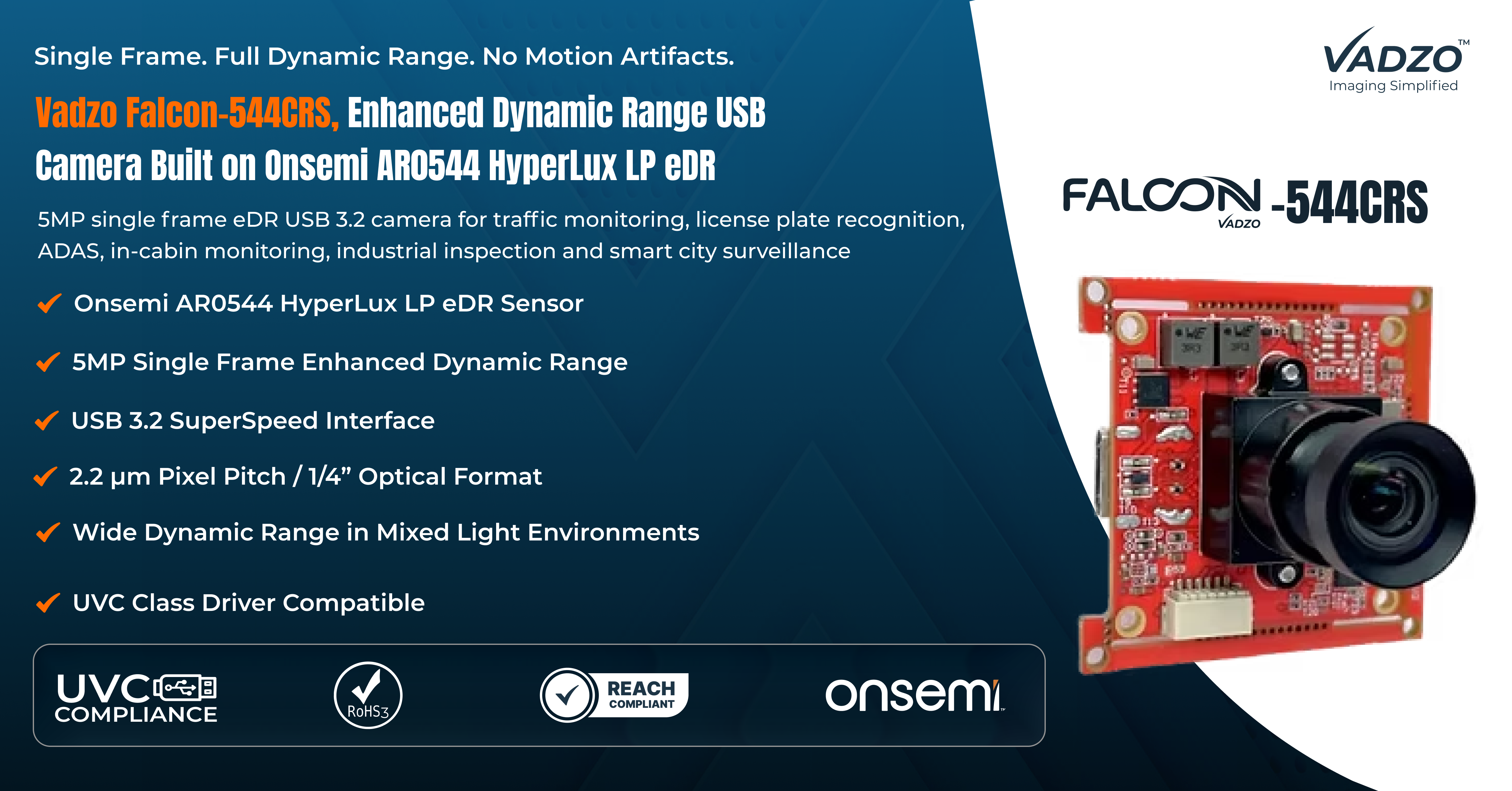
Key Capabilities of the Falcon-544CRS: AR0544 Enhanced Dynamic Range USB Camera
Single Frame eDR for Reliable Imaging in High Contrast and Mixed Light Scenes: Standard CMOS image sensors capture scene luminance within a fixed exposure window per frame. Outdoor environments, traffic intersections under direct sunlight, factory floors with overhead point source lighting, and tunnel entry or exit zones routinely present scene luminance ratios that exceed the tonal capacity of a standard single exposure. The sensor either clips bright regions to pure white or compresses shadow regions to featureless black, and no amount of image signal processor post-processing recovers pixel data that was never captured.
Multi-frame HDR addresses this by capturing two or more frames at different integration times and compositing them in the ISP. This approach introduces a latency penalty between the shortest and longest exposures and generates ghosting artifacts wherever scene content has moved between frames. For vehicles at roadway speeds, pedestrians crossing a surveillance field of view, and mechanical components on production conveyor lines, this inter-frame motion is a constant operating condition. Multi-frame HDR output is unreliable as a result.
The Onsemi AR0544 HyperLux LP eDR sensor resolves this at the silicon level. The eDR architecture extends the usable tonal range within a single frame readout cycle without requiring a second exposure event, preserving both highlight and shadow detail in the same image output delivered in one frame period. For OEM teams specifying a 5MP HDR USB camera for traffic monitoring or industrial inspection, this is the practical difference between an approach that delivers clean output at operational frame rates and one that generates ghosted or latency-impacted data under real scene conditions. As a wide-dynamic-range USB camera, the Falcon-544CRS resolves this challenge at the sensor hardware level rather than delegating it to software pipelines that add latency and require dedicated compute resources.
5MP Resolution for High-Detail Scene Coverage: At 5MP, the AR0544 delivers sufficient spatial resolution to support simultaneous scene overview and region of interest analysis within a single captured frame. In license plate recognition deployments, this means capturing the full lane width for vehicle classification while retaining character-level plate legibility at operational distances. In defect detection and quality inspection workloads, 5MP spatial resolution enables surface anomaly detection at the sub-millimeter scale on components moving across a conveyor inspection zone without requiring multiple lower-resolution sensor units covering the same field of view.
The combination of 5MP spatial resolution with eDR tonal range positions the Falcon-544CRS as a eDR USB camera capable of handling inspection and detection tasks that would otherwise require separate high-resolution capture units and dynamic range management subsystems, reducing sensor count and system integration overhead for OEM hardware teams.
USB 3.2 Interface for Broad Platform Compatibility: The Falcon-544CRS connects to host systems via USB 3.2 SuperSpeed, providing sufficient interface bandwidth for 5MP streaming at practical frame rates across a wide range of embedded computing and industrial PC host platforms. USB 3.2 with UVC class driver compliance eliminates the need for proprietary capture cards, FPGA frame grabbers, or network infrastructure required by Gigabit Ethernet and MIPI-based camera interface architectures. This makes it accessible to development teams working in standard embedded Linux and Windows environments.
For high-dynamic-range industrial camera deployments in traffic monitoring infrastructure, smart city surveillance and industrial inspection platforms where USB-capable embedded computing hardware is already deployed, UVC compliance means the sensor module enumerates and streams with standard OS video capture APIs. This accelerates validation timelines and reduces the firmware integration workload for OEM engineering teams.
Low Power HyperLux LP Architecture for Embedded System Integration: The HyperLux LP designation indicates a low-power CMOS sensor architecture optimized for embedded deployment in thermally and power-constrained environments. For AMR embedded camera systems on battery-powered navigation platforms, ADAS embedded camera modules within automotive electronic control unit power domains, and in-cabin monitoring camera units in vehicles with strict power budget constraints, the sensor power draw influences sensor selection directly.
The HyperLux LP architecture reduces active power consumption relative to standard CMOS sensors of equivalent resolution, extending battery runtime in mobile platforms and reducing thermal load in enclosed enclosures where passive heat dissipation is the only available thermal management approach. For low-light industrial camera and warehouse automation installations operating across extended duty cycles, this translates to lower per-unit operating cost and simpler enclosure thermal design.
"The problem that the AR0544 HyperLux LP eDR addresses is a fundamental one for any embedded vision deployment in an outdoor or industrial environment. You cannot control the lighting conditions in a traffic installation or a factory floor the way you can in a controlled studio, and the luminance range in those real-world environments will exceed what a standard single-exposure sensor can render. Multi-frame HDR solves the range problem but introduces motion artifacts that are equally disqualifying for applications involving moving subjects. What the Falcon-544CRS delivers is a 5MP eDR output in a single frame period over USB 3.2 without the ghosting and without the latency. For teams building traffic monitoring, ADAS evaluation, smart city surveillance, or industrial inspection systems, that is the design capability they need, and it is what the AR0544 HyperLux LP eDR sensor is built to provide." - Alwin Vincent, Product Manager, Vadzo Imaging.
Target Applications
Traffic Monitoring and License Plate Recognition: Traffic monitoring deployments require simultaneous imaging of retroreflective license plates illuminated by active IR strobes and the surrounding roadway environment under ambient daylight or artificial street lighting. The luminance ratio between an actively illuminated retroreflective plate and the surrounding scene can exceed a range that standard sensors cannot render in a single exposure. Conventional camera products handle this by running separate short-exposure capture windows for plate legibility at the cost of ambient scene context or by using dual-camera setups with synchronized exposure timing. The AR0544 single-frame eDR captures both luminance levels within one frame period, enabling the traffic monitoring USB camera to deliver plate-readable output alongside full lane scene context for vehicle classification, speed estimation and incident detection in a single sensor. For license plate recognition camera deployments at toll plazas, highway gantries and urban intersection monitoring points, this single sensor approach reduces installation hardware count and eliminates the synchronization overhead of multi-unit capture arrangements. The eDR output also supports ANPR and ALPR algorithm pipelines that require consistent character contrast across all ambient lighting conditions, including dusk, dawn and artificial streetlighting.
ADAS and Automotive Embedded Camera Development: ADAS embedded camera platforms require reliable image output across the full range of on-road luminance conditions, including direct sunlight, tunnel interior, oncoming headlight glare at night, and the rapid luminance transition at tunnel entrance and exit points where ambient light levels change by several orders of magnitude within the sensor field of view in a fraction of a second. Standard sensors respond to these transitions by overexposing or underexposing the scene as automatic exposure control converges to the new luminance level. During this convergence window, forward collision warning, lane departure detection, and pedestrian recognition algorithms receive compromised image input. The AR0544 eDR architecture handles this within the single-frame processing path, providing usable image output throughout the luminance transition period without waiting for exposure settling. For ADAS embedded camera development teams evaluating sensor platforms for level two and level three driver assistance functions, the Falcon-544CRS delivers data quality across the full luminance range of real-world driving conditions in a USB 3.2 form factor compatible with standard development board configurations and ADAS algorithm validation setups.
In-Cabin Driver and Occupant Monitoring: In-cabin monitoring camera systems for driver monitoring, occupant detection, and interior surveillance face a specific dynamic range challenge: the camera field of view simultaneously includes the bright exterior environment visible through windows and the dim interior cabin space illuminated by ambient cabin lighting or supplemental near-infrared LED arrays. The luminance ratio between a sunlit exterior scene visible through a vehicle windshield and the cabin interior under normal conditions exceeds what a standard single-exposure sensor can render in both regions simultaneously. For driver monitoring applications requiring simultaneous visibility of driver facial features for drowsiness detection and gaze tracking alongside exterior scene context for scenario classification, this luminance mismatch requires eDR imaging at the sensor level. The AR0544 HyperLux LP eDR processes the interior-to-exterior luminance range within single-frame output, delivering consistent image quality for head pose estimation, eyelid openness detection and occupant classification algorithms that operate under variable cabin and window luminance conditions.
Industrial Defect Detection and Quality Inspection: Manufacturing quality inspection systems encounter extreme dynamic range conditions on production lines where specularly reflective metal surfaces, transparent polymer components and matte substrates occupy the same sensor field of view simultaneously. Under structured LED illumination, a reflective metal surface returns light intensity levels several orders of magnitude higher than a matte substrate in the same frame. This exceeds the dynamic range of a standard sensor and produces specular overexposure that masks surface features in the high-luminance regions. For defect detection USB camera applications where surface anomalies in both reflective and matte material regions must be detected in a single frame, a sensor with extended dynamic range is a system requirement, not an optional enhancement. The AR0544 eDR enables the Falcon-544CRS to capture surface detail across both specular and diffuse material regions, simultaneously supporting quality inspection USB camera deployments in semiconductor packaging, pharmaceutical container inspection and precision machined component verification. For warehouse automation camera and vision-guided robotics camera installations, the same wide dynamic range capability supports reliable pick-and-place operations in environments where ambient lighting varies across work zones or between shift cycles.
Smart City Surveillance and Outdoor Security: Outdoor smart surveillance USB camera and outdoor security USB camera installations operate across a wide range of lighting transitions, including direct sunlight, overcast conditions, dusk and dawn lighting cycles, and artificial street lighting at night. The transition from daylight to artificial illumination creates a dynamic range challenge for conventional sensors as the scene luminance shifts and the sensor exposure setting tracks the change. For smart city vision camera deployments in video analytics networks, pedestrian flow monitoring systems and urban intersection surveillance where scene content and lighting conditions change, eDR imaging continuously at the sensor level provides consistent image output quality across all lighting states without requiring exposure mode switching or sensor parameter reconfiguration between lighting cycles. The AR0544 eDR output supports vehicle and pedestrian detection, traffic flow analytics, and smart parking management algorithms that require stable image input regardless of time-of-day lighting variations.
Vision-Guided Robotics and AMR Navigation: AMR embedded camera systems and vision-guided robotics platforms operate in factory and warehouse environments where overhead lighting creates luminance gradients across the work floor, window areas introduce high-intensity ambient light patches, and robot arm shadows create dark zones adjacent to brightly illuminated work surfaces. For pick-and-place systems using image-based grasp point detection, specular overexposure on target objects compromises the feature extraction and pose estimation algorithms that guide the end effector. The AR0544 eDR ensures both bright and shadowed work zone regions are rendered with usable detail in each captured frame, supporting reliable object detection and pose estimation in variable-illumination factory environments. For autonomous mobile robot navigation in warehouse aisle environments, the eDR output maintains consistent landmark and obstacle visibility across lighting-variable zones without stopping for sensor recalibration between zones.
Frequently Asked Questions
Q: What is the difference between enhanced dynamic range and standard HDR in a USB camera, and why does it matter for industrial and traffic applications?
A: Dynamic range in a camera sensor is the ratio between the brightest scene luminance the sensor can capture without pixel saturation and the darkest luminance it can record above the noise floor. Standard CMOS sensors used in conventional USB camera products typically operate within a dynamic range of 60 to 80 decibels depending on pixel size and readout architecture. Real-world scenes in industrial and traffic environments routinely present luminance ratios that exceed this range, forcing the sensor to choose between highlight detail and shadow detail in each frame.
Multi-frame HDR processing addresses this by capturing two or more frames at different integration times and blending them into a composite image in the host ISP or application software. The approach does extend the usable tonal range but introduces two problems that make it unsuitable for applications involving subjects in motion. First, the total acquisition period spans multiple frame times, introducing capture-to-output latency proportional to the number of frames composited. Second, wherever scene content has moved between the short-exposure and long-exposure frames, the composite image contains ghosting artifacts. For vehicles on roadways, assembly line components on conveyors, and pedestrians in surveillance frames, these conditions are not edge cases, but standard operating conditions making multi-frame HDR output unreliable.
Enhanced dynamic range in the AR0544 HyperLux LP eDR sensor captures extended tonal range within the readout of a single frame without a second exposure event or a compositing step. The output is a full dynamic range image delivered in one standard frame period. The result is no inter-frame ghosting and no multi-frame latency. For OEM teams evaluating sensor platforms for a 5MP HDR USB camera deployment in traffic monitoring, ADAS or industrial inspection workloads, this is the architectural distinction that determines whether the solution is viable under production operating conditions.
Q: Which USB 3.2 camera is best suited for outdoor traffic monitoring and license plate recognition in high-contrast day-night lighting conditions?
A: Outdoor traffic monitoring and license plate recognition deployments present a set of demanding imaging requirements that disqualify most standard USB camera products. The sensor must simultaneously capture retroreflective license plates under active IR strobe illumination at high luminance and the surrounding roadway scene under ambient daylight or streetlighting at much lower luminance. The sensor must perform across full daylight, dusk, and nighttime illumination transitions without manual exposure adjustment. And the sensor must deliver frame-consistent output at vehicle approach speeds that produce significant subject motion between any two consecutively captured frames.
Vadzo Imaging's Falcon-544CRS, built on the Onsemi AR0544 HyperLux LP eDR sensor, is purpose-built for this requirement set. The single-frame eDR captures both the high-luminance plate region and the ambient-lit roadway context in a single frame period without ghosting. At 5MP resolution, the Falcon-544CRS provides the spatial detail for character-level plate legibility at lane-width field-of-view distances alongside vehicle classification and traffic flow data in the same frame. The USB 3.2 interface with UVC compliance enables straightforward integration with the embedded computing platforms used in traffic monitoring system designs. OEM teams and system integrators can request an evaluation unit from Vadzo Imaging to validate the Falcon-544CRS against their specific installation geometry and lighting conditions before committing to volume production.
Q: How does the Onsemi AR0544 HyperLux LP eDR sensor maintain consistent image output during rapid luminance transitions in ADAS systems?
A: The tunnel entry and exit transition is one of the most demanding luminance scenarios for ADAS embedded camera systems. As a vehicle approaches a tunnel entrance, the sensor's field of view transitions from a high-luminance outdoor scene to a dark interior within a very short time period. Standard sensors with automatic exposure control respond by adjusting the integration time to the new luminance level. During the convergence interval, the output swings between overexposure of the dark tunnel interior and underexposure of the bright entrance portal. Forward collision warning systems, lane-keeping assist algorithms, and pedestrian detection pipelines that rely on this sensor output receive degraded image data during the convergence window. This creates a detection gap at precisely the moment when scene complexity and driving demands are highest.
The AR0544 HyperLux LP eDR architecture handles both the bright and dark luminance regions within a single frame eDR readout. The sensor does not need to wait for exposure convergence because the eDR processing path retains both high-luminance exterior detail and low-luminance tunnel interior detail within the same capture event. The output across the luminance transition is a sequence of single-frame eDR images that maintain usable scene detail throughout rather than degrading during the adaptation period. For ADAS embedded camera development teams evaluating sensor platforms for highway, urban and mixed-road ADAS validation, the Falcon-544CRS delivers this luminance-transition resilience in a USB 3.2 form factor compatible with standard ADAS evaluation and simulation setups.
Q: Can I use a 5MP HDR USB camera for both ADAS evaluation and in-cabin monitoring development on the same embedded platform?
A: Yes. The Falcon-544CRS from Vadzo Imaging is suitable for both ADAS embedded camera evaluation workloads and in-cabin monitoring camera system development on standard embedded Linux and Windows development platforms. The AR0544 HyperLux LP eDR sensor's single-frame eDR capability addresses the core imaging challenge in both applications: resolving a luminance range that exceeds the capacity of a standard sensor in a single frame period. For forward-facing ADAS, this means handling sunlight, oncoming headlights, and tunnel transition luminance in the same sensor output stream. For in-cabin monitoring, this means simultaneously imaging the dim cabin interior alongside the high-luminance exterior scene visible through the windshield.
Vadzo Imaging supports OEM teams that require separate in-cabin monitoring camera and forward-facing ADAS embedded camera module variants with differing optical configurations, field-of-view specifications, and mounting form factors while maintaining the same AR0544 HyperLux LP eDR sensor core across both application modules. Vadzo's engineering team provides ISP tuning support for optimizing AR0544 eDR output parameters specific to in-cabin near-infrared illumination environments and forward-facing visible spectrum ADAS scenes independently. Evaluation units are available without minimum order requirements for teams at the prototype validation stage of their ADAS and in-cabin system development.
Q: What evaluation, customization, and volume production support does Vadzo Imaging provide for OEM teams integrating the AR0544 5MP USB camera into production systems?
A: Vadzo Imaging provides OEM support for the Falcon-544CRS across the full product development lifecycle from initial sensor evaluation through to volume production integration. Evaluation units are available without minimum order requirements, allowing engineering teams to validate AR0544 eDR imaging performance, USB 3.2 interface compatibility and frame output characteristics against their specific application scene conditions and host platform configuration before advancing to production tooling.
For teams moving from evaluation to production, Vadzo provides form factor modification and PCB redesign for board level integration into OEM mechanical assemblies, custom firmware development and ISP parameter tuning optimized for specific scene luminance profiles and illumination types, lens holder and optical filter customization for application-specific field of view and spectral response requirements and IR LED array board design and integration for active illumination in-cabin and low ambient light deployments. Vadzo's engineering team provides driver porting support for embedded Linux platform targets and IP-rated enclosure design for outdoor security USB camera and traffic monitoring USB camera installations requiring environmental protection from dust and moisture ingress. Volume procurement is available through Vadzo's standard OEM engagement process. Teams can initiate evaluation by contacting Vadzo Imaging at support@vadzoimaging.com or visiting the product page for full specifications.
Availability and Customization
The Falcon-544CRS, Vadzo Imaging's enhanced dynamic range USB camera built on the Onsemi AR0544 HyperLux LP eDR sensor, is available now for evaluation and OEM integration. To request full specifications or an evaluation unit, contact the Vadzo Imaging sales team at support@vadzoimaging.com.
Vadzo supports full OEM customization across the Falcon-544CRS, including form factor modification and board redesign for board-level integration, custom firmware development and ISP tuning, IR and visible LED illumination board integration, lens holder and optical filter customization, and enclosure design for both IP-rated outdoor deployments and non-IP-rated enclosed installations. As part of Vadzo's USB camera series, the Falcon-544CRS carries the same OEM support infrastructure available across Vadzo's embedded vision camera portfolio. Driver porting support for additional embedded Linux platforms is available on request from Vadzo's engineering team.
About Vadzo Imaging
Vadzo Imaging develops embedded and machine vision camera products for OEMs and system integrators building production-ready vision systems across industrial automation, robotics, automotive, healthcare and smart infrastructure. The company's camera portfolio spans MIPI CSI-2, USB, Gigabit Ethernet, Wi-Fi and SerDes interface-based camera products supporting a wide range of embedded deployment architectures. Vadzo provides end-to-end imaging support, including sensor integration, ISP tuning, firmware development and SDK frameworks to accelerate system deployment. Learn more at www.vadzoimaging.com.
Media Contact
Alwin Vincent
Vadzo Imaging
Email: alwin@vadzoimaging.com
LinkedIn: Vadzo Imaging
YouTube: Vadzo Imaging
X: Vadzo Imaging
SOURCE: Vadzo Imaging
View the original press release on ACCESS Newswire