Vadzo's Merlin-291CRS is a 2MP Sony IMX291 STARVIS HDR USB camera with dual endpoint H.264 and MJPEG streaming, enabling simultaneous compressed and uncompressed video output over a single USB 2.0 connection for facial recognition, retail AI analytics, and smart kiosk deployments where bandwidth efficiency and inference-grade image quality are concurrent system requirements
FORT WORTH, TX / ACCESS Newswire / June 30, 2026 / Vadzo Imaging today validates the Merlin-291CRS, a 2MP Sony STARVIS IMX291 USB camera engineered for kiosk facial recognition, retail AI vision, and embedded video analytics applications. Built on the Sony IMX291 BSI CMOS sensor with dual endpoint H.264 and MJPEG streaming over USB 2.0, the Merlin-291CRS addresses a persistent deployment challenge in always-on USB vision systems: delivering both a bandwidth-efficient compressed stream for recording or remote transmission and a high-quality stream for inference-grade local processing from a single camera module without switching protocols or sacrificing frame quality on either output.
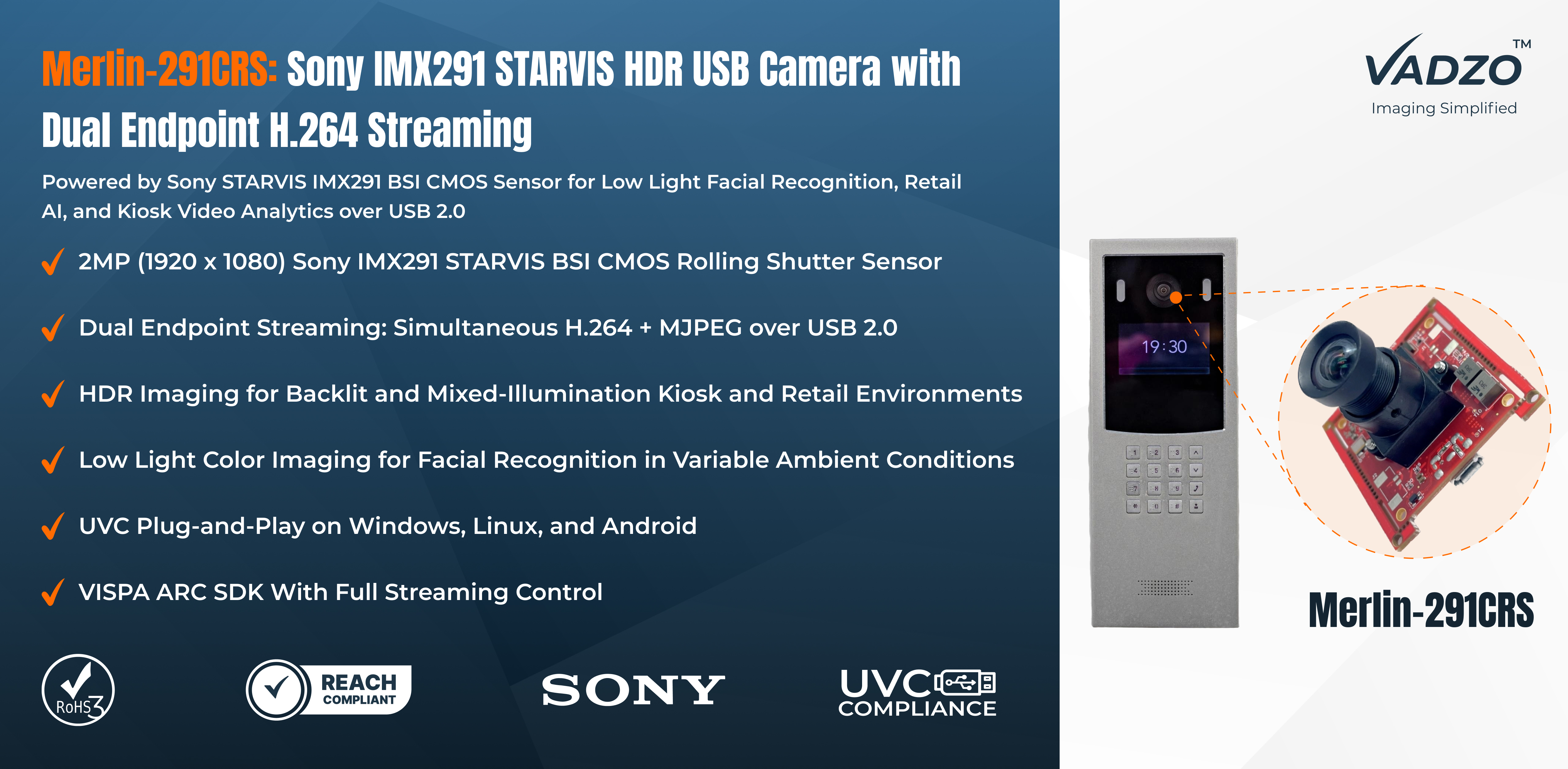
Key Capabilities of the Merlin-291CRS Sony IMX291 STARVIS HDR USB Camera
Sony IMX291 STARVIS BSI Sensor for Low Light and Facial Recognition Imaging: The Sony IMX291 is a Back-side illuminated CMOS sensor from Sony's STARVIS generation, built around a 1/2.8" optical format with 2.9 µm pixel pitch and 2MP (1920 x 1080) resolution. Back-side illumination repositions the photodiode layer to the light-receiving surface of the sensor substrate, routing metal wiring below rather than above the pixel layer. This configuration maximizes photon capture efficiency per pixel area, which is the primary sensor-level factor that determines low-light imaging performance. In facial recognition of USB camera deployments, the practical effect is the ability to capture biometrically usable face images in lobby, entrance, and kiosk environments where ambient illumination is uncontrolled or non-uniform.
The IMX291 STARVIS architecture delivers strong near-infrared sensitivity alongside visible-light color imaging, making it well-suited to facial recognition systems that combine visible-light capture with NIR-illuminated liveness detection passes within the same imaging pipeline. In retail AI camera deployments, this low-light capability extends reliable people counting and behavior analysis into early morning and late evening store hours without requiring supplemental illumination hardware. The rolling shutter readout provides full-frame color imaging at 1920 x 1080 resolution, meeting the minimum resolution that most facial recognition inference pipelines require to produce reliable biometric embeddings from a face crop at typical kiosk working distances.
Key specs: 2MP (1920 x 1080) | Sony IMX291 STARVIS BSI 1/2.8" 2.9 µm pixel | Color | Rolling Shutter | Dual Endpoint H.264 + MJPEG | HDR | USB 2.0 | 1080p / 720p | UVC | Windows · Linux · Android
Dual Endpoint H.264 and MJPEG Streaming for Concurrent Inference and Recording: The defining technical feature of the Merlin-291CRS is its dual endpoint USB architecture. A single USB camera module presents two distinct USB video endpoints to the host system: one streaming H.264 compressed video and one streaming MJPEG. The host application accesses both endpoints simultaneously, enabling the camera to serve two parallel consumer paths from a single sensor to capture without switching codec mode or interrupting either stream.
In a retail AI camera deployment, the inference pipeline receives MJPEG frames that preserve spatial detail for people counting and behavior analysis at full 1080p resolution, while the H.264 stream feeds a recording or remote monitoring system simultaneously. In a kiosk facial recognition camera deployment, the compressed H.264 endpoint serves a central video management or compliance recording system while the MJPEG endpoint provides the lower-compression frame quality that biometric recognition algorithms require for accurate feature extraction. Without dual endpoint architecture, a USB camera module operating in a single codec mode must switch between compressed and uncompressed output depending on the active consumer, meaning the recording and the inference pipeline cannot run concurrently from the same device.
H.264 compression is also the technical enabler for 1080p streaming over USB 2.0. USB 2.0 provides 480 Mbps of raw bandwidth, which is insufficient for 1920 x 1080 uncompressed YUV output at 30fps. H.264 reduces that bitrate significantly without meaningful loss of image quality at inference-relevant spatial frequencies, making full HD operation over USB 2.0 practical on embedded hosts where USB 3.x port availability is limited or absent.
HDR for Challenging Kiosk and Retail Lighting Environments: Facial recognition and retail AI deployments encounter lighting scenarios that a single-exposure imaging pipeline cannot handle reliably. Kiosk terminals positioned near windows or entrances face backlighting conditions that create high-contrast frames where a face in the foreground becomes silhouetted against a bright background. Retail floor environments mix overhead fluorescent or LED illumination with natural daylight from storefronts, creating horizontal illumination gradients across the scene. The Sony IMX291 sensor supports HDR imaging that extends the effective dynamic range of each captured frame, preserving usable detail in both shadow regions and highlights within the same capture.
For a kiosk HDR camera deployment, this means facial feature data is recoverable even when the background behind the subject is significantly brighter than the face itself. For a retail AI deployment analyzing footfall across a store floor, HDR prevents the loss of trackable human silhouettes in the transition zones between bright and shadowed areas. The result is more consistent input quality to the downstream AI inference pipeline across a wider range of real-world lighting conditions than standard single-exposure imaging provides.
UVC Plug-and-Play Integration on USB 2.0: The Merlin-291CRS is UVC compliant, registering as a standard USB video device on Windows, Linux, and Android without requiring custom driver installation. For OEM teams integrating a facial recognition camera module into a kiosk or retail terminal platform, UVC compliance eliminates driver development from the integration scope, removes driver compatibility risk across OS versions, and simplifies the software maintenance burden across the deployed fleet. USB 2.0 host availability is broader than USB 3.x on compact embedded SBCs, microcontrollers, and entry-level kiosk hardware, making the Merlin-291CRS directly deployable on a wider range of production host platforms without board redesign or interface adapter hardware.
"Kiosk and retail AI deployments have a dual-stream problem that most USB camera module products do not address at the hardware level. You need a compressed H.264 output for recording or transmission to a central system, and you need a quality MJPEG output for the local inference engine at the same time. Switching between the two in software is a workaround that introduces latency and integration complexity. The Merlin-291CRS dual endpoint architecture resolves this at the USB level and pairs it with the IMX291 STARVIS sensor's low-light performance and HDR capability that these environments actually demand."- Alwin Vincent, Product Manager, Vadzo Imaging
VISPA ARC SDK for Developer Integration
The Merlin-291CRS is supported by the Vadzo VISPA ARC SDK, providing programmatic control over streaming configuration, H.264 encoding parameters, MJPEG quality settings, region of interest, exposure, and firmware updates. APIs are available in C, C++, C#, and Python across Windows, Linux, and Android. The SDK supports independent configuration of both USB endpoints, enabling development teams to set compression parameters, resolution, and ROI separately for the H.264 and MJPEG outputs from the same device handle. For OEM teams building retail AI or kiosk facial recognition products, the VISPA ARC SDK reduces integration time and provides a consistent control interface across the Vadzo USB camera portfolio.
Target Applications
Facial Recognition and Access Control Kiosks: Kiosk facial recognition systems operate at entry points, visitor management terminals, and self-service authentication stations where subjects approach varying distances, under mixed indoor lighting, and often against a backlit backdrop. The IMX291 STARVIS sensor's BSI architecture captures biometrically usable face images at low ambient illumination levels without supplemental flash illumination, which is a practical requirement at kiosk installations where additional lighting hardware is impractical. The dual endpoint architecture allows the kiosk platform to run H.264 compliance recording alongside MJPEG inference processing simultaneously, addressing both operational logging requirements and biometric pipeline requirements from a single camera module. HDR preserves facial feature detail in backlit scenarios where window light or entry signage competes with the subject's face for sensor dynamic range.
Retail AI and People Counting: Retail AI camera deployments for people counting, dwell time analysis, and customer flow mapping need sustained 1080p imaging across a full store operating cycle that spans low-traffic early hours, peak midday traffic, and dimly lit evening periods. The IMX291 STARVIS sensor maintains consistent image quality in low ambient illumination conditions that degrade inference accuracy on front-illuminated sensor architectures. Dual endpoint streaming allows people to count and behavior analysis software to access MJPEG frames for local inference while a compressed H.264 stream simultaneously feeds a cloud analytics platform or central store monitoring system. For OEM teams building embedded vision solutions for retail environments, the Merlin-291CRS serves as a People counting USB camera that handles both inference and recording requirements without requiring two separate camera modules.
Smart Kiosk and Digital Signage: Self-service kiosks for banking, retail checkout, ticketing, and information display require vision capability for user interaction detection, audience analytics, and audience-adaptive content delivery. The Merlin-291CRS provides USB 2.0 plug-and-play integration that kiosk hardware designers require on compact embedded platforms, combined with HDR imaging for the mixed-light kiosk environments that single-exposure camera module products handle inconsistently. The dual endpoint H.264 streaming architecture enables the kiosk to transmit management video to a remote fleet monitoring system while the local interaction detection pipeline accesses the MJPEG stream without interference, covering both operational and analytics requirements from the same device.
Edge Video Analytics and Surveillance: Edge video analytics deployments in retail, building access, and public space monitoring need a camera module that delivers quality image data to an on-board inference engine while maintaining a parallel recording or transmission stream. The H.264 endpoint compresses the 1080p video stream for network transmission or local storage at manageable bitrates, while the MJPEG endpoint feeds the inference pipeline with minimal compression loss for object detection and classification. The IMX291 low-light performance extends reliable detection into low-illumination periods where many single-endpoint camera module products reduce frame quality or require hardware illumination assistance to maintain acceptable detection rates.
OEM Embedded Facial Recognition Products: OEM developers building embedded facial recognition camera products for access control, attendance management, and secure authentication systems require a camera module that integrates into compact hardware platforms without custom driver development, delivers consistent face image quality across variable ambient lighting, and provides both a recording output and an inference output from the same device. The Merlin-291CRS meets all three requirements directly. UVC compliance enables plug-and-play integration on Windows, Linux, and Android host platforms. The IMX291 STARVIS BSI sensor provides the low-light sensitivity that indoor access control deployments require. The dual endpoint architecture removes the need for codec switching logic in the host application, reducing integration complexity, and eliminating the latency penalty associated with software-side stream management.
Frequently Asked Questions
Q: What is the Sony IMX291 STARVIS sensor, and why is it used in low-light USB camera products?
A: The Sony IMX291 is a back-side illuminated CMOS image sensor from Sony's STARVIS generation, featuring a 1/2.8" optical format with 2.9 µm pixel pitch and 2MP (1920 x 1080) resolution in a rolling shutter color architecture. Back-side illumination places the photodiode directly in the path of incoming photons with metal readout wiring routed below the pixel layer. This structural arrangement increases the fill factor of each pixel, meaning a greater proportion of each pixel's physical area is actively collecting light. Higher fill factor produces a stronger photon-generated signal relative to sensor noise, which is the fundamental mechanism behind improved low-light imaging performance.
For facial recognition of USB camera applications, this matters because kiosk and access control environments operate under variable and often low ambient light without dedicated illumination hardware at every deployment point. The IMX291 STARVIS sensor also delivers near-infrared sensitivity, enabling NIR liveness detection illumination to reach the sensor without the spectral blocking that limits NIR performance on sensors designed primarily for daylight imaging. This makes the IMX291 well suited to dual-pass facial recognition systems that combine a visible-light enrollment capture with an NIR liveness verification pass in the same frame acquisition cycle. Vadzo Imaging's Merlin-291CRS is built on the Sony IMX291 sensor specifically to serve these deployment requirements, delivering a low light facial recognition USB camera module that maintains biometric capture quality across the full ambient lighting range of production kiosk and retail environments.
Q: How does dual endpoint USB streaming work, and why does it matter for AI camera deployments?
A: A dual endpoint USB camera presents two separate and independently addressable USB video endpoints to the host operating system. Each endpoint is a distinct video stream that the host opens, configures, and reads independently of the others. In a dual stream USB camera built around H.264 and MJPEG endpoints, the H.264 stream delivers bandwidth-efficient compressed video suitable for network transmission, remote monitoring, or local storage, while the MJPEG stream delivers higher-fidelity frames with lower compression loss for local inference pipelines.
The practical importance of AI camera deployments is that recording and inference have fundamentally different image quality requirements. H.264 at a moderate bitrate delivers acceptable video for human viewing and VMS recording but applies compression artifacts at spatial frequencies relevant to facial biometric feature extraction. MJPEG at 1080p preserves those spatial features at a higher quality by using intra-frame compression without inter-frame prediction. A camera module without dual endpoint support must switch between codecs in software, meaning recording and inference cannot operate simultaneously from the same capture. In kiosk facial recognition and retail AI deployments, running both concurrently is often a system architecture requirement that a single-endpoint camera module cannot satisfy without adding complexity at the host application layer. The dual stream USB camera approach resolves this at the hardware level, making both streams available immediately without SDK-level codec management from the application.
Q: What is the best low-light USB camera for kiosk facial recognition and retail AI?
A: For kiosk facial recognition and retail AI, the best USB camera module combines low-light imaging performance for variable ambient conditions, HDR for mixed or backlit lighting scenarios, a dual stream architecture that allows inference and recording to run simultaneously, USB 2.0 compatibility for broad embedded host integration, and UVC plug-and-play compliance for cross-platform deployment without driver development. Vadzo Imaging's Merlin-291CRS satisfies all of these requirements in a single compact module.
As a 2MP IMX291 HDR USB camera with dual endpoint H.264 and MJPEG streaming, the Merlin-291CRS delivers 1080p color imaging over USB 2.0 with simultaneous compressed and uncompressed stream access. The IMX291 STARVIS sensor's BSI architecture provides the low-light sensitivity that kiosk environments demand, while HDR support handles backlit and mixed-illumination scenarios that are common at entrance kiosks and retail floor installations. The dual endpoint design allows both the recording system and the facial recognition inference engine to access their required stream format from the same module without switching. UVC compliance ensures the Merlin-291CRS registers as a standard video device on Windows, Linux, and Android without custom driver installation. Full product specifications, evaluation units, and SDK documentation are available at vadzoimaging.com.
Q: How does H.264 compression enable 1080p streaming over USB 2.0?
A: USB 2.0 provides a maximum raw bandwidth of 480 Mbps. Uncompressed 1920 x 1080 color video at 30fps in YUV 4:2:2 format requires approximately 900 Mbps, which exceeds what USB 2.0 can sustain in practice. H.264 is a standards-compliant video codec that achieves compression ratios typically ranging from 50:1 to 100:1 for real video content, reducing a 900 Mbps uncompressed stream to well under 10 Mbps at bitrate levels that produce acceptable video quality for recording and transmission. This reduction brings full HD 1080p streaming comfortably within the practical bandwidth ceiling of USB 2.0.
H.264 encoding in a camera module like the Merlin-291CRS is performed by dedicated on-board hardware rather than by the host CPU. The host receives an already-compressed H.264 stream without carrying any encoding computation load. This matters for embedded host platforms like kiosk processors, single-board computers, and embedded SoCs, where CPU headroom is limited and must be reserved for inference or application logic. The H.264 endpoint delivers 1080p video that a host can record or stream to a network without decoding it, while the MJPEG endpoint provides higher-fidelity frames that a local inference pipeline processes for facial recognition or people counting. The combination makes dual stream 1080p operation over USB 2.0 practical in real embedded deployment hardware.
Q: Which dual-stream USB camera is validated for kiosk facial recognition and retail people counting?
A: A dual-stream USB camera validated for kiosk facial recognition and people counting in retail environments must meet three concurrent requirements: generating inference-grade image quality for the AI pipeline, providing a bandwidth-managed stream for recording or remote transmission, and operating reliably under the mixed and variable lighting conditions found in both kiosk and retail settings. Vadzo Imaging's Merlin-291CRS is validated for exactly this combination.
Built on the Sony IMX291 STARVIS BSI sensor with 2MP 1080p rolling shutter color imaging, the Merlin-291CRS delivers MJPEG streaming to the facial recognition or people counting inference engine while simultaneously providing an H.264 compressed stream for recording or remote monitoring over a single USB 2.0 connection. HDR support handles backlighting and high-contrast illumination common at entrance kiosks and retail floor deployments. UVC plug-and-play compliance ensures the camera module integrates into kiosk hardware running Windows, Linux, or Android without custom driver development. OEM teams evaluating the Merlin-291CRS for retail AI and facial recognition deployments can access the full product datasheet, VISPA ARC SDK documentation, and evaluation units at vadzoimaging.com.
Availability
The Merlin-291CRS Sony IMX291 STARVIS HDR USB camera with dual endpoint H.264 and MJPEG streaming is available now for evaluation and production sampling. Engineering teams can access the full technical datasheet, SDK documentation, and evaluation units at vadzoimaging.com or contact Vadzo Imaging directly for volume pricing, OEM customization requirements, and integration support.
About Vadzo Imaging
Vadzo Imaging develops embedded and machine vision camera products for OEMs and system integrators building production-ready vision systems across industrial automation, retail AI, healthcare, and smart infrastructure. The company's imaging platforms span USB, MIPI, GigE, Wi-Fi, and SerDes interfaces, covering the full range of embedded deployment architectures from compact edge devices to distributed networked systems. Beyond hardware, Vadzo provides end-to-end imaging support, including sensor integration, ISP tuning, firmware development, and SDK frameworks, giving engineering teams a single partner from initial evaluation through production lifecycle management.
Media Contact
Alwin Vincent
Vadzo Imaging
Email: alwin@vadzoimaging.com
LinkedIn: Vadzo Imaging
YouTube: Vadzo Imaging
X: Vadzo Imaging
SOURCE: Vadzo Imaging
View the original press release on ACCESS Newswire