The global kid snacks market is entering a strong growth phase driven by rising demand for convenient and nutritious snack products, expanding consumer preference for clean-label and high-protein formulations, and increasing adoption of healthier packaged foods across households, schools, and retail distribution channels.
NEWARK, DE / ACCESS Newswire / May 14, 2026 / According to the latest insights by Future Market Insights (FMI), the global Kid Snacks Market is transitioning toward a more health-focused and convenience-driven phase as manufacturers increasingly prioritize nutritional value, clean-label ingredients, and product diversification. Long-term market expansion is being supported by rising health-conscious parenting trends, increasing demand for portable snack formats, and expanding retail and e-commerce penetration across both developed and emerging economies.
Quick Stats: Kid Snacks Market
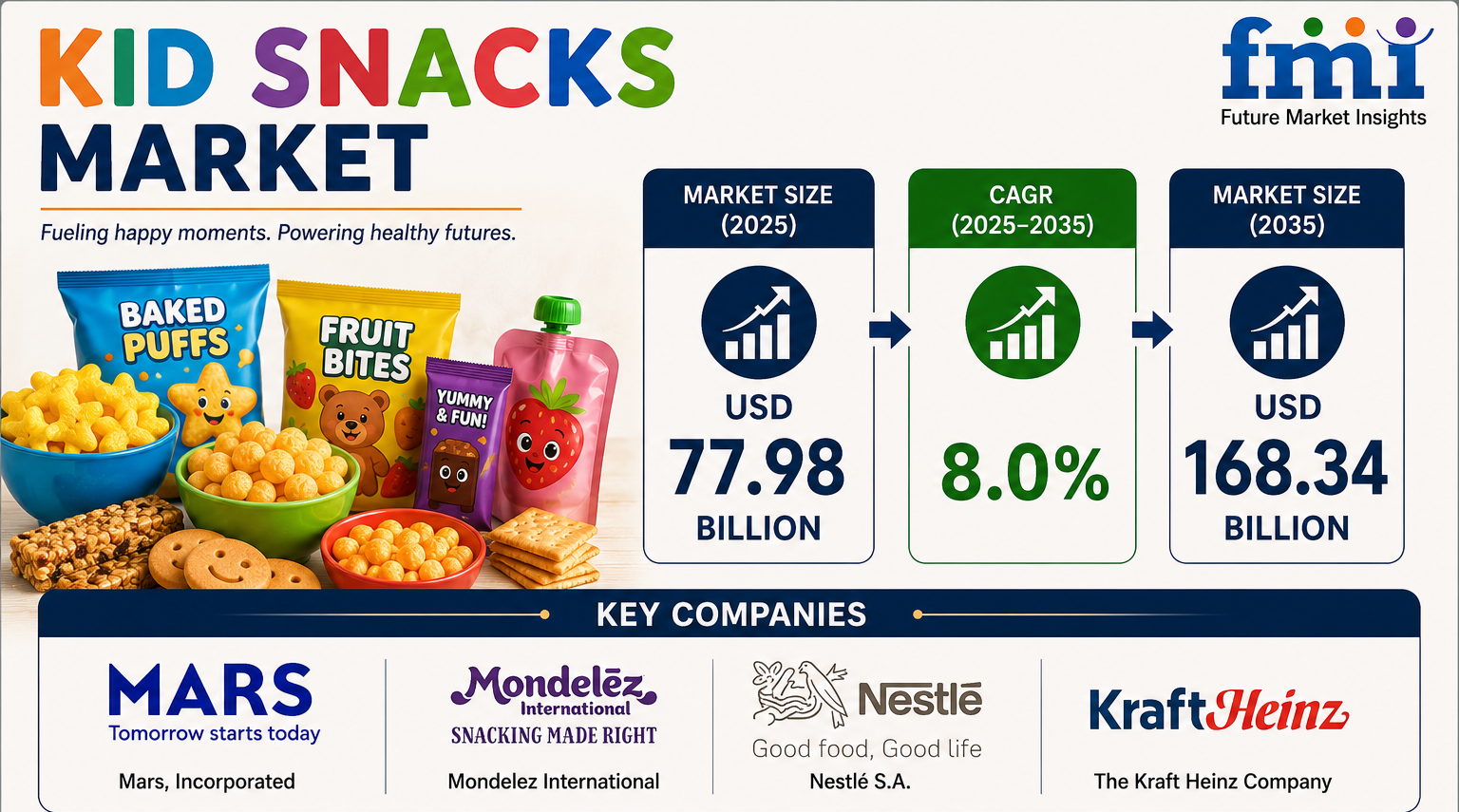
Market Size (2026): USD 77.98 billion
Projected Market Value (2036): USD 168.34 billion
Forecast CAGR (2026-2036): 8.0%
Leading Source Segment: Conventional Kid Snacks (68.4%)
Leading Product Type: Bakery Snacks (36.7%)
Leading Distribution Channel: Supermarkets & Hypermarkets (41.0%)
Fastest Growing Markets: China, India, Japan
Get detailed market forecasts, competitive benchmarking, and pricing trends: https://www.futuremarketinsights.com/reports/sample/rep-gb-4357
A Market Increasingly Defined by Healthier Snacking and Functional Nutrition
Kid snacks are increasingly evolving from traditional confectionery products into nutrition-focused food categories designed to support convenience, balanced diets, and healthier consumption habits among children.
Manufacturers are increasingly prioritizing:
Gluten-free snack formulations
Organic and clean-label ingredients
High-protein and fortified snacks
Portion-controlled packaging
Low-sugar snack innovation
Convenient on-the-go formats
The market is also benefiting from growing parental awareness around nutritional quality, ingredient transparency, and healthier alternatives to conventional processed snacks.
Market Forecast: Product Diversification Continues Supporting Long-Term Growth
The kid snacks market is expected to maintain stable long-term expansion as brands continue strengthening product portfolios and improving retail accessibility.
Conventional kid snacks are projected to account for 68.4% of market demand in 2026 due to broad affordability, established consumption patterns, and strong retail penetration.
Bakery-based snacks are expected to dominate with 36.7% market share because consumers increasingly prefer:
Portable baked snack products
Granola and cereal bars
Healthy breakfast snacks
Shelf-stable bakery items
Convenient lunchbox solutions
Supermarkets and hypermarkets are projected to maintain 41.0% market share because family-focused snack purchasing remains highly dependent on organized retail visibility and bulk purchasing convenience.
Why Health-Conscious Parenting and Convenience Continue Driving Demand
Health-oriented snacking remains the strongest commercial foundation for the kid snacks market.
Demand is increasingly linked to:
Nutritious lunchbox solutions
Portable breakfast alternatives
High-fiber snack products
Protein-enriched snack options
Clean-label food products
Reduced-sugar snack innovations
Unlike traditional snack categories focused primarily on indulgence, kid snacks are increasingly positioned around balanced nutrition, convenience, and ingredient transparency.
Parents are also prioritizing products that align with active lifestyles while offering improved nutritional profiles compared to conventional snack foods.
E-commerce and Retail Expansion Are Improving Market Accessibility
Retail and e-commerce distribution expansion is improving kid snack accessibility across both mature and emerging markets.
Online snack retail and direct-to-consumer channels are becoming increasingly important due to:
Subscription-based snack boxes
Digital grocery platforms
Urban delivery infrastructure
Personalized nutrition offerings
Convenience-driven purchasing behavior
At the same time, traditional supermarkets and hypermarkets continue dominating because household grocery shopping remains the primary purchasing channel for kid snack products.
Customize insights for your business strategy: https://www.futuremarketinsights.com/customization-available/rep-gb-4357
Regional Analysis: China and India Lead Global Growth
China Leads Global Growth (8.4% CAGR)
China is projected to remain the fastest-growing kid snacks market through 2036 due to:
Rising disposable income
Growing urban family population
Expanding modern retail infrastructure
Increasing health-conscious parenting
Strong e-commerce growth
Chinese consumers are increasingly prioritizing healthier packaged snack products that combine convenience with nutritional value.
India Strengthens Healthy Snack Adoption
India is expected to grow at 7.8% CAGR due to:
Rapid urbanization
Rising middle-class consumption
Expanding organized retail
Increasing awareness of child nutrition
Growth of packaged food consumption
Manufacturers are increasingly introducing localized healthy snack products tailored to evolving consumer preferences.
Japan Focuses on Premium and Functional Snacking
Japan continues expanding kid snack demand through:
Functional food innovation
Portion-controlled packaging
Premium convenience foods
Health-oriented consumer behavior
Advanced retail infrastructure
Japanese consumers increasingly prioritize high-quality ingredients and balanced nutritional formulations.
Germany Supports Clean-Label Snack Growth
Germany's market remains supported by:
Strong organic food demand
Clean-label purchasing behavior
Established specialty retail networks
Preference for healthier packaged foods
Regulatory focus on nutritional transparency
Competitive Landscape: Brand Strength and Product Innovation Matter Most
The kid snacks market remains highly competitive, with leading manufacturers maintaining advantages through diversified product portfolios, manufacturing scale, and strong retail distribution.
Key companies include:
Mars, Incorporated
Mondelez International
Nestlé S.A.
The Kraft Heinz Company
General Mills, Inc.
PepsiCo, Inc.
Kellogg Company
Danone S.A.
Hain Celestial Group, Inc.
Unilever PLC
Competition is increasingly centered around:
Clean-label product innovation
High-protein snack development
Organic and gluten-free offerings
Sustainable packaging initiatives
Retail expansion strategies
Direct-to-consumer engagement
Unlock 360° insights for strategic decision making and investment planning: https://www.futuremarketinsights.com/checkout/4357
Strategic Implications for Industry Stakeholders
For Snack Manufacturers: Product differentiation through nutrition-focused innovation and clean-label positioning remains essential for long-term market competitiveness.
For Retailers: Health-focused snack categories continue supporting premium shelf positioning and higher-margin packaged food sales.
For Distributors: Strong retail partnerships and efficient supply-chain management are becoming increasingly important in expanding snack distribution networks.
For Investors: Asia-Pacific snack consumption trends continue presenting strong long-term growth opportunities in packaged food and functional nutrition categories.
Future Outlook: Functional and Healthier Snacks Will Define Market Expansion
The kid snacks market is expected to evolve further toward nutrition-focused and convenience-oriented product categories rather than purely indulgence-driven snack consumption.
Over the next decade:
Healthier snack formulations will continue driving innovation
Organic and clean-label products will gain stronger market share
E-commerce snack retail will expand significantly
Portion-controlled packaging formats will gain popularity
Functional nutrition and fortified snacks will strengthen demand
Asia-Pacific markets will remain the fastest-growing consumption regions
Executive Takeaways
Kid snack demand is increasingly driven by health-conscious parenting and convenience trends
Bakery snacks remain the leading product segment globally
Supermarkets and hypermarkets continue dominating retail sales
China and India represent the fastest-growing consumption markets
Clean-label and high-protein snack innovation are reshaping competition
E-commerce and direct-to-consumer distribution are improving global accessibility
Related Reports:
Upcycled Food Waste Protein Snacks Market: https://www.futuremarketinsights.com/reports/upcycled-food-waste-protein-snacks-market
Mediterranean Lentil Crisps and Inclusion Bases Market: https://www.futuremarketinsights.com/reports/mediterranean-lentil-crisps-and-inclusion-bases-market
Edible Nuts Market: https://www.futuremarketinsights.com/reports/edible-nuts-market
Better for You Snacks Market: https://www.futuremarketinsights.com/reports/better-for-you-snacks-market
Plant-based Snacks Market: https://www.futuremarketinsights.com/reports/plant-based-snacks-market
About Future Market Insights (FMI)
Future Market Insights (FMI) delivers actionable, decision-focused market intelligence that goes beyond traditional research reports. The company provides:
In-depth pricing and cost benchmarking analysis
Demand forecasting based on real industry inputs
Procurement and buyer behavior insights
Supply chain and trade flow intelligence
Technology adoption trends across industries
FMI follows a robust bottom-up research methodology, combining insights from industry experts, procurement leaders, and technical professionals to ensure accurate and practical market intelligence.
For Press & Corporate Inquiries
Rahul Singh
AVP - Marketing and Growth Strategy
Future Market Insights, Inc.
+91 8600020075
For Sales - sales@futuremarketinsights.com
For Media - Rahul.singh@futuremarketinsights.com
For web - https://www.futuremarketinsights.com/
For Web - https://www.factmr.com/
SOURCE: Future Market Insights, Inc.
View the original press release on ACCESS Newswire