Mycoprotein market growth accelerates as fermentation advances, retail expansion, and rising demand for meat alternatives drive wider adoption across food formats.
NEWARK, DE / ACCESS Newswire / April 30, 2026 / The global mycoprotein market is entering a more pragmatic phase-less defined by novelty and more by execution. Once associated primarily with frozen meat substitutes, fungi-based protein is now expanding into chilled foods, ingredient applications, and new consumption occasions. As fermentation infrastructure matures and consumer exposure improves, mycoprotein is positioning itself as a commercially viable bridge between plant-based proteins and next-generation food technologies.
Quick Stats Snapshot
Market value (2026): USD 791.0 million
Forecast (2036): USD 1,458.0 million
CAGR (2026-2036): 6.3%
Incremental opportunity: USD 667.0 million
2025 baseline: USD 762.0 million
Leading product format: Minced mycoprotein (30%)
Top end-use: Meat alternatives (28%)
Primary sales channel: Retail supermarkets (26%)
Detailed market forecasts, competitive benchmarking, and pricing trends: https://www.futuremarketinsights.com/reports/sample/rep-gb-14826
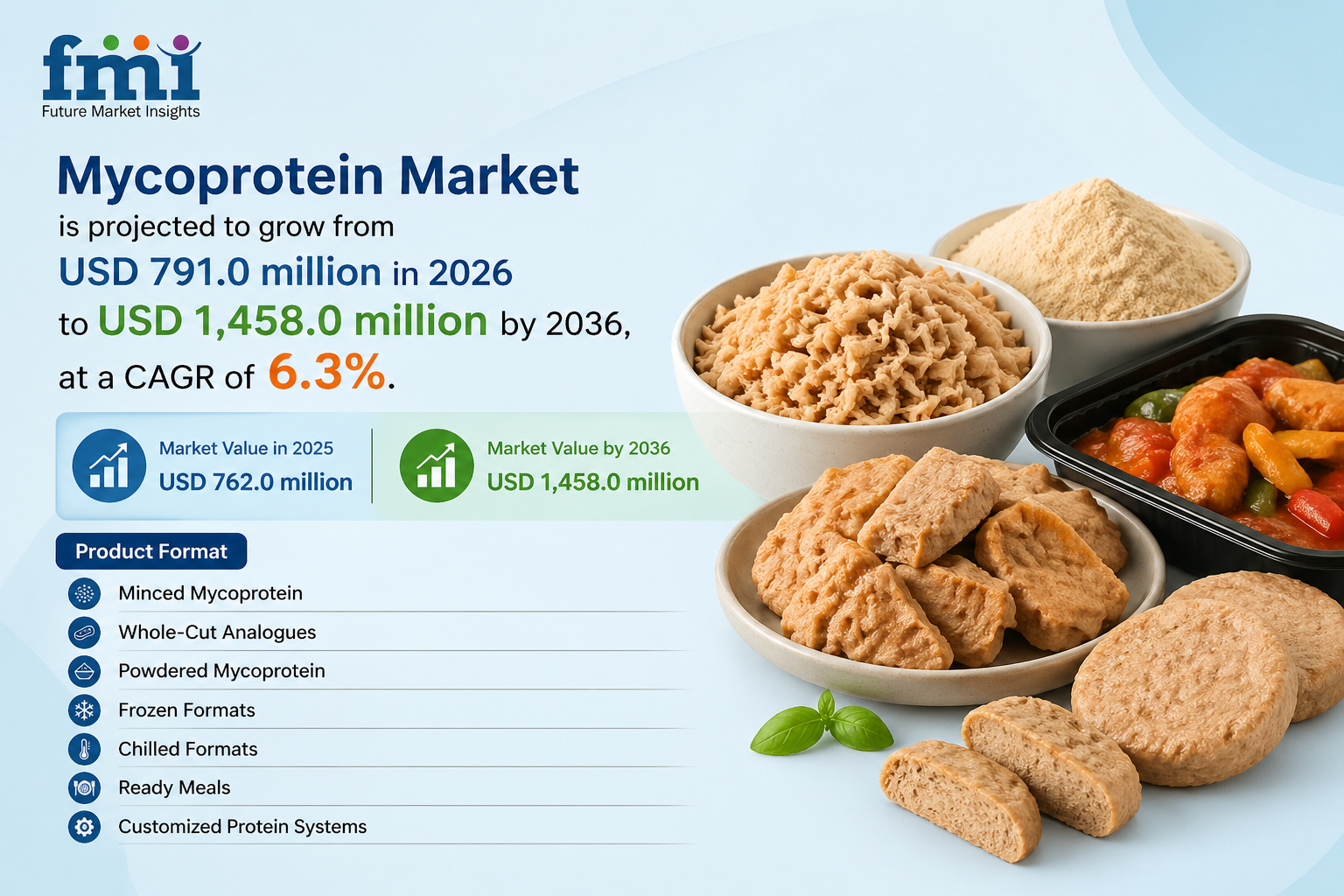
Market Size and Forecast: Steady Growth with Industrial Backing
The mycoprotein market is projected to grow from USD 791.0 million in 2026 to USD 1,458.0 million by 2036, reflecting a steady 6.3% CAGR. While not explosive, this growth trajectory signals durability-particularly for a category already embedded in retail and supported by decades of fermentation expertise.
The USD 667.0 million incremental opportunity underscores a shift from early-stage experimentation toward scaled commercialization. Unlike newer alternative proteins still navigating regulatory or technical hurdles, mycoprotein benefits from an established production base and proven consumer use cases.
Growth Drivers: Fermentation Investment Meets Consumer Familiarity
Three structural forces are shaping market expansion:
1. Industrial fermentation capacity is catching up with ambition.
Public and private investments-exceeding USD 200 million globally-are strengthening the backbone required for large-scale fungi protein production. Facilities, utilities, and co-location models are improving cost structures and accelerating time-to-market.
2. Meat alternative demand has matured.
With downstream markets already at industrial scale in regions like Europe, mycoprotein is benefiting from existing demand for structured, meat-like textures-something many plant proteins still struggle to deliver.
3. Product diversification is unlocking new occasions.
Recent launches in yogurt, bacon analogues, and snack formats signal a shift beyond frozen entrées. This broadens relevance across dayparts and reduces reliance on a single category narrative.
Market Challenges: Economics and Education Still Matter
Despite progress, two constraints remain central:
Cost and scale discipline.
Fermentation sits in a challenging middle ground-technically viable but not always cost-competitive at scale. Yield optimization, feedstock efficiency, and downstream processing remain critical.
Consumer understanding gap.
Awareness of fungi-based proteins lags behind trial willingness. While many consumers accept the product after explanation, unclear labeling or unfamiliar terminology can slow first-time purchases.
Opportunity Landscape: Ingredient Expansion and Hybrid Formats
The next growth wave is likely to come from B2B ingredient integration. Food manufacturers are increasingly exploring mycoprotein for:
Protein fortification
Satiety enhancement
Texture improvement in blended products
Hybrid applications-combining mycoprotein with plant or animal proteins-also present a pragmatic route to scale without requiring full dietary shifts.
Segmentation Insights: Where Value Is Concentrated
Product Format:
Minced mycoprotein leads with a 30% share due to its versatility across burgers, nuggets, and ready meals. It remains the easiest format to scale and integrate.
End Use:
Meat alternatives dominate at 28%, reflecting the category's strongest product-market fit in replicating meat texture.
Sales Channel:
Retail supermarkets account for 26%, reinforcing the importance of shelf visibility and habitual purchasing behavior.
Production Technology:
Biomass fermentation commands 68%, highlighting its dominance as the most scalable production method.
Storage Format:
Frozen products lead with 46%, driven by distribution efficiency and shelf-life advantages.
Consumption Occasion:
Main meals represent 49%, indicating that mycoprotein remains primarily a lunch and dinner solution rather than a snack or supplement.
Speak to Analyst: Customize insights for your business strategy: https://www.futuremarketinsights.com/customization-available/rep-gb-14826
Regional Analysis: UK Leads, China Builds, US Experiments
United Kingdom (6.4% CAGR):
A combination of strong research funding and long-standing consumer familiarity makes the UK the most mature and commercially prepared market.
China (6.0% CAGR):
Growth is infrastructure-led, with significant biotechnology investments supporting fermentation capacity. Localization will be key to adoption.
United States (5.8% CAGR):
Consumer openness is high, but familiarity is still developing. Premium retail channels are driving early-stage growth.
Germany and France (5.4% and 5.2% CAGR):
Established meat-alternative ecosystems provide a stable base for incremental adoption.
South Korea and Japan (5.0% and 4.6% CAGR):
Growth is supported by structured R&D programs, though commercialization remains in earlier stages.
Competitive Landscape: Scale vs. Specialization
The market remains moderately concentrated, with Quorn Foods maintaining a strong lead due to its retail presence and brand recognition. However, the competitive field is widening:
ENOUGH is strengthening ingredient supply through partnerships and industrial-scale production.
Nature's Fynd is expanding into dairy-adjacent categories, redefining category boundaries.
MyForest Foods is differentiating through whole-cut formats like mycelium bacon.
Naplasol and Infinite Roots are building regional and ingredient-focused strategies.
The Better Meat Co. is leveraging regulatory progress to expand B2B adoption.
The competitive divide is increasingly defined by fermentation scale readiness and channel access, rather than just product innovation.
Strategic Implications for Decision-Makers
Invest in scale early: Fermentation economics improve significantly with volume and infrastructure integration.
Prioritize format familiarity: Products that align with existing cooking habits outperform technically superior but unfamiliar formats.
Expand beyond retail: Ingredient supply and foodservice channels offer underexploited growth pathways.
Balance innovation with clarity: Scientific credibility must be matched with clear consumer communication.
Future Outlook: From Alternative to Integrated Protein
Mycoprotein is unlikely to remain a niche "alternative" protein. Instead, it is evolving into a functional ingredient platform that can serve multiple food categories-from meat substitutes to dairy analogues and hybrid formulations.
As fermentation capacity scales and product formats diversify, the category's success will depend less on novelty and more on price parity, taste consistency, and supply reliability.
Unlock 360° insights for strategic decision making and investment planning: https://www.futuremarketinsights.com/checkout/14826
Executive Takeaways
The mycoprotein market is transitioning from early adoption to scalable growth, supported by fermentation infrastructure and retail familiarity.
A USD 667.0 million incremental opportunity signals steady, not speculative, expansion.
Minced formats, meat alternatives, and retail channels remain the commercial backbone.
Regional growth is led by the UK, while China and the US represent high-potential but structurally different opportunities.
Competitive advantage is shifting toward companies that can combine fermentation scale, product clarity, and channel execution.
In a protein landscape often driven by hype cycles, mycoprotein's trajectory stands out for its relative stability-grounded in industrial capability, evolving consumer acceptance, and a widening range of real-world applications.
Related Reports:
Fermented Mycoprotein Market: https://www.futuremarketinsights.com/reports/fermented-mycoprotein-market
Protein Hydrolysate Ingredient Market: https://www.futuremarketinsights.com/reports/protein-hydrolysate-ingredient-market
Protein Ingredients Market: https://www.futuremarketinsights.com/reports/protein-ingredient-market
Protein Condiments Market: https://www.futuremarketinsights.com/reports/protein-condiments-market
About Future Market Insights (FMI)
Future Market Insights (FMI) delivers actionable, decision-maker-focused research, offering deeper insights beyond traditional market data. Its reports include:
Pricing and cost benchmarking
Consumer behavior and procurement analysis
Supply chain intelligence
Technology and trend forecasting
FMI combines industry expertise with real-world data inputs to provide practical, validated, and business-ready insights, helping organizations make informed strategic decisions in evolving global markets.
For Press & Corporate Inquiries:
Rahul Singh
AVP - Marketing and Growth Strategy
Future Market Insights, Inc.
+91 8600020075
For Sales - sales@futuremarketinsights.com
For Media - Rahul.singh@futuremarketinsights.com
For web - https://www.futuremarketinsights.com/
SOURCE: Future Market Insights, Inc.
View the original press release on ACCESS Newswire