Rising demand for sub-zero battery efficiency, advanced thermal management systems, and OEM-integrated solutions accelerates market growth at a CAGR of 12.0%
NEWARK, DE / ACCESS Newswire / April 30, 2026 / According to the latest analysis by Future Market Insights, the global cold-climate optimized EV battery systems market is entering a strong growth phase as electric vehicle adoption expands into northern and extreme-weather regions. Automakers and fleet operators are increasingly prioritizing battery systems engineered for reliable sub-zero performance, improved charging efficiency, and minimized winter range loss.
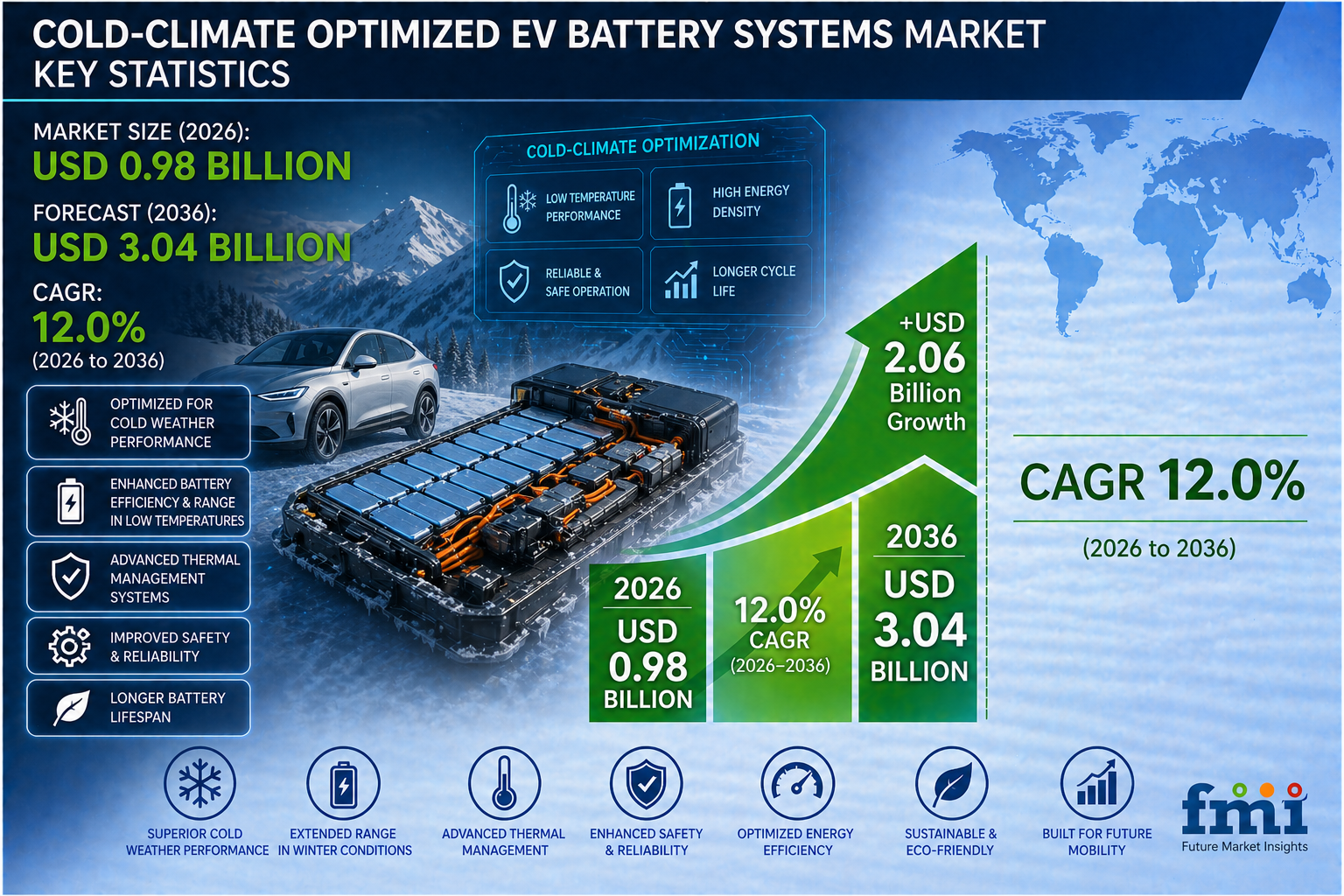
Valued at USD 0.88 billion in 2025, the market is projected to reach USD 0.98 billion in 2026 and grow significantly to USD 3.04 billion by 2036, registering a CAGR of 12.0% during the forecast period. This represents an incremental opportunity of USD 2.06 billion.
This growth reflects the increasing importance of thermal management, battery heating systems, and integrated pack-level engineering as EV deployment expands into colder geographies where performance reliability directly impacts user adoption and fleet economics.
Quick Stats: Cold-Climate Optimized EV Battery Systems Market
Market Value (2025): USD 0.88 billion
Estimated Market Value (2026): USD 0.98 billion
Forecast Market Value (2036): USD 3.04 billion
CAGR (2026-2036): 12.0%
Incremental Opportunity: USD 2.06 billion
Leading Chemistry: NMC Batteries (38% share)
Leading Thermal Architecture: Liquid-Cooled Systems (56% share)
Leading Application: Passenger EVs (62% share)
Leading Sales Channel: OEM Line-Fit (71% share)
Fastest Growing Market: Canada (12.6% CAGR)
Key Growth Driver: Rising EV adoption in cold and seasonal climates requiring enhanced battery thermal performance
Major Players: CATL, LG Energy Solution, Samsung SDI, Panasonic Energy, BorgWarner, Gentherm, Hanon Systems
Get detailed market forecasts, competitive benchmarking, and pricing trends:
https://www.futuremarketinsights.com/reports/sample/rep-gb-32932
Market Value Analysis: Cold-Weather Performance Drives System Innovation
Between 2026 and 2030, demand for cold-climate optimized EV battery systems is expected to accelerate as automakers expand EV offerings across regions with harsh winters and variable temperature conditions.
Organizations are increasingly focusing on:
Integration of battery heating and pre-conditioning systems at pack level
Adoption of liquid-cooled thermal architectures for stable temperature control
Development of low-temperature charging optimization technologies
Enhancement of battery management systems (BMS) for cold performance
Deployment of insulation and thermal routing systems to reduce energy loss
Failure to incorporate cold-weather optimization may result in reduced driving range, slower charging speeds, and increased operational inefficiencies, particularly in fleet and commercial EV applications.
From 2030 to 2036, growth will be driven by fleet electrification, expansion into northern markets, and increased OEM investment in integrated thermal systems.
Technology Evolution: Thermal Management and Battery Engineering Lead Innovation
The evolution of cold-climate EV battery systems is being shaped by advancements in battery chemistry, thermal engineering, and integrated system design.
Key innovations include:
Advanced battery heating systems for sub-zero startup performance
Liquid cooling circuits for consistent temperature regulation
Low-temperature BMS algorithms for optimized charging and discharge
Integration of thermal plates, insulation layers, and coolant pathways
Development of next-generation chemistries with improved cold tolerance
A key challenge remains balancing performance, cost, and weight, as additional thermal components increase system complexity and development time.
An industry analyst notes:
"Cold-climate battery optimization is no longer optional-it is becoming a core requirement as EV adoption expands into regions where winter performance directly impacts usability and customer satisfaction."
Cold-Climate Battery Systems Become Critical to EV Adoption
As EV adoption spreads globally, cold-weather performance is emerging as a decisive factor in vehicle design and customer acceptance.
Core capabilities include:
Improved winter driving range stability
Faster and more reliable cold-weather charging
Enhanced battery durability and lifecycle performance
Reduced energy loss due to heating inefficiencies
Better fleet uptime and operational reliability
This transition is positioning cold-climate battery systems as a strategic component in next-generation EV platforms.
Speak to Analyst: Customize insights for your business strategy:
https://www.futuremarketinsights.com/customization-available/rep-gb-32932
Segment Spotlight
Liquid-Cooled Systems Lead Thermal Architecture (56%)
Driven by superior heat transfer efficiency and compatibility with high-performance EV platforms.
Passenger EVs Lead Application Segment (62%)
Supported by widespread adoption of personal and corporate electric vehicles in cold regions.
OEM Line-Fit Leads Sales Channel (71%)
Reflecting strong demand for factory-integrated, validated cold-weather battery systems.
NMC Batteries Lead Chemistry Segment (38%)
Favored for their strong low-temperature performance and established use in premium EV platforms.
Regional Insights: Cold Regions and EV Growth Drive Market Expansion
The market is expanding globally, supported by increasing EV penetration in cold climates and growing demand for winter-ready vehicle performance.
Country |
CAGR (2026-2036) |
Key Growth Drivers |
|---|---|---|
Canada |
12.6% |
Harsh winters and expanding EV adoption |
China |
12.0% |
Large-scale EV production and northern region demand |
United States |
11.4% |
Fleet electrification and cold-region usage |
Norway |
10.8% |
High EV penetration and strict zero-emission policies |
Sweden |
10.6% |
Strong EV adoption and cold-weather conditions |
Finland |
10.2% |
Long-distance winter driving requirements |
Japan |
9.4% |
Gradual EV adoption and selective cold-region demand |
Regional growth reflects differences in climate severity, EV adoption rates, and policy support for electrification.
Opportunities: Thermal Integration and Fleet Electrification Unlock Growth
Key opportunities shaping the market include:
Expansion of integrated thermal battery systems
Growing demand from commercial fleets in cold regions
Development of advanced battery chemistries for low temperatures
Increasing focus on pack-level system integration
Adoption of AI-driven battery management and predictive thermal control
These opportunities are enabling manufacturers to enhance EV performance, reduce energy losses, and improve customer satisfaction in cold climates.
Competitive Landscape: Integration Capability and Thermal Expertise Define Leadership
The market remains moderately concentrated, with competition driven by battery technology expertise, thermal integration capability, and OEM partnerships.
Leading companies include:
CATL
LG Energy Solution
Samsung SDI
Panasonic Energy
BorgWarner
Gentherm
Hanon Systems
Competitive differentiation is driven by:
Advanced battery chemistry and pack design capabilities
Strong thermal management system integration
Long-term OEM program partnerships
Expertise in low-temperature validation and testing
Scalable manufacturing and global supply chain presence
Future Outlook: Cold-Weather Optimization Becomes Standard in EV Design
Looking ahead to 2036, cold-climate optimized EV battery systems will become increasingly essential as EV adoption expands into diverse and extreme environmental conditions.
Key trends include:
Wider adoption of integrated battery heating and cooling systems
Growth in AI-driven battery management and thermal optimization
Increased focus on low-temperature charging efficiency
Expansion of fleet-oriented winter-ready EV platforms
Greater integration of battery, HVAC, and energy management systems
As automakers continue prioritizing performance reliability, efficiency, and user experience, cold-climate battery systems will play a critical role in shaping the next phase of global EV adoption.
Unlock 360° insights for strategic decision making and investment planning:
https://www.futuremarketinsights.com/checkout/32932
Browse More Automotive Industry Reports:
SCR Dosing Control Modules Market - https://www.futuremarketinsights.com/reports/scr-dosing-control-modules-market
Hybrid Vehicles Market - https://www.futuremarketinsights.com/reports/global-hybrid-vehicles-market
Cars Market - https://www.futuremarketinsights.com/reports/cars-market
Machine Condition Monitoring Market - https://www.futuremarketinsights.com/reports/machine-condition-monitoring-market
Aerial Firefighting Market - https://www.futuremarketinsights.com/reports/aerial-firefighting-market
About Future Market Insights (FMI)
Future Market Insights (FMI) is a leading provider of market intelligence and consulting services, serving clients in over 150 countries. Headquartered in Delaware, USA, with a global delivery center in India and offices in the UK and UAE, FMI delivers actionable insights to businesses across industries including automotive, technology, consumer products, manufacturing, energy, and chemicals.
An ESOMAR-certified research organization, FMI provides custom and syndicated market reports and consulting services, supporting both Fortune 1,000 companies and SMEs. Its team of 300+ experienced analysts ensures credible, data-driven insights to help clients navigate global markets and identify growth opportunities.
For Press & Corporate Inquiries
Rahul Singh
AVP - Marketing and Growth Strategy
Future Market Insights, Inc.
+91 8600020075
For Sales - sales@futuremarketinsights.com
For Media - Rahul.singh@futuremarketinsights.com
For web - https://www.futuremarketinsights.com/
SOURCE: Future Market Insights, Inc.
View the original press release on ACCESS Newswire