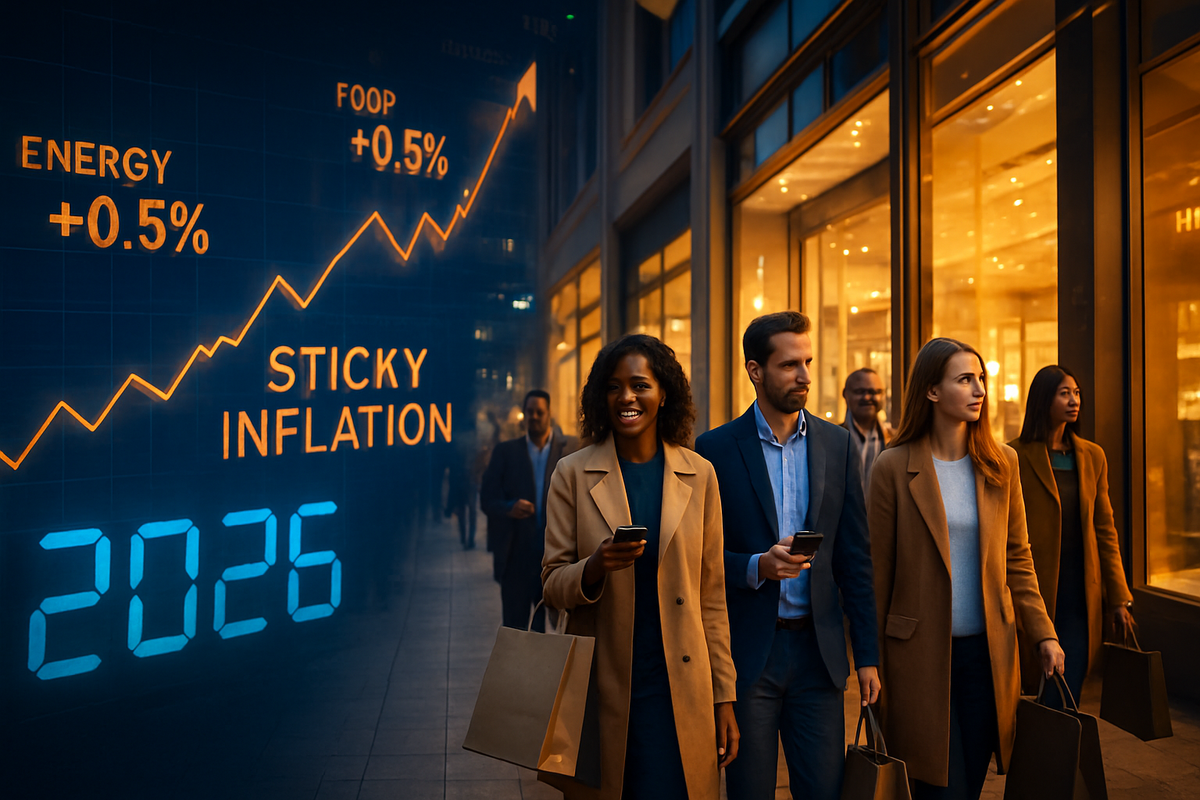
As of mid-April 2026, the U.S. economy presents a striking paradox that has confounded traditional economic models. Despite headline inflation climbing to 3.3% in March and the Federal Reserve maintaining a "higher-for-longer" interest rate stance, the American consumer remains an unstoppable force. Retail sales figures released earlier this month show a resilient 0.6% month-over-month jump, signaling that the primary engine of the U.S. Gross Domestic Product (GDP)—consumer spending—is not only intact but accelerating in key sectors.
This resilience is increasingly being termed "The Great Decoupling," where household spending habits have detached from the negative sentiment typically associated with "sticky" inflation and a cooling labor market. While the unemployment rate has ticked up to 4.3%, the combination of record-high household net worth and a massive wave of tax-related liquidity has provided a buffer that continues to propel the markets forward.
The Q1 Surge: Tax Refunds and Tariff Front-Loading
The first quarter of 2026 has been characterized by a unique confluence of fiscal and trade-related drivers. According to data from the National Retail Federation (NRF), total retail sales for the year are now projected to reach $5.6 trillion. This momentum was largely fueled by the "Working Families Tax Cut Act" and the "One Big Beautiful Bill Act" (OBBBA), both enacted in mid-2025. These legislative measures expanded the SALT deduction cap to $40,000 and introduced retroactive tax relief for tips and overtime. By February and March 2026, these provisions translated into massive tax refunds—averaging between $2,900 and $3,750 per filer—which hit bank accounts just as energy prices began to spike due to renewed Middle East tensions.
Furthermore, consumer behavior in early 2026 has been influenced by "front-loading" tactics. With significant new tariffs scheduled for late April, both businesses and proactive consumers surged their purchases of electronics, clothing, and durable goods in Q1. This "buy now to save later" mentality helped offset the 0.9% month-over-month increase in the March Consumer Price Index (CPI). While the Federal Reserve remains concerned about core PCE hovering near 2.9%, the immediate liquidity from tax cuts has effectively neutralized the "sticker shock" at the pump and the grocery store for many households.
The Retail Giants and the Payment Powerhouses
The winners in this high-inflation, high-spending environment are those who have mastered the "value-convenience" axis. Walmart Inc. (NYSE: WMT) and Costco Wholesale Corp. (NASDAQ: COST) have emerged as the primary beneficiaries of a "K-shaped" spending pattern. Walmart recently reported a 29% surge in earnings, driven significantly by a growing demographic of high-income shoppers (households earning over $100,000) who are trading down from specialty grocers to find value. Similarly, Costco’s membership renewals have hit record highs as consumers lean into bulk purchasing to hedge against future price increases.
The digital frontier is dominated by Amazon.com, Inc. (NASDAQ: AMZN), which as of early 2026, has officially surpassed Walmart in total annual retail revenue. Amazon now captures 11.1% of all U.S. retail spending, bolstered by its integration of "agentic commerce"—AI-driven tools that automatically replenish household essentials. On the financial infrastructure side, Visa Inc. (NYSE: V) and Mastercard Inc. (NYSE: MA) have reported Q1 revenue growth of 15% and 18%, respectively. These payment giants are benefiting from a shift toward service-based spending and "experience-first" travel, with cross-border transaction volumes rising 14% year-over-year. However, the "losers" in this environment are traditional mid-tier discretionary retailers and luxury brands that lack a strong value proposition, as middle-class budgets are increasingly swallowed by essential services and energy costs.
A New Pillar of Support: The $181 Trillion Wealth Effect
The broader significance of the 2026 spending boom lies in the total transformation of household balance sheets. While the pandemic-era excess savings that dominated 2021-2023 have finally been exhausted, they have been replaced by a staggering "Wealth Effect." U.S. household net worth reached a record $181.6 trillion at the start of this year, driven by a $13 trillion appreciation in equity and real estate values over the last eighteen months. For the top 20% of households—who now account for more than 60% of total consumer outlays—the fluctuations in the labor market are secondary to the performance of their investment portfolios.
This creates a complex challenge for the Federal Reserve. Historically, the Fed would use higher interest rates to cool consumer demand and bring inflation down to its 2% target. However, in 2026, the wealth effect is so potent that even 5%+ interest rates have failed to meaningfully dampen spending among the affluent. This has led to a "higher-for-longer" interest rate environment that disproportionately affects lower-income renters and those with variable-rate debt, deepening the divide between the asset-owning class and the rest of the economy. This policy divergence is likely to remain a central theme in the upcoming 2026 midterm elections.
Navigating the Second Half: Risks and Strategic Pivots
Looking ahead to the remainder of 2026, the primary question is whether this momentum can survive the cooling labor market. While March saw a surprising 178,000 jobs added, the "low-hire, low-fire" environment suggests that wage growth (currently at 3.5%) is barely keeping pace with headline inflation. If energy prices continue their upward trajectory following recent geopolitical shocks, the "financial breathing room" provided by the 2025 tax cuts will eventually evaporate. Investors should expect a strategic pivot from retailers toward even more aggressive loyalty programs and AI-integrated personalized pricing to capture the dwindling discretionary dollars of the bottom 40% of earners.
In the short term, the market will be hyper-focused on the late-April tariff implementation. If these tariffs lead to a second wave of cost-push inflation, the Fed may be forced to consider a "terminal rate" higher than any analyst projected at the start of the year. Conversely, if the front-loading of goods leads to an inventory glut in Q3, we could see a period of aggressive discounting that finally breaks the back of sticky inflation, albeit at the cost of corporate profit margins.
Summary for the Forward-Looking Investor
The U.S. consumer in April 2026 is a study in contradictions: burdened by 3.3% inflation and high interest rates, yet buoyed by $181 trillion in net worth and fresh fiscal stimulus. The key takeaway for the market is that consumer spending is no longer a monolith. It is a bifurcated engine where the top tier is driven by asset appreciation and the bottom tier is sustained by strategic value-seeking and temporary tax relief.
Moving forward, investors should keep a close watch on real wage growth and monthly PCE deflators. The resilience seen today is real, but it is increasingly dependent on the stability of the housing and equity markets. As long as the "Wealth Effect" remains intact and the tax-cut liquidity continues to circulate, consumer spending will likely remain the primary floor preventing a broader economic recession. However, with the "front-loading" boost about to end and tariffs beginning to bite, the true test of the 2026 consumer will arrive in the summer months.
This content is intended for informational purposes only and is not financial advice.