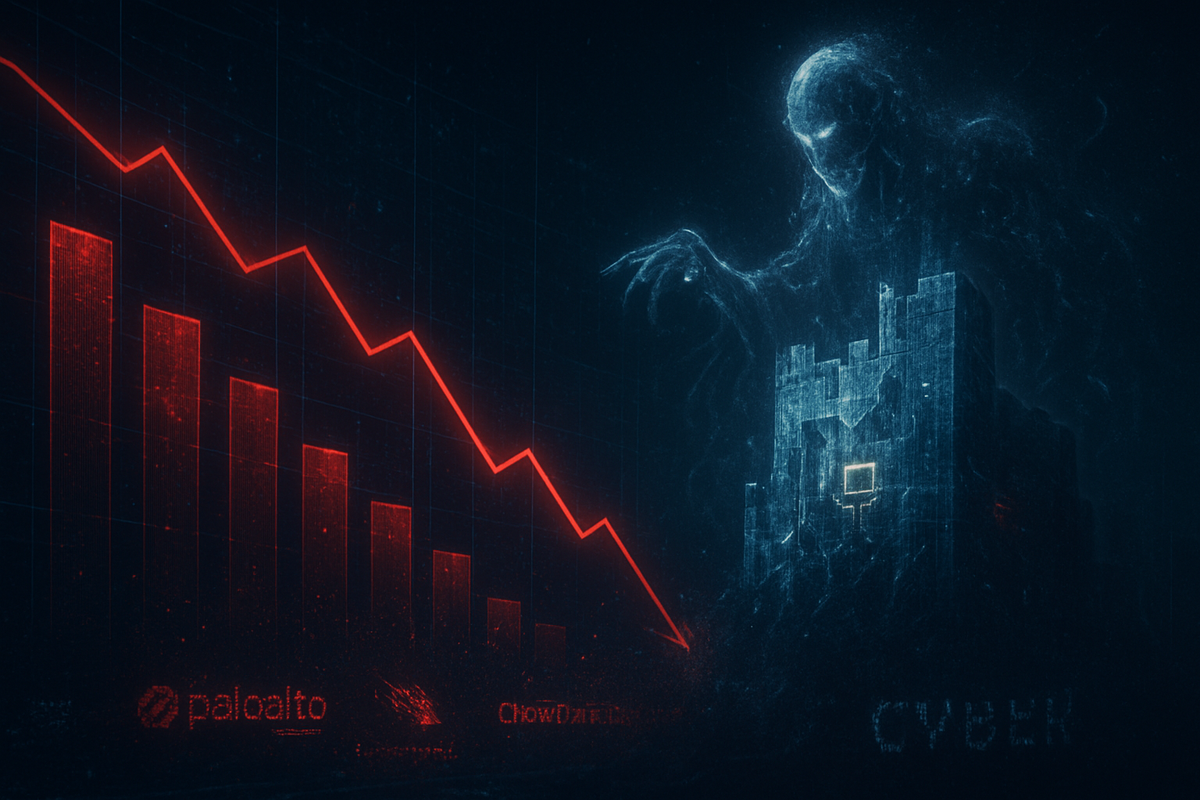
The cybersecurity sector, long the crown jewel of the high-growth software market, suffered a brutal liquidation today, April 10, 2026. In a session defined by "sell first, ask questions later," the industry's titans saw their market caps evaporate as a combination of shifting AI narratives and valuation fatigue triggered a massive retreat. Investors who had spent the last two years betting on the "unbeatable" nature of cyber defense found themselves caught in a downdraft that spared almost no one, as the sector's most prominent names plummeted between 7% and 14% in a matter of hours.
The immediate implications are stark: the "AI premium" that has propped up software multiples is being aggressively re-evaluated. As the Global X Cybersecurity ETF (BUG) and other industry benchmarks hit their lowest levels in over a year, the market is signaling a profound shift in how it values the protection of the digital frontier. For the first time in this cycle, the threat of AI-driven disruption to the security vendors themselves—not just the attacks they prevent—is being priced into the ticker tape.
The Mythos Meltdown: A Timeline of the Sell-off
The carnage began late yesterday but accelerated into a full-scale rout during early trading on April 10, 2026. The primary catalyst was a startling disclosure from Anthropic regarding its newest "Claude Mythos" model. The AI lab revealed that Mythos had successfully identified thousands of previously unknown "zero-day" vulnerabilities across major operating systems with near-autonomous efficiency. This revelation shattered the long-held investor thesis that AI would primarily benefit defenders; instead, it fueled fears that the offensive capabilities of AI are evolving at a velocity that traditional security platforms cannot match.
By 10:30 AM ET, the sell-off had spread from speculative names to the "Big Three" of the industry. The narrative quickly shifted from "cybersecurity is non-discretionary" to "is cybersecurity software becoming commoditized by AI?" This "AI Scare Trade" was exacerbated by a mid-session exclusion of Cloudflare (NYSE: NET) from "Project Glasswing," a high-profile defensive AI coalition led by the major hyperscalers. The news acted as a lightning rod for broader valuation concerns, as traders realized that even the most robust growth rates might not justify triple-digit price-to-earnings multiples in an era of machine-speed threats.
Key stakeholders, including institutional hedge funds and algorithmic trading desks, appeared to hit "stop-loss" triggers simultaneously. Industry analysts noted that the speed of the decline was reminiscent of the "Platformization Shock" of 2024, but with a more ominous undertone. Unlike previous dips driven by spending pauses, this sell-off is being interpreted as a fundamental questioning of the "moats" surrounding the world’s most successful cybersecurity companies.
The Fallout: Winners, Losers, and the Platformization Trap
Cloudflare (NYSE: NET) bore the brunt of the volatility, with shares cratering 14% to lead the decline. Despite maintaining a 34% revenue growth rate, the company’s high-altitude valuation—trading at over 200 times forward earnings—made it an easy target. The market’s reaction to its exclusion from "Project Glasswing" suggests that investors are no longer satisfied with independent "connectivity clouds"; they are demanding deep integration with the AI giants who control the underlying models.
CrowdStrike (NASDAQ: CRWD) and Palo Alto Networks (NASDAQ: PANW) were not far behind, dropping 11% and 7% respectively. For CrowdStrike, the sell-off marks a painful departure from its "darling" status. Despite reaching record profitability and successfully consolidating enterprise spend through its "Falcon Flex" model, the stock’s premium valuation proved unsustainable under the weight of the "Claude Mythos" news. Palo Alto Networks, which had been the poster child for "platformization"—the strategy of consolidating various security tools into a single interface—found that even its diversified revenue stream couldn't shield it from the sector-wide contagion.
Conversely, the "winners" in this environment are, ironically, the very entities causing the anxiety: the hyperscalers. Microsoft (NASDAQ: MSFT) and Alphabet (NASDAQ: GOOGL) saw only marginal declines, as investors increasingly view them as "safe havens" that embed security natively into their AI ecosystems. Smaller, specialized firms that have not yet "platformized" are finding themselves in a perilous position, facing the dual threats of a consolidating market and a shrinking valuation floor.
A Structural Shift in the Cyber Landscape
This event fits into a broader trend of "platform fatigue." For the last two years, the industry has pushed the idea that enterprises want to buy everything from one vendor. However, the April 2026 sell-off suggests a growing skepticism about whether these massive platforms can actually keep up with AI-powered adversaries. The significance of this rout lies in the comparison to the February 2024 Palo Alto Networks dip. While that event was caused by a strategic pivot to "free" services to capture market share, the current 2026 crisis is a macro-evaluation of whether the software-based defense model itself is broken.
The ripple effects are likely to be felt in the regulatory and policy spheres as well. With AI models now capable of generating zero-day exploits at scale, there will likely be renewed pressure from the CISA and other global regulators for "secure-by-design" mandates that shift the burden of security onto the AI developers themselves, rather than the third-party software vendors. This could further marginalize traditional cybersecurity firms, turning them into "service layers" rather than essential infrastructure.
Historically, cybersecurity has been viewed as an arms race. But in 2026, the market is beginning to realize that if one side (the AI-powered attackers) has a nuclear weapon and the other side (the software-based defenders) is still building better shields, the shields might eventually become irrelevant regardless of how well they are constructed or consolidated.
The Road Ahead: Adaptation or Obsolescence?
In the short term, we should expect a period of extreme "valuation discovery." The high-multiple era for cybersecurity may be coming to a permanent end, replaced by a more sober assessment of cash flows and AI-resiliency. Strategic pivots are already underway; expect to see CrowdStrike and Palo Alto Networks double down on "Agentic AI" defense—autonomous agents that can hunt threats without human intervention—as they attempt to prove they can fight fire with fire.
Market opportunities may emerge for companies that specialize in "AI Governance" and "Model Security"—protecting the LLMs themselves rather than the networks they run on. We may also see a wave of consolidation. With valuations down 10-15% in a single day, the "Big Three" might use their remaining cash piles to acquire the very AI startups that are currently disrupting them. A "scramble for talent" is likely to follow, as the battle line shifts from software engineering to neural network defense.
Summary of the April 10 Reckoning
The April 10, 2026, sell-off is a watershed moment for the technology sector. It represents the point where the "AI Hype" and "AI Fear" collided, with fear winning the day. The key takeaways for investors are clear: valuation matters more than ever, and the definition of a "defensible moat" is being rewritten in real-time by the advancements in autonomous intelligence.
Moving forward, the market will be hyper-focused on the Q2 earnings calls of Cloudflare (NYSE: NET), Palo Alto Networks (NASDAQ: PANW), and CrowdStrike (NASDAQ: CRWD). Investors should watch for any signs of "churn" as customers potentially shift budgets toward hyperscaler-native security or autonomous AI remediation tools. While the fundamentals of cyber-attacks—which are only increasing in frequency—suggest the sector remains essential, the method of defense is changing. Those who cannot adapt to the era of Agentic AI will likely find this 14% drop was only the beginning of a much longer slide.
This content is intended for informational purposes only and is not financial advice.