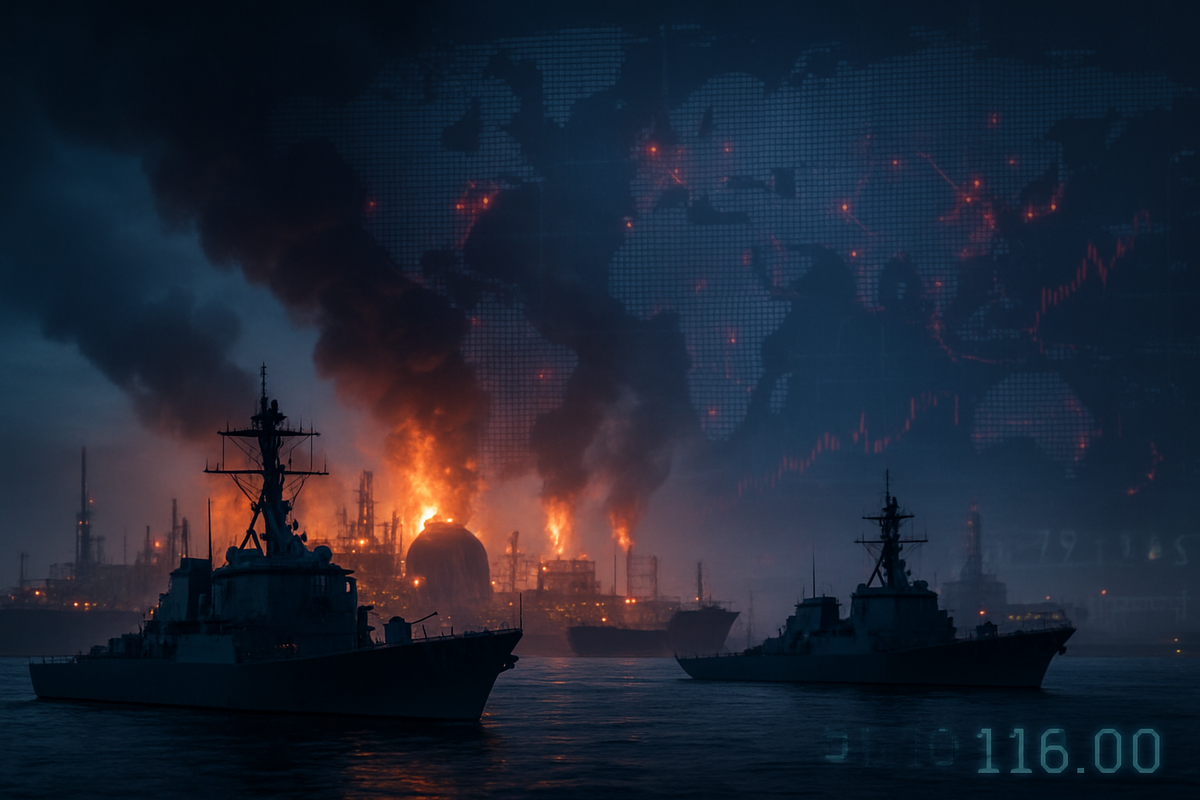
Global energy markets were thrust into a state of high-intensity volatility today, March 19, 2026, as Brent Crude oil prices surged by 8%, briefly touching $116 per barrel. The dramatic spike follows a series of devastating military strikes on critical energy infrastructure in the Persian Gulf, specifically targeting Iran’s South Pars gas field and Qatar’s Ras Laffan industrial complex. The escalation marks a turning point in the long-simmering tensions between the US-Israel alliance and Iran, as "Operation Epic Fury"—a massive joint military campaign—commenced in the early hours of the morning.
The immediate implications of these strikes are profound, as the Strait of Hormuz, the world’s most vital artery for oil and liquefied natural gas (LNG), has seen traffic ground to a near-halt. Iranian naval assets, in a direct retaliatory move, have reportedly deployed sea mines and fast-attack craft to disrupt tanker transit, effectively choking off 20% of the world’s daily oil supply and 20% of global LNG trade. Traders are now pricing in a sustained "war premium," fearing that the damage to infrastructure and the closure of the Strait could lead to a protracted period of energy scarcity not seen in decades.
Precision Strikes and Naval Blockades: A Timeline of Escalation
The crisis began at approximately 04:00 local time when a wave of precision-guided munitions struck the South Pars gas field, the bedrock of Iran's domestic energy production. Preliminary reports indicate significant damage to extraction platforms and processing hubs that provide nearly 80% of Iran’s natural gas. Shortly thereafter, at 05:30, explosions were reported at the Ras Laffan facility in Qatar. While Qatar has traditionally maintained a neutral stance, the proximity of its North Field—which it shares with Iran—has made its infrastructure a casualty of the widening theater of war. The destruction at Ras Laffan, the world's premier LNG export hub, has sent shockwaves through European and Asian markets that rely heavily on Qatari gas for electricity and heating.
This military escalation is the culmination of "Operation Epic Fury," a multi-domain campaign launched by US and Israeli forces aimed at neutralizing Iranian strategic assets. The operation was reportedly triggered by intelligence suggesting an imminent Iranian-backed offensive against regional interests. In the hours following the initial strikes, the Iranian leadership announced a "total blockade" of the Strait of Hormuz, declaring it a "forbidden zone" for any vessels cooperating with Western powers.
The timeline of today's events saw Brent Crude jump from its opening price of $107 per barrel to over $116 in less than four hours of trading. Initial market reactions were panicked, with energy futures hitting limit-up levels in several exchanges. Beyond the price of raw crude, the cost of maritime insurance for tankers in the Gulf has increased tenfold, with most major shipping lines ordering their fleets to drop anchor in safe waters outside the Gulf of Oman.
Corporate Impact: Energy and Defense Gains vs. Transport Losses
The immediate beneficiaries of the price surge are the global energy majors, who stand to see massive windfall profits from the spike in commodity prices. ExxonMobil (NYSE: XOM) and Chevron (NYSE: CVX) both saw their stock prices jump by more than 6% in early trading, as investors bet on the increased value of their non-Middle Eastern assets. Shell (NYSE: SHEL) and BP (NYSE: BP), while also seeing stock gains, face a more complex reality due to their significant historical investments and partnerships in Middle Eastern LNG projects, particularly in Qatar. However, the overall "upstream" advantage of $116 oil is currently outweighing those operational risks in the eyes of the market.
Defense contractors are also seeing a surge in demand as "Operation Epic Fury" underscores the reliance on advanced missile defense and precision strike capabilities. Lockheed Martin (NYSE: LMT) and RTX Corporation (NYSE: RTX) have reported a flurry of activity as Gulf allies seek to replenish their interceptor stockpiles, such as the Patriot and THAAD systems. Northrop Grumman (NYSE: NOC) has also seen increased interest in its autonomous surveillance and drone technology, which is currently being used to monitor Iranian naval movements in the Strait.
Conversely, the transport and logistics sectors are reeling. Airlines, already struggling with high operational costs, are facing a massive spike in jet fuel prices. United Airlines (NASDAQ: UAL) and Delta Air Lines (NYSE: DAL) saw their shares tumble by 7% and 9%, respectively, as the prospect of sustained $110+ oil threatens to erase profit margins for the fiscal year. Global logistics giants like FedEx (NYSE: FDX) are also under pressure, as the cost of international freight is expected to rise sharply, potentially triggering another round of global inflationary pressure.
Beyond the Barrel: Global Policy and Energy Sovereignty
This event signifies a major disruption to the "energy transition" narrative that has dominated the 2020s. While many nations have moved toward renewables, today’s crisis proves that the global economy remains tethered to the fossil fuel heart of the Middle East. The disruption of the South Pars and Ras Laffan facilities isn't just a regional issue; it is a systemic shock to the global supply chain. The sudden loss of Qatari LNG is particularly devastating for European nations that had pivoted away from Russian gas, leaving them with few alternatives as they head toward the next heating season.
The current situation bears a haunting resemblance to the 1973 oil embargo, yet with the added complexity of modern integrated supply chains. Unlike previous decades, the "Operation Epic Fury" campaign represents a shift toward high-intensity, peer-to-peer conflict in a region that houses the world's most critical infrastructure. This could lead to a permanent restructuring of how energy is priced, with "geopolitical risk" no longer being a secondary factor but a primary driver of market valuation.
Regulatory and policy implications are likely to follow rapidly. We may see Western governments tapping into Strategic Petroleum Reserves (SPR) at an unprecedented rate, though the effectiveness of such moves is limited if the Strait of Hormuz remains blocked. There is also the potential for emergency energy rationing policies in Asia—specifically Japan and South Korea—which are almost entirely dependent on the transit through the Strait.
Future Outlook: Volatility, Scarcity, and Strategic Pivots
In the short term, the market will remain in a state of hyper-volatility until the extent of the damage at Ras Laffan and South Pars is fully assessed. If the strikes have permanently disabled cooling units or liquefaction trains, the global LNG market could be undersupplied for years, not months. The military theater is also highly unpredictable; any further escalation that includes strikes on Saudi Arabian or Emirati oil terminals could send Brent toward the $150 mark.
Strategically, this conflict may force a rapid acceleration of domestic energy production in the US and Brazil, as well as an even more desperate push toward nuclear and renewable alternatives. Companies will likely have to adapt by diversifying their supply routes and building more resilient, localized energy grids. The "just-in-time" energy model is effectively dead as of March 19, 2026, replaced by a "just-in-case" model that prioritizes security over cost-efficiency.
Long-term, the scenario of a closed Strait of Hormuz could lead to the permanent relocation of heavy industry away from regions that lack energy sovereignty. Investors should prepare for a landscape where energy prices remain "higher for longer," as the cost of securing maritime routes and rebuilding destroyed infrastructure is factored into every barrel.
Final Assessment: A Global Market Redefined
Today’s events represent a "black swan" moment for the global economy. The jump to $116 Brent is a visceral reaction to the reality that the world’s energy security is far more fragile than many had assumed. The strikes on South Pars and Ras Laffan, combined with the naval blockade in the Strait of Hormuz, have created a dual crisis of supply and transit that has no easy diplomatic or military solution.
The key takeaways for the market are clear: the era of cheap, reliable energy from the Gulf has been interrupted by "Operation Epic Fury." As we move forward, the focus will shift from daily price fluctuations to the broader question of how long the Strait of Hormuz remains impassable. If the blockade persists, the global economy could face a recessionary environment driven by energy-induced inflation.
Investors should watch for two critical indicators in the coming months: the speed of repairs at the Qatari LNG facilities and any sign of de-escalation in the naval theater. Until then, the "war premium" is here to stay, and the energy sector will remain the epicenter of global market movements.
This content is intended for informational purposes only and is not financial advice.