As the financial markets open for the first week of 2026, Advanced Micro Devices, Inc. (NASDAQ: AMD) is commanding the spotlight with a decisive technical breakout that has sent ripples through the technology sector. After a stellar 2025 that saw the stock surge over 80%, AMD is currently trading between $223 and $226, hovering just below a critical psychological and technical resistance level of $227.63. This movement comes as the global semiconductor industry officially enters what analysts are calling the "Trillion-Dollar Era," with total market valuation projected to hit the $1 trillion milestone by year-end.
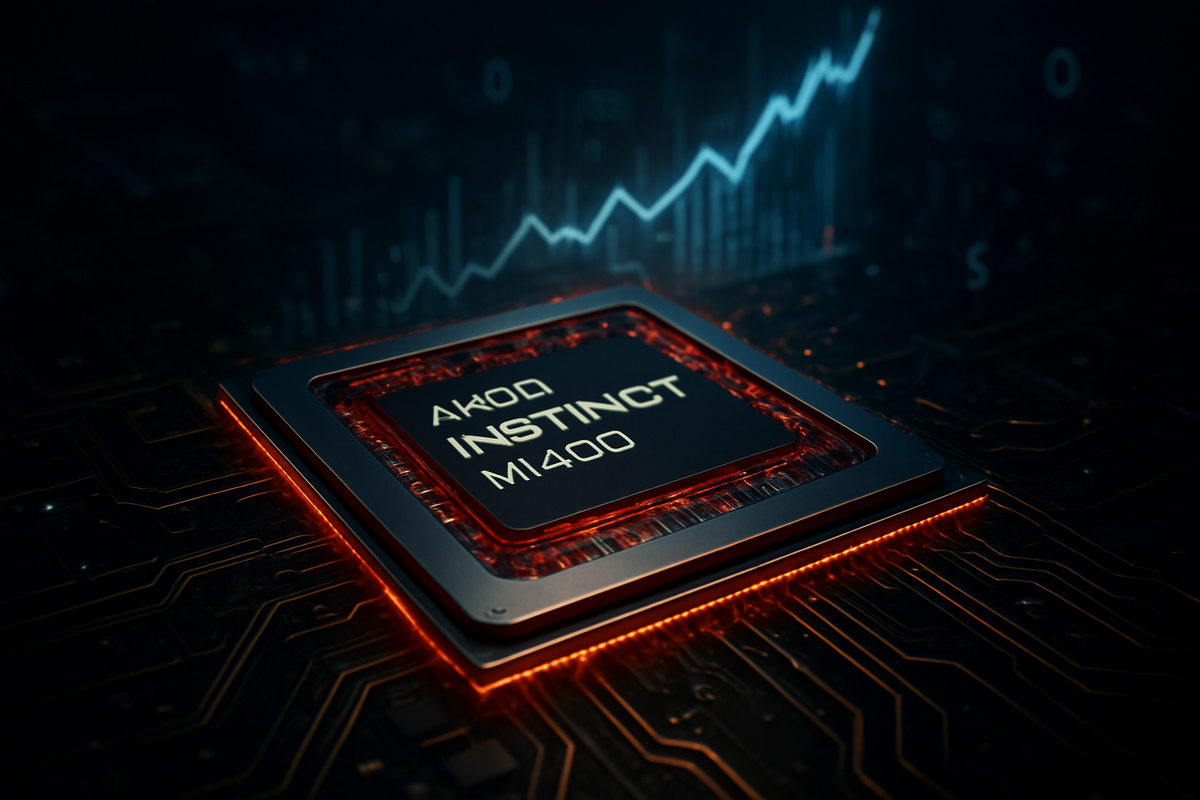
The immediate implications of AMD’s performance are profound. For the first time in the AI era, the "one-horse race" dominated by NVIDIA (NASDAQ: NVDA) appears to be evolving into a true duopoly. With the launch of the Instinct MI400 series and the robust adoption of the "Helios" rack-scale platform, AMD is no longer just a budget-friendly alternative; it is setting the pace for high-bandwidth memory (HBM) integration and AI inference efficiency. Investors are now watching the $227 level closely; a sustained close above this mark could clear the path for a run toward the $270 all-time high.
Technical Foundations and the MI400 Milestone
The technical setup for AMD at the start of 2026 is the result of a multi-month consolidation phase following a volatile mid-2025. After retreating to support levels near $150 last summer, the stock staged a massive recovery fueled by the unveiling of the CDNA 5 architecture. The current price action shows the stock trading well above its 20-day and 200-day moving averages, with the 50-day Simple Moving Average (SMA) at $227.63 acting as the final gatekeeper for a new bullish leg.
The timeline leading to this moment was defined by the late-2025 release of the Instinct MI400X. This accelerator has proven to be a "leapfrog" product, boasting 432GB of HBM4 memory—nearly 1.5 times the capacity of NVIDIA’s initial Rubin-class chips. This massive memory overhead has made AMD the preferred choice for enterprises running "trillion-parameter" Large Language Models, which require immense throughput. Furthermore, a landmark deal with Oracle (NYSE: ORCL) to deploy 50,000 MI400 GPUs starting in the third quarter of 2026 has provided the fundamental "floor" that institutional investors were seeking.
Market reaction to these developments has been overwhelmingly positive. While the Relative Strength Index (RSI) currently sits at a neutral 56, suggesting the stock is not yet overbought, the MACD (Moving Average Convergence Divergence) is beginning to show signs of a bullish crossover. Analysts at major firms like TD Cowen have recently raised their price targets to $290, citing AMD's ability to capture the burgeoning "sovereign AI" market—nations building their own localized AI infrastructure independent of the major US cloud providers.
The Competitive Landscape: Winners and Losers in the AI Shift
In this new landscape, AMD is emerging as a primary winner, successfully eroding NVIDIA's market share from over 90% in 2024 to an estimated 68% as of early 2026. While NVIDIA remains the industry titan with its "Vera Rubin" architecture and a $500 billion order backlog, the narrative has shifted from NVIDIA's total dominance to a market where AMD owns the high-capacity memory niche. Another clear winner is Taiwan Semiconductor Manufacturing Co. (NYSE: TSM), which continues to serve as the primary foundry for both giants, benefiting from the relentless demand for 2nm and 3nm nodes.
Conversely, the "losers" in this cycle appear to be those unable to pivot quickly to the rack-scale computing model. Intel Corporation (NASDAQ: INTC) continues to face challenges, as its Gaudi line struggles to gain the same software ecosystem traction as AMD’s ROCm platform. While Intel has made strides in the AI PC market, its data center presence remains under pressure from AMD’s EPYC "Venice" processors. Additionally, traditional general-purpose server manufacturers are seeing margins compressed as the market shifts toward specialized AI hardware.
The memory sector is also seeing a massive divergence. Micron Technology (NASDAQ: MU) and SK Hynix have reported that their entire 2026 HBM4 supply is already sold out, creating a "haves and have-nots" scenario for chip designers. Companies that secured early long-term agreements (LTAs) for memory, like AMD, are positioned to fulfill orders, while smaller players may find themselves sidelined by the HBM squeeze.
Broad Industry Trends and the Edge AI Revolution
The significance of AMD's current trajectory extends beyond its stock price; it signals a broader shift in the semiconductor industry toward "Edge AI." In 2026, AI PC penetration is expected to reach 55%, up from just 31% a year ago. This trend plays directly into AMD’s strengths in integrated graphics and mobile processing, where the Ryzen AI series has become a benchmark for performance-per-watt. The industry is moving away from purely cloud-based AI toward a hybrid model where inference happens on the local device, a transition that favors AMD’s diverse product portfolio.
Furthermore, the industry is grappling with new regulatory and geopolitical realities. The 25% China export surcharge implemented in late 2025 has forced a realignment of supply chains. AMD’s strategic pivot toward "Sovereign AI" projects in Europe and the Middle East has allowed it to mitigate some of these headwinds, providing a blueprint for other tech firms looking to diversify their geographic revenue base. This mimics historical precedents like the mid-2000s shift to mobile computing, where companies that diversified early, such as Apple (NASDAQ: AAPL), ultimately led the market.
The "Trillion-Dollar Era" also brings increased scrutiny. Regulatory bodies are closely monitoring the HBM4 supply chain for anti-competitive behavior, as the scarcity of high-end memory becomes a national security concern for many G7 nations. The transition to HBM4 is not just a technical upgrade; it is a structural shift in how silicon is valued, moving the industry toward a "system-in-package" (SiP) model that de-emphasizes individual chips in favor of integrated modules.
The Road Ahead: 2026 and Beyond
Looking forward, the short-term focus for AMD will be the upcoming CES 2026 announcements. Investors are expecting CEO Lisa Su to provide more concrete details on the "Helios" platform's rollout and potential partnerships with additional Tier-1 cloud providers. The ability to demonstrate a seamless software experience through ROCm 7.0 will be the ultimate litmus test for whether AMD can sustain its current momentum. If the company can prove that its software stack is now "plug-and-play" with industry-standard frameworks, the valuation gap between AMD and NVIDIA could close even further.
In the long term, the transition to 2nm manufacturing processes in late 2026 and early 2027 represents the next major battlefield. AMD’s ability to secure leading-edge capacity at TSMC will be critical. We may also see a strategic pivot toward custom silicon, where AMD leverages its "chiplet" expertise to help companies like Meta (NASDAQ: META) or Alphabet (NASDAQ: GOOGL) design semi-custom accelerators. This "silicon-as-a-service" model could provide a more stable, recurring revenue stream compared to the cyclical nature of hardware sales.
Potential challenges include a potential cooling in enterprise AI spending if ROI (Return on Investment) targets are not met by mid-2026. However, the current backlog and the "sold-out" status of HBM memory suggest that the demand remains structural rather than speculative. The most likely scenario is a period of high-level consolidation as the market digests the gains of 2025, followed by another breakout if Q1 2026 earnings confirm the MI400's market-share gains.
Conclusion: A New Era of Computing
As we navigate the first week of 2026, AMD stands at a historic crossroads. The company has successfully transitioned from a perennial underdog to a dominant force in the most important technology cycle of the 21st century. By clearing key technical levels and challenging NVIDIA’s supremacy in the AI data center, AMD has proven that its long-term strategy of focusing on high-performance compute and chiplet innovation was the correct path.
For investors, the key takeaways are clear: the semiconductor market is no longer a winner-take-all environment, but a diversified ecosystem where memory capacity and inference efficiency are the new gold standards. Moving forward, the market will be characterized by a shift toward the "Edge" and the rise of custom, sovereign AI infrastructure. Investors should watch for the $227 resistance break and monitor HBM4 supply chain updates as the primary indicators of health for the sector.
The lasting impact of this event is the validation of a multi-polar semiconductor world. As AMD pushes toward the $300 mark, it carries with it the expectations of an industry that is now the backbone of the global economy. The "Trillion-Dollar Era" is here, and AMD is firmly in the driver's seat.
This content is intended for informational purposes only and is not financial advice.