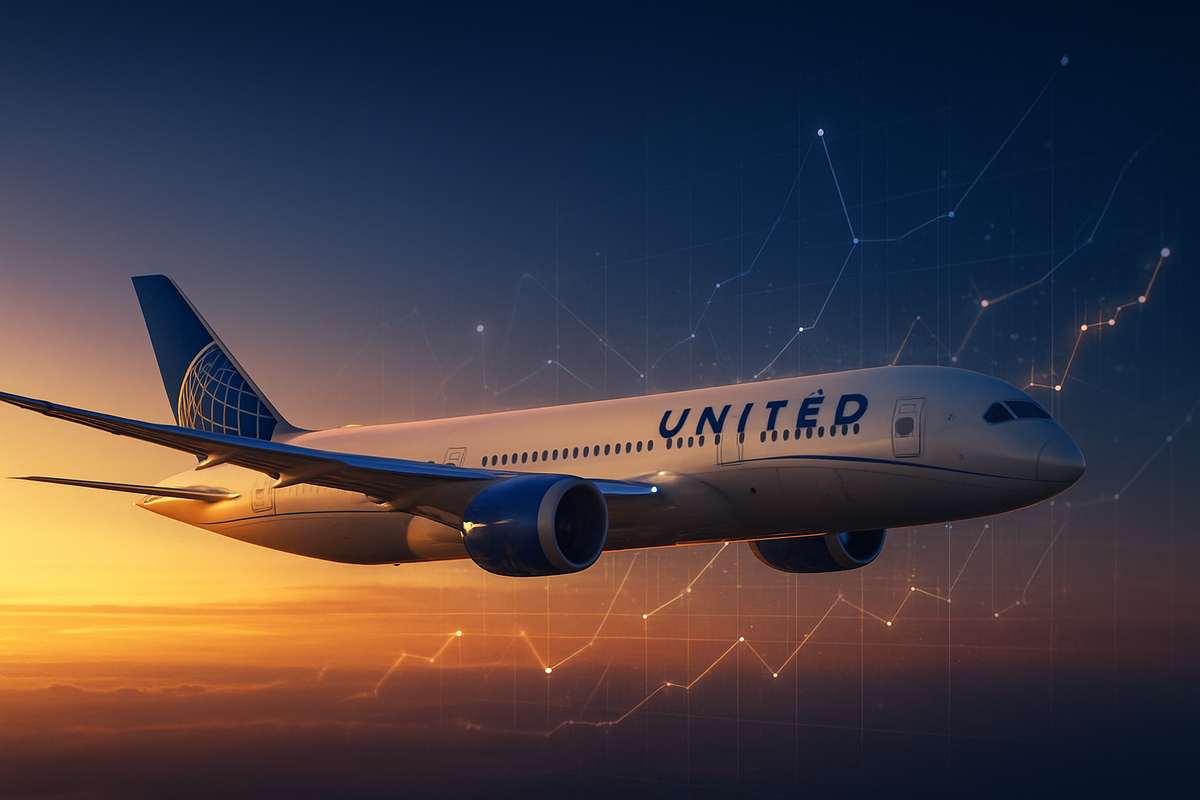
As the sun sets on the first trading day of the week, the financial world has its eyes fixed firmly on the skies. United Airlines (NASDAQ: UAL) is set to release its fourth-quarter 2025 earnings report after the closing bell today, January 20, 2026. The report comes at a pivotal moment for the aviation giant, serving as a litmus test for the industry's resilience following a turbulent close to the previous year. Analysts are largely coalescing around a consensus Earnings Per Share (EPS) estimate of $2.93, a figure that reflects both the robust appetite for international travel and the lingering scars of domestic operational disruptions.
The stakes for this afternoon’s announcement extend far beyond a single ticker symbol. With the broader travel industry transitioning from a post-pandemic "recovery" phase into a high-stakes "premiumization" era, United’s performance will signal whether legacy carriers can successfully pass on rising labor costs to a consumer base that is becoming increasingly bifurcated. While revenue is projected to climb to approximately $15.4 billion—a healthy 5% year-over-year increase—investors are bracing for a potential dip in bottom-line profits compared to the same period last year, as the airline grapples with the fallout of a late-2025 federal government shutdown and record-breaking labor contracts.
High Altitudes and Headwinds: The Q4 Journey
The road to today's earnings report was anything but smooth. The final quarter of 2025 was defined by a 43-day federal government shutdown that spanned October and November, throwing domestic flight schedules into disarray and chilling corporate travel bookings during a critical window. United, with its heavy reliance on major hubs like Washington Dulles and Newark, bore a significant brunt of the logistical chaos. Despite this, the carrier’s strategic pivot toward long-haul international routes and high-margin premium cabins appears to have acted as a financial shock absorber.
Leading up to this moment, United has doubled down on its "United Next" strategy, an aggressive fleet modernization plan designed to increase "gauge" (the number of seats per aircraft) while simultaneously elevating the passenger experience. Market reactions in the weeks preceding the report have been cautiously optimistic, with the stock maintaining a steady flight path even as competitors like Delta Air Lines (NYSE: DAL) reported "noisy" results characterized by high revenue but pressured margins. Stakeholders are particularly keen to see how United’s Total Revenue per Available Seat Mile (TRASM) has fared in a domestic market that spent much of 2025 oversupplied with budget seats.
A Field Divided: Winners and Losers in the New Aviation Landscape
As United prepares to unveil its books, the competitive landscape of the "Big Three" reveals a widening gap between those who have successfully courted the affluent traveler and those still searching for a clear identity. United Airlines remains a primary beneficiary of the "K-shaped" travel demand, where luxury and business travelers continue to spend record amounts even as budget-conscious flyers pull back. This shift has arguably left discount carriers in the lurch; the recent bankruptcy of Spirit Airlines has effectively removed a massive amount of low-cost capacity from the market, providing a tailwind for United by allowing for better "yield management" and higher pricing power in the main cabin.
However, the "winner" status is not without its costs. Labor remains the most significant hurdle. United, along with American Airlines (NASDAQ: AAL) and Delta, has signed historic contracts with pilots and flight attendants, leading to a projected 5.8% increase in non-fuel costs for 2026. While United stands to win from a projected 2.4% decline in jet fuel prices, the margin for error has narrowed. Furthermore, the delivery delays at Boeing (NYSE: BA) continue to be a thorn in the side of United’s expansion plans. Any guidance tonight that hints at further delays for the much-anticipated Boeing 737 MAX deliveries could dampen the enthusiasm surrounding the airline's growth trajectory.
The Premiumization Pivot and Industry Ripple Effects
The United earnings call is expected to highlight a broader industry trend: the death of the "commodity seat." The airline industry in 2026 is no longer about just getting from Point A to Point B; it is about the "connectivity and comfort" ecosystem. United’s massive investment in Starlink—the satellite internet service provided by SpaceX—is a cornerstone of this strategy. By promising free, high-speed Wi-Fi across its fleet starting this year, United is attempting to seize the "business traveler" crown from Delta, essentially turning every seat into a high-functioning mobile office.
This move has forced a defensive reaction across the industry. Competitors are now scrambling to upgrade their own in-flight tech, leading to a "tech arms race" that benefits satellite providers and hardware manufacturers but puts further pressure on airline capital expenditures. Historically, the airline industry has been plagued by "capacity wars" where carriers flew too many planes with too many empty seats. The current trend toward "rationalization"—driven by the Spirit bankruptcy and fleet constraints at JetBlue (NASDAQ: JBLU)—suggests a more disciplined era of American aviation where profitability is prioritized over mere market share.
The Flight Path Ahead: Starlink and Strategic Pizazz
Looking forward, the focus for United will shift from surviving the 2025 shutdown to executing its 2026 vision. One of the most anticipated elements of today's report will be the guidance for the first quarter of 2026, particularly regarding the rollout of the "United Elevated" interiors. These new widebody products, featuring redesigned Polaris suites with sliding doors, are set to debut on the Boeing 787-9 Dreamliner fleet this spring. If United can prove that these premium retrofits are driving higher yields on key routes like San Francisco to London, it will validate the billions spent on the upgrade.
In the short term, the market will be looking for a "clean" outlook that moves past the one-off disruptions of the previous year. A strategic pivot toward high-value loyalty revenue is also on the horizon. Following the late-2025 hiring of former American Airlines executive Vasu Raja to oversee the MileagePlus program, investors are looking for signs that United can turn its frequent flyer program into a more aggressive profit center, similar to the high-margin credit card partnerships that have long bolstered Delta’s bottom line.
Investor Takeaways: Watching the Horizon
As United Airlines prepares to report its $2.93 EPS, the takeaway for the market is clear: volume is secondary to value. The key metrics to watch will not just be the headline earnings, but the "CASM-ex" (cost per available seat mile excluding fuel). If United can keep its non-fuel costs in check while its Starlink and "Elevated" cabin initiatives begin to bear fruit, it may solidify its position as the top airline pick for 2026.
Moving forward, investors should keep a close watch on domestic yield stabilization. With the excess capacity of the discount airlines largely purged, the ability for United to maintain premium pricing in a cooling economy will be the ultimate test of its business model. While the $2.93 expectation is the immediate hurdle, the long-term story remains United’s transformation from a traditional legacy carrier into a technology-driven, premium-focused global powerhouse.
This content is intended for informational purposes only and is not financial advice.