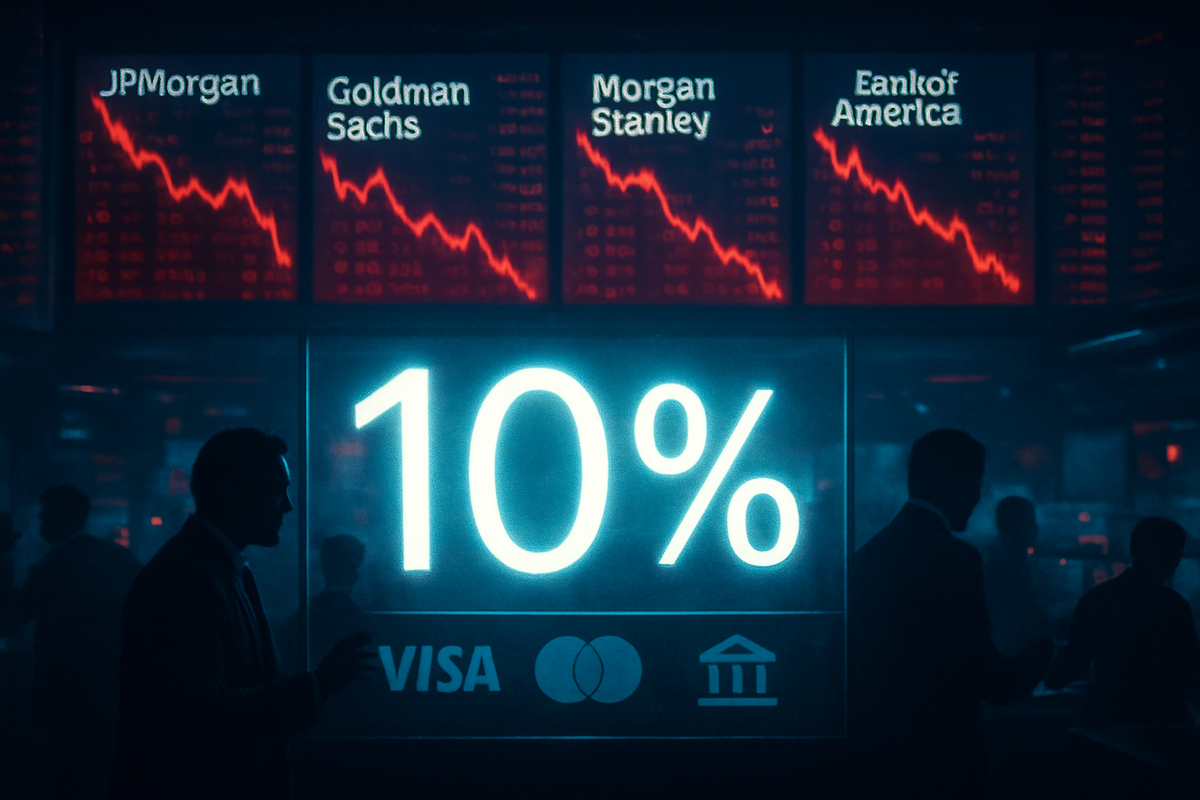
As the second week of 2026 draws to a close, the credit card industry is facing its most significant legislative challenge in decades. A bipartisan push to cap credit card annual percentage rates (APRs) at a flat 10% has moved from a fringe populist idea to a central pillar of congressional debate, threatening to upend the business models of some of the nation’s largest financial institutions. The proposal, which has gained unexpected momentum in the early days of the 2026 legislative session, is designed to provide "immediate relief" to American households currently burdened by a record $1.17 trillion in revolving debt.
The immediate implications of this proposal have been nothing short of chaotic for the financial markets. Investors, fearing a total collapse of net interest margins for subprime-heavy lenders, have triggered a massive sell-off in the banking sector. As of January 20, 2026, shares of major issuers have plummeted to levels not seen since the regional banking crisis of 2023, while analysts warn of a "credit desert" where millions of Americans could see their credit lines slashed or canceled entirely as banks move to mitigate the risks of a fixed 10% return.
The Populist Surge: From Proposal to Potential Policy
The legislative journey toward the 10% cap began in earnest in February 2025, when Senator Josh Hawley (R-MO) and Senator Bernie Sanders (I-VT) introduced the 10 Percent Credit Card Interest Rate Cap Act (S.381). Initially dismissed by industry lobbyists as a political stunt, the bill found fertile ground as inflation remained stubbornly sticky and consumer debt reached a breaking point. By late 2025, the narrative shifted from "if" the bill would be considered to "when" a vote would occur, particularly after Senator Roger Marshall (R-KS) introduced the companion Consumer Affordability Protection Act in early January 2026, which aligned with White House calls for a temporary cap to address the cost-of-living crisis.
The timeline leading to this moment has been marked by a series of aggressive regulatory moves that set the stage for such a drastic cap. Throughout 2024 and 2025, the Consumer Financial Protection Bureau (CFPB) systematically moved to lower late fees and eliminate "junk fees," signaling a broader federal appetite for intervention in consumer finance. When the Hawley-Sanders alliance solidified in late 2025, the market’s "political risk premium" spiked. Initial reactions from the American Bankers Association and other trade groups have been fierce, characterized by warnings that a 10% cap is mathematically incompatible with the costs of lending to anyone other than the most affluent "super-prime" borrowers.
The Existential Threat: Capital One and Synchrony in the Crosshairs
Perhaps no institutions are more exposed to this legislative threat than Capital One Financial Corp (NYSE: COF) and Synchrony Financial (NYSE: SYF). Capital One, which finalized its massive $35.3 billion acquisition of Discover Financial Services in May 2025, has become a lightning rod for the debate. Now the largest credit card issuer in the United States, Capital One's strategy relied heavily on the proprietary Discover payment network to bypass interchange fee caps. However, a 10% interest rate cap would strike at the very heart of its revenue model. Analysts from Wells Fargo and Morningstar have noted that with Capital One’s average card APRs currently exceeding 20%, a forced reduction to 10% would effectively wipe out the profit margin for a majority of its portfolio, particularly those segments catering to "near-prime" consumers.
Synchrony Financial faces an even steeper uphill battle. Specializing in private-label "store cards" for retail giants like Amazon.com, Inc. (NASDAQ: AMZN) and Lowe's Companies, Inc. (NYSE: LOW), Synchrony’s business model is built on high-risk, high-reward lending. These cards typically carry significantly higher interest rates to offset high default rates among shoppers. If a 10% cap were enacted, analysts estimate that Synchrony could swing from a robust $1.4 billion quarterly gain to a staggering $1.5 billion loss almost overnight. Furthermore, the profit-sharing arrangements Synchrony has with its retail partners would likely be terminated, potentially leading to a breakdown in the retail financing ecosystem that supports big-ticket consumer purchases.
A Fundamental Shift in the Lending Landscape
The wider significance of a 10% rate cap extends far beyond the balance sheets of a few banks; it represents a fundamental shift in the American credit culture. For the last four decades, the credit card industry has operated under a "risk-based pricing" model, where borrowers with lower credit scores pay higher interest rates to compensate for their higher likelihood of default. This system allowed for the democratization of credit, giving millions of subprime borrowers access to cards that were previously unavailable. A 10% cap effectively outlaws this model, forcing banks to treat every borrower as a "prime" risk or simply deny them credit.
This event fits into a broader global trend of "neo-regulation," where governments are increasingly willing to set price controls on financial products. It mirrors historical precedents like the usury laws of the early 20th century, but with a modern twist: the scale of today's digital economy makes a sudden credit contraction far more volatile. Ripple effects are already being felt by competitors like JPMorgan Chase & Co. (NYSE: JPM) and American Express Company (NYSE: AXP). While these "money-center" banks have more diversified revenue streams, they too would see their credit card divisions move from profit centers to utility-like services, potentially leading to the reintroduction of widespread annual fees for all cardholders as a way to recoup lost interest income.
The Road Ahead: Adaptation or Contraction?
Looking forward to the remainder of 2026, the short-term outlook is dominated by legislative uncertainty. If the bill passes, the most likely immediate outcome is a "Great Credit Contraction." Banks will likely begin purging higher-risk cardholders from their books, closing millions of accounts to avoid the 10% cap's "unprofitable" threshold. Strategic pivots are already being discussed in boardrooms; we may see a resurgence of the "annual fee" model, where consumers pay $50 to $100 just for the privilege of holding a card, regardless of their interest rate. This would allow banks to shift the cost of lending from interest-based revenue to fee-based revenue.
In the long term, this crisis may create market opportunities for non-bank fintech lenders and credit unions that are not subject to the same regulatory oversight—though the current bill includes "anti-evasion" clauses designed to prevent exactly that. The scenario most feared by economists is a "credit bifurcations" where only the wealthy can access revolving credit, while the rest of the population is forced toward more expensive and less regulated "Buy Now, Pay Later" (BNPL) schemes or predatory payday lenders that might fall through the cracks of the new legislation.
Navigating the New Financial Frontier
The proposed 10% interest rate cap represents a watershed moment for the U.S. financial sector. It is a direct challenge to the profitability of massive institutions like Capital One and Synchrony and a potential death knell for the subprime credit market as we know it. The key takeaway for the market is that the era of aggressive, high-margin consumer lending may be coming to a close, replaced by a more restricted, utility-style banking environment driven by populist political pressure rather than traditional market risk.
Moving forward, the market will likely remain volatile as the bill moves through committee. Investors should watch for any amendments that might raise the cap to a more "workable" 15% or 18%, which would mitigate the most catastrophic impacts on bank earnings. For now, the "Great Rate Bifurcation" is the reality on Wall Street. As of January 2026, the message from Washington is clear: the cost of credit is no longer a matter for the markets to decide—it is a matter of public policy.
This content is intended for informational purposes only and is not financial advice.