Value Added Tax (VAT) is one of the most important indirect taxes businesses need to understand when entering the Turkish market. For foreign companies, VAT can become relevant not only when selling goods or services in Turkey, but also when importing goods, receiving certain services, or carrying out taxable activities through a Turkish business presence.
Understanding when VAT registration is required, which VAT rates may apply and how ongoing VAT compliance works can help international businesses avoid unexpected tax liabilities and administrative problems.
What Is VAT in Turkey?
Value Added Tax, known as KDV (Katma Değer Vergisi) in Turkey, is an indirect tax generally imposed on taxable supplies of goods and services.
The VAT system operates throughout the supply chain, with businesses generally collecting VAT from customers and offsetting eligible input VAT against output VAT, subject to the applicable rules.
Turkey has different VAT rates depending on the nature of the goods or services. Under the current framework, the standard rate is 20%, while certain goods and services qualify for reduced rates, including categories subject to 10% and 1% VAT.
For businesses operating across borders, determining the correct VAT treatment requires examining the nature and location of each transaction rather than applying one rate to all activities.
Who Needs VAT Registration in Turkey?
Businesses conducting taxable activities in Turkey may be required to register for VAT and comply with Turkish VAT reporting requirements.
This can include Turkish companies as well as foreign businesses that conduct activities giving rise to Turkish VAT obligations.
Examples may include companies involved in:
Local sales of goods
Provision of taxable services in Turkey
Importation of goods
E-commerce activities
Commercial activities carried out through a Turkish business presence
Certain services supplied by or to non-resident businesses
The exact VAT treatment depends on the transaction and the circumstances of the parties involved.
For this reason, foreign businesses should determine their VAT position before beginning taxable activities in Turkey rather than treating registration as a purely administrative step.
VAT Registration for Foreign Companies
Foreign companies require particular attention because their VAT obligations may differ depending on how they operate in Turkey.
A non-resident company does not automatically become subject to Turkish VAT simply because it has customers in Turkey. The place of supply, nature of the transaction, where the service is performed or used, and whether the foreign company has a Turkish establishment can all be relevant.
For certain services supplied by businesses that do not have a residence, workplace, legal or business headquarters in Turkey, the Turkish recipient may be responsible for declaring and paying VAT under the reverse-charge mechanism. The Turkish Revenue Administration explains that services performed in Turkey, as well as certain services performed abroad but benefited from in Turkey, can fall within the Turkish VAT system.
This distinction is particularly important for multinational businesses providing professional, technical, consulting, digital or other cross-border services.
When Should a Foreign Business Assess VAT Registration?
VAT registration should generally be assessed before taxable activities begin.
A foreign business entering Turkey should review:
What products or services it will sell
Where its customers are located
Where the goods or services are supplied
Whether goods will be imported into Turkey
Whether the company will establish a Turkish subsidiary or branch
Whether employees or other resources will be located in Turkey
Whether services are performed in Turkey or used in Turkey
Whether a reverse-charge mechanism applies
This analysis can determine whether the business needs Turkish VAT registration or whether VAT should instead be accounted for by another party.
VAT Rates in Turkey
VAT rates vary according to the category of goods or services.
The current general framework includes:
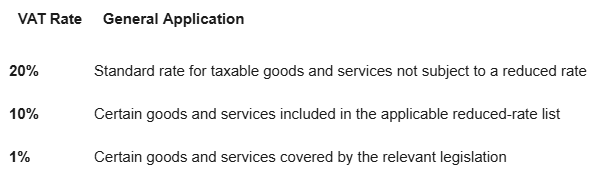
The applicable rate should always be determined based on the specific transaction and the legislation in force at the time.
Businesses should also consider whether a transaction qualifies for an exemption rather than simply assuming that every sale is subject to the standard VAT rate.
How to Register for VAT in Turkey
For businesses that are required to register, VAT registration forms part of the company's wider tax registration process.
A typical process may involve:
1. Determining the Tax Position
The business first needs to establish whether its activities create a Turkish VAT obligation.
2. Obtaining the Necessary Tax Identification
Foreign companies and entities carrying out activities requiring Turkish tax registration may need an appropriate Turkish tax identification number. The Turkish Revenue Administration also provides procedures for foreign legal entities to obtain tax identification numbers in relevant circumstances.
3. Preparing the Required Documents
Depending on the structure and circumstances, the authorities may require corporate documents, identification documents, authorization documents, registered address information and other supporting records.
4. Completing Tax Office Procedures
The relevant registration procedures are completed with the Turkish tax authorities.
5. Starting VAT Compliance
Once the company becomes subject to VAT, it must comply with the applicable invoicing, bookkeeping, return filing and payment requirements.
Foreign investors looking for a detailed overview can refer to this guide to VAT Registration in Turkey.
VAT Compliance After Registration
VAT registration is not the end of the process. It creates ongoing compliance obligations.
Depending on the company's activities, these may include:
Issuing compliant VAT invoices
Recording input and output VAT
Filing VAT returns
Paying VAT when due
Maintaining accounting records
Applying the correct VAT rate
Managing VAT exemptions
Maintaining supporting documentation
Handling VAT refunds where applicable
Complying with electronic invoicing requirements where applicable
A company may also need to consider how VAT interacts with its corporate tax and accounting obligations.
For foreign businesses, this is particularly important because Turkish statutory accounting and tax reporting procedures may differ from those used in the company's home jurisdiction.
VAT and Imports
Importing goods into Turkey can create VAT obligations at the customs stage.
A foreign business importing products into Turkey should therefore consider VAT together with customs duties and other import-related obligations.
The company's commercial structure can also affect the process. For example, an international group importing goods through a Turkish subsidiary may have different accounting and VAT considerations from a foreign company selling directly to Turkish customers.
Businesses involved in regular imports should establish the VAT and customs treatment before beginning commercial operations.
VAT on Cross-Border Services
Cross-border services require careful analysis.
The Turkish VAT rules consider factors including where a service is performed and where it is benefited from. Under the applicable rules, certain services supplied by non-resident businesses but used in Turkey can result in VAT being declared and paid by the Turkish recipient.
This can be relevant to multinational companies purchasing:
Consulting services
Legal services
Technical services
Management services
Software and technology services
Professional services
Other cross-border services
The VAT treatment should therefore be reviewed before the invoice is issued or paid.
VAT and E-Commerce Businesses
E-commerce companies should also assess Turkish VAT obligations carefully.
Businesses selling products or services to Turkish customers may need to consider:
The nature of the product or service
Customer location
Place of supply
Import arrangements
Local business presence
Invoicing requirements
VAT collection and reporting
The tax treatment can differ between physical goods, electronically supplied services and other types of transactions.
International e-commerce businesses should therefore assess their Turkish VAT position as part of their market-entry planning.
Common VAT Registration Mistakes
Foreign businesses can encounter problems when they underestimate the administrative side of VAT.
Common issues include:
Registering for VAT too late
Applying the wrong VAT rate
Failing to identify a VAT obligation on cross-border transactions
Treating every foreign service payment in the same way
Inadequate invoice documentation
Missing VAT filing deadlines
Failing to reconcile input and output VAT
Assuming that company incorporation automatically resolves every VAT issue
These problems can result in additional tax exposure, penalties, interest or disputes with the tax authorities.
How Foreign Businesses Can Manage VAT More Effectively
A practical VAT compliance system should begin before the first taxable transaction.
Foreign companies should establish:
A clear analysis of their Turkish VAT position.
Appropriate tax registration.
Correct invoicing procedures.
Reliable accounting records.
A process for reviewing cross-border transactions.
Procedures for identifying applicable VAT rates and exemptions.
Regular VAT reconciliation.
A calendar for VAT declarations and payments.
Appropriate electronic tax and invoicing systems.
Professional support where the transactions are complex.
For multinational businesses, VAT should be considered alongside corporate tax, withholding tax, transfer pricing and accounting rather than as an isolated obligation.
Final Thoughts
VAT registration is an important consideration for foreign businesses entering the Turkish market. However, registration itself is only one part of the overall VAT compliance framework.
The correct treatment depends on the company's activities, transaction structure, customers, suppliers and presence in Turkey. Cross-border services, imports, e-commerce and transactions between related companies can all create additional VAT considerations.
By assessing VAT obligations before starting operations and establishing appropriate accounting and reporting procedures, foreign businesses can reduce the risk of unexpected tax liabilities and compliance problems.
For international companies, professional local tax and accounting support can also help bridge the gap between Turkish VAT rules and the company's existing international finance processes.
A&M Consulting Co. is a Turkey-based professional consulting firm supporting foreign investors and international businesses with VAT registration, tax compliance, accounting, company formation and ongoing corporate support. The firm assists international businesses throughout the process of establishing and operating in Turkey, from tax registration and VAT compliance to accounting and other ongoing tax obligations.
If you are planning to establish or operate a business in Turkey, you can learn more about A&M Consulting Co. and its accounting, tax and business support services for foreign investors.