Conductive bags are becoming essential industrial packaging solutions, driven by semiconductor growth, ESD protection demand, compliance standards, and resilient supply chain expansion.
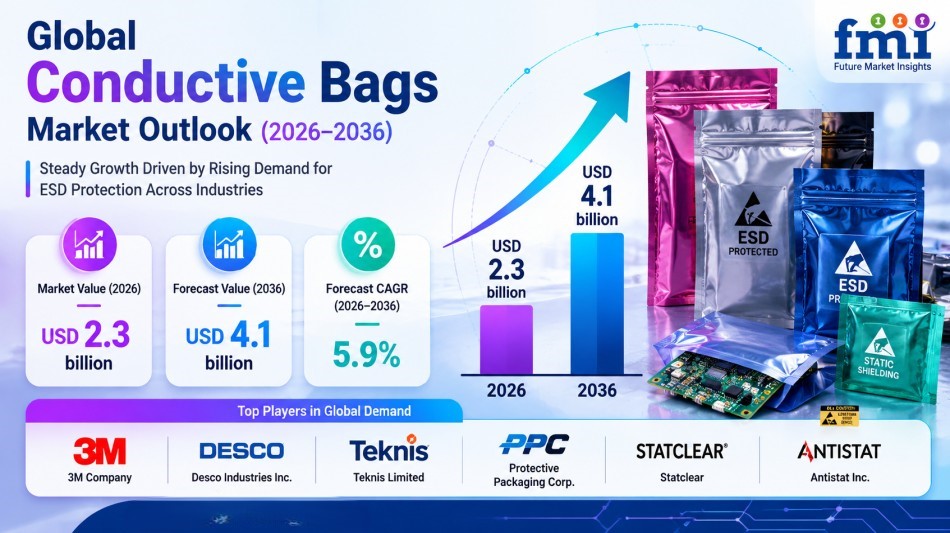
NEWARK, DE / ACCESS Newswire / May 25, 2026 / According to the latest market analysis by Future Market Insights, the conductive bags market is evolving from a niche protective packaging category into a critical component of industrial supply chains, particularly across electronics, semiconductors, automotive, and pharmaceutical equipment industries. Valued at USD 2.2 billion in 2025 and projected to reach USD 2.3 billion by 2026-end, the market is expected to expand at a CAGR of 5.9%, ultimately reaching USD 4.1 billion by 2036.
The market's growth reflects a broader industrial transition toward higher compliance standards, sensitive component protection, and localized manufacturing ecosystems designed to reduce operational risk and supply chain disruptions.
Quick Stats at a Glance
Market size (2025): USD 2.2 billion
Estimated value (2026): USD 2.3 billion
Forecast (2036): USD 4.1 billion
CAGR (2026-2036): 5.9%
Incremental opportunity: USD 1.8 billion
Leading product type: Plain conductive bags (41% share)
Dominant material segment: Aluminum Coated (56% share)
Leading growth market: Germany (6.8% CAGR)
Other key growth markets: USA (6.7%), South Korea (6.5%), UK (6.4%), Japan (6.3%)
Get detailed market forecasts, competitive benchmarking, and pricing trends:
https://www.futuremarketinsights.com/reports/sample/rep-gb-4792
Market Size and Structural Shift
The conductive bags market is entering a long-term expansion phase as industries increasingly prioritize electrostatic discharge (ESD) protection, moisture resistance, and contamination control across critical manufacturing environments.
Historically, conductive bags were treated as commodity packaging products with limited strategic importance. That perception is changing rapidly. As semiconductor miniaturization, advanced electronics manufacturing, and sensitive component logistics expand globally, conductive packaging is becoming essential infrastructure rather than optional protection.
Manufacturers are now investing in higher-specification conductive packaging solutions capable of meeting strict compliance standards while supporting operational continuity in increasingly automated and globally distributed supply chains.
Growth Drivers: Compliance, Electronics Expansion, and Industrial Reliability
Three major structural trends are accelerating market adoption globally.
1. Rising Semiconductor and Electronics Production
The rapid expansion of semiconductor fabrication, PCB manufacturing, and electronics assembly operations is significantly increasing demand for reliable ESD-safe packaging solutions.
Conductive bags play a critical role in protecting sensitive components during storage, transportation, and assembly processes.
2. Tightening Regulatory and Quality Standards
Global industries are facing stricter safety, environmental, and quality compliance requirements. Procurement teams increasingly prefer suppliers with strong certification portfolios, proven material reliability, and consistent product performance.
This trend particularly favors established manufacturers with integrated manufacturing and testing capabilities.
3. Regional Manufacturing Expansion
Governments and industrial sectors are accelerating investments in localized manufacturing infrastructure to reduce dependency on global supply chains.
As regional electronics and automotive manufacturing hubs expand, demand for locally sourced conductive packaging solutions is increasing alongside production capacity.
Market Constraints: Cost Pressure and Supply Chain Complexity
Despite strong long-term demand, the market faces operational and structural challenges.
Raw material price volatility remains a significant concern, particularly for aluminum-coated materials and specialty polymer films. Margin pressure is especially intense in commodity-grade product categories where low-cost producers dominate.
Supply chain concentration also creates operational risks. Manufacturers dependent on limited raw material suppliers or concentrated logistics networks remain vulnerable to disruptions, price spikes, and lead-time volatility.
At the same time, compliance requirements related to material sourcing, environmental standards, and safety certifications are increasing operational complexity across global supply chains.
Speak to Analyst: Customize insights for your business strategy:
https://www.futuremarketinsights.com/customization-available/rep-gb-4792
Opportunity Landscape: Where Future Value Is Emerging
Several high-value opportunities are shaping the next phase of conductive bags market expansion:
Expansion of semiconductor manufacturing capacity globally
Increasing demand for ESD-safe logistics and storage solutions
Growth of pharmaceutical equipment protection applications
Regionalized manufacturing and local sourcing strategies
Development of advanced moisture-barrier and shielding materials
Rising demand for reusable conductive packaging systems
The shift toward resilient and localized industrial ecosystems is expected to create sustained demand for suppliers with diversified production footprints and integrated manufacturing capabilities.
Segment Insights: Where the Market Is Concentrated
By Product Type:
Plain conductive bags are expected to dominate with a 41% market share in 2026, supported by broad industrial applicability, cost efficiency, and growing adoption across electronics and component storage applications.
Other product categories including tubing, grid, and bubble conductive bags continue expanding to address specialized packaging and protection requirements.
By Material:
Aluminum Coated materials are projected to hold 56% share of the market due to their superior electrostatic shielding, moisture barrier performance, and durability.
These materials are increasingly preferred for semiconductor packaging, PCB handling, and sensitive industrial component protection.
Regional Dynamics: Industrial Hubs Continue to Lead
Growth remains concentrated in industrial manufacturing economies with strong electronics, automotive, and advanced manufacturing ecosystems.
Germany (6.8% CAGR): Germany is expected to remain the leading growth market, supported by industrial automation expansion, precision manufacturing demand, and strong compliance-driven procurement standards.
United States (6.7% CAGR): The U.S. market continues benefiting from semiconductor investment, reshoring initiatives, and expanding advanced manufacturing infrastructure.
South Korea (6.5% CAGR): South Korea's leadership in semiconductor and electronics production continues driving demand for advanced ESD packaging solutions.
United Kingdom (6.4% CAGR): Industrial modernization and compliance-focused procurement are supporting steady market expansion across the UK manufacturing sector.
Japan (6.3% CAGR): Japan's high-value electronics manufacturing ecosystem continues to generate demand for precision protective packaging applications.
Unlock high-growth opportunities with FMI's niche business market insights:
https://www.futuremarketinsights.com/industry-analysis
Competitive Landscape: Reliability and Integration Becoming Decisive
The competitive environment is increasingly shifting beyond price competition toward operational reliability, manufacturing scale, and integrated product capabilities.
Leading companies including 3M Company, Desco Industries Inc., Teknis Limited, Protective Packaging Corp., Statclear, and Antistat Inc. are focusing on:
Integrated manufacturing capabilities
Multi-regional distribution networks
Product portfolio diversification
Technical differentiation and specialty applications
Long-term procurement relationships
Supply chain resilience and compliance management
For buyers, the priority is increasingly shifting toward dependable supply continuity, certification strength, and consistent product quality.
Strategic Implications for Industry Stakeholders
For manufacturers, competitive advantage will increasingly depend on balancing cost efficiency with technical specialization and regional production flexibility.
For procurement leaders, supplier selection criteria are evolving beyond pricing to include compliance reliability, sourcing diversification, and operational resilience.
For investors, recurring growth opportunities are emerging across specialized conductive materials, ESD protection technologies, and integrated industrial packaging ecosystems.
For industrial operators, conductive packaging is becoming a critical risk-management tool supporting product integrity, logistics efficiency, and manufacturing continuity.
Future Outlook: From Commodity Packaging to Strategic Infrastructure
Over the next decade, conductive bags are expected to transition from standard protective packaging products into essential components of advanced manufacturing ecosystems.
Key trends likely to shape the market include:
Expansion of semiconductor manufacturing investments
Increasing localization of industrial supply chains
Growth of reusable and sustainable packaging systems
Advanced multi-layer shielding technologies
Higher automation across industrial packaging workflows
Greater integration of compliance-driven procurement systems
As industrial sectors become increasingly dependent on sensitive electronics and precision manufacturing, conductive packaging will play a more strategic role across global value chains.
Executive Takeaways
Conductive bags are evolving into essential industrial protection infrastructure.
Semiconductor growth and ESD protection requirements are driving long-term demand.
Regulatory compliance and supply chain resilience are reshaping procurement priorities.
Aluminum coated materials continue dominating due to shielding and barrier performance.
Germany and the U.S. remain leading growth markets supported by industrial investment.
Competitive differentiation is increasingly tied to reliability, compliance, and manufacturing integration.
Future growth will be driven by localized production ecosystems and higher-value industrial applications.
Explore the Latest Packaging Industry Analysis Now:
https://www.futuremarketinsights.com/industry-analysis/packaging
Related Reports:
Conductive Polymer Packaging Market: https://www.futuremarketinsights.com/reports/conductive-polymer-packaging-market
Conductive Cardboard Market: https://www.futuremarketinsights.com/reports/conductive-cardboard-market
Polybags Market: https://www.futuremarketinsights.com/reports/polybags-market
Food Bags Market: https://www.futuremarketinsights.com/reports/food-bags-market
Paper Bags Market: https://www.futuremarketinsights.com/reports/paper-bags-market
About Future Market Insights (FMI)
Future Market Insights (FMI) is a leading provider of market intelligence and consulting services, serving clients in over 150 countries. Headquartered in Delaware, USA, with a global delivery center in India and offices in the UK and UAE, FMI delivers actionable insights to businesses across industries including automotive, technology, consumer products, manufacturing, energy, and chemicals.
An ESOMAR-certified research organization, FMI provides custom and syndicated market reports and consulting services, supporting both Fortune 1,000 companies and SMEs. Its team of 300+ experienced analysts ensures credible, data-driven insights to help clients navigate global markets and identify growth opportunities.
For Press & Corporate Inquiries
Rahul Singh
AVP - Marketing and Growth Strategy
Future Market Insights, Inc.
+91 8600020075
For Sales - sales@futuremarketinsights.com
For Media - Rahul.singh@futuremarketinsights.com
For Web - https://www.futuremarketinsights.com/
For Web - https://www.factmr.com/
SOURCE: Future Market Insights, Inc.
View the original press release on ACCESS Newswire