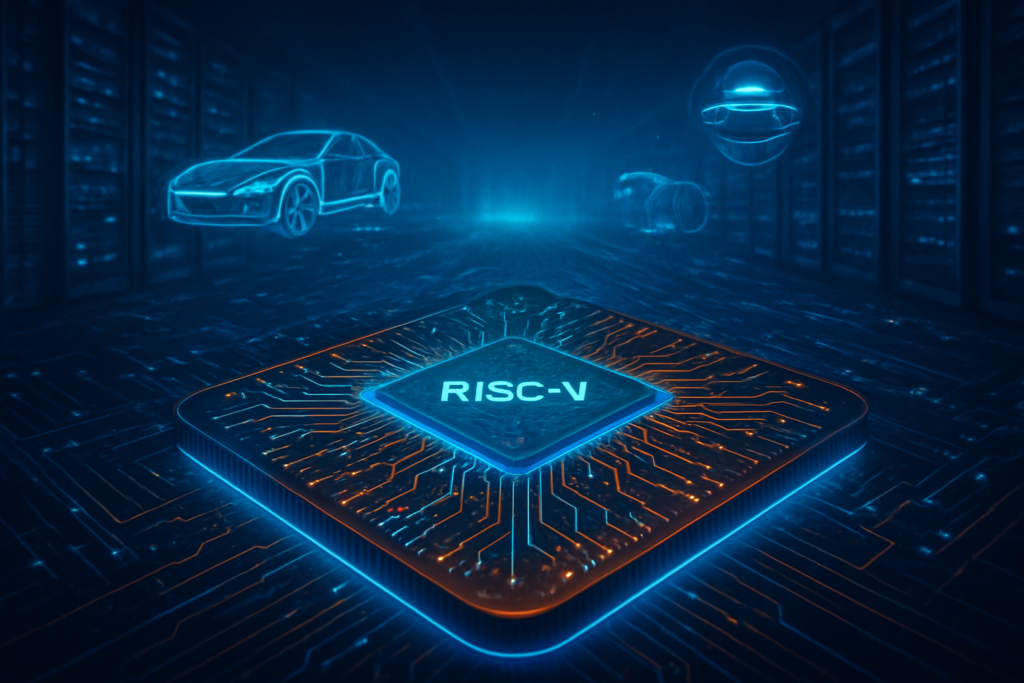
As of January 2026, the global semiconductor landscape has reached a definitive turning point. For decades, the industry was locked in a duopoly between the x86 architecture, dominated by Intel (Nasdaq: INTC) and AMD (Nasdaq: AMD), and the proprietary ARM Holdings (Nasdaq: ARM) architecture. However, the last 24 months have seen the meteoric rise of RISC-V, an open-source instruction set architecture (ISA) that has transitioned from an academic experiment into what experts now call the "third pillar" of computing. In early 2026, RISC-V's momentum is no longer just about cost-saving; it is about "silicon sovereignty" and the ability for tech giants to build hyper-specialized chips for the AI era that proprietary licensing models simply cannot support.
The immediate significance of this shift is most visible in the data center and automotive sectors. In the second half of 2025, major milestones—including NVIDIA’s (Nasdaq: NVDA) decision to fully support the CUDA software stack on RISC-V and Qualcomm’s (Nasdaq: QCOM) landmark acquisition of Ventana Micro Systems—signaled that the world’s largest chipmakers are diversifying away from ARM. By providing a royalty-free, modular framework, RISC-V is enabling a new generation of "domain-specific" processors that are 30-40% more efficient at handling Large Language Model (LLM) inference than their general-purpose predecessors.
The Technical Edge: Modularity and the RVA23 Breakthrough
Technically, RISC-V’s primary advantage over legacy architectures is its "Frozen Base" modularity. While x86 and ARM have spent decades accumulating "instruction bloat"—thousands of legacy commands that must be supported for backward compatibility—the RISC-V base ISA consists of fewer than 50 instructions. This lean foundation allows designers to eliminate "dark silicon," reducing power consumption and transistor count. In 2025, the ratification and deployment of the RVA23 profile standardized high-performance computing requirements, including mandatory Vector Extensions (RVV). These extensions are critical for AI workloads, allowing RISC-V chips to handle complex matrix multiplications with a level of flexibility that ARM’s NEON or x86’s AVX cannot match.
A key differentiator for RISC-V in 2026 is its support for Custom Extensions. Unlike ARM, which strictly controls how its architecture is modified, RISC-V allows companies to bake their own proprietary AI instructions directly into the CPU pipeline. For instance, Tenstorrent’s latest "Grendel" chip, released in late 2025, utilizes RISC-V cores integrated with specialized "Tensix" AI cores to manage data movement more efficiently than any existing x86-based server. This "hardware-software co-design" has been hailed by the research community as the only viable path forward as the industry hits the physical limits of Moore’s Law.
Initial reactions from the AI research community have been overwhelmingly positive. The ability to customize the hardware to the specific math of a neural network—such as the recent push for FP8 data type support in the Veyron V3 architecture—has allowed for a 2x increase in throughput for generative AI tasks. Industry experts note that while ARM provides a "finished house," RISC-V provides the "blueprints and the tools," allowing architects to build exactly what they need for the escalating demands of 2026-era AI clusters.
Industry Impact: Strategic Pivots and Market Disruption
The competitive landscape has shifted dramatically following Qualcomm’s acquisition of Ventana Micro Systems in December 2025. This move was a clear shot across the bow of ARM, as Qualcomm seeks to gain "roadmap sovereignty" by developing its own high-performance RISC-V cores for its Snapdragon Digital Chassis. By owning the architecture, Qualcomm can avoid the escalating licensing fees and litigation that have characterized its relationship with ARM in recent years. This trend is echoed by the European venture Quintauris—a joint venture between Bosch, BMW, Infineon Technologies (OTC: IFNNY), NXP Semiconductors (Nasdaq: NXPI), and Qualcomm—which standardized a RISC-V platform for automotive zonal controllers in early 2026, ensuring that the European auto industry is no longer beholden to a single vendor.
In the data center, the "NVIDIA-RISC-V alliance" has sent shockwaves through the industry. By July 2025, NVIDIA began allowing its NVLink high-speed interconnect to interface directly with RISC-V host processors. This enables hyperscalers like Google Cloud—which has been using AI-assisted tools to port its software stack to RISC-V—to build massive AI factories where the "brain" of the operation is an open-source RISC-V chip, rather than an expensive x86 processor. This shift directly threatens Intel’s dominance in the server market, forcing the legacy giant to pivot its Intel Foundry Services (IFS) to become a leading manufacturer of RISC-V silicon for third-party designers.
The disruption extends to startups as well. Commercial RISC-V IP providers like SiFive have become the "new ARM," offering ready-to-use core designs that allow small companies to compete with tech giants. With the barrier to entry for custom silicon lowered, we are seeing an explosion of "edge AI" startups that design hyper-efficient chips for drones, medical devices, and smart cities—all running on the same open-source foundation, which significantly simplifies the software ecosystem.
Global Significance: Silicon Sovereignty and the Geopolitical Chessboard
Beyond technical and corporate interests, the rise of RISC-V is a major factor in global geopolitics. Because the RISC-V International organization is headquartered in Switzerland, the architecture is largely shielded from U.S. export controls. This has made it the primary vehicle for China's technological independence. Chinese giants like Alibaba (NYSE: BABA) and Huawei have invested billions into the "XiangShan" project, creating RISC-V chips that now power high-end Chinese data centers and 5G infrastructure. By early 2026, China has effectively used RISC-V to bypass western sanctions, ensuring that its AI development continues unabated by geopolitical tensions.
The concept of "Silicon Sovereignty" has also taken root in Europe. Through the European Processor Initiative (EPI), the EU is utilizing RISC-V to develop its own exascale supercomputers and automotive safety systems. The goal is to reduce reliance on U.S.-based intellectual property, which has been a point of vulnerability in the global supply chain. This move toward open standards in hardware is being compared to the rise of Linux in the software world—a fundamental shift from proprietary "black boxes" to transparent, community-vetted infrastructure.
However, this rapid adoption has raised concerns regarding fragmentation. Critics argue that if every company adds its own "custom extensions," the unified software ecosystem could splinter. To combat this, the RISC-V community has doubled down on strict "Profiles" (like RVA23) to ensure that despite hardware customization, a standard "off-the-shelf" operating system like Android or Linux can still run across all devices. This balancing act between customization and compatibility is the central challenge for the RISC-V foundation in 2026.
The Horizon: Autonomous Vehicles and 2027 Projections
Looking ahead, the near-term focus for RISC-V is the automotive sector. As of January 2026, nearly 25% of all new automotive silicon shipments are based on RISC-V architecture. Experts predict that by 2028, this will rise to over 50% as "Software-Defined Vehicles" (SDVs) become the industry standard. The modular nature of RISC-V allows carmakers to integrate safety-critical functions (which require ISO 26262 ASIL-D certification) alongside high-performance autonomous driving AI on the same die, drastically reducing the complexity of vehicle electronics.
In the data center, the next major milestone will be the arrival of "Grendel-class" 3nm processors in late 2026. These chips are expected to challenge the raw performance of the highest-end x86 server chips, potentially leading to a mass migration of general-purpose cloud computing to RISC-V. Challenges remain, particularly in the "long tail" of enterprise software that has been optimized for x86 for thirty years. However, with Google and Meta leading the charge in software porting, the "software gap" is closing faster than most analysts predicted.
The next frontier for RISC-V appears to be space and extreme environments. NASA and the ESA have already begun testing RISC-V designs for next-generation satellite controllers, citing the architecture's inherent radiation-hardening potential and the ability to verify every line of the open-source hardware code—a luxury not afforded by proprietary architectures.
A New Era for Computing
The rise of RISC-V represents the most significant shift in computer architecture since the introduction of the first 64-bit processors. In just a few years, it has moved from the fringes of academia to become a cornerstone of the global AI and automotive industries. The key takeaway from the early 2026 landscape is that the "open-source" model has finally proven it can deliver the performance and reliability required for the world's most critical infrastructure.
As we look back at this development's place in AI history, RISC-V will likely be remembered as the "great democratizer" of hardware. By removing the gatekeepers of instruction set architecture, it has unleashed a wave of innovation that is tailored to the specific needs of the AI era. The dominance of a few large incumbents is being replaced by a more diverse, resilient, and specialized ecosystem.
In the coming weeks and months, the industry will be watching for the first "mass-market" RISC-V consumer laptops and the further integration of RISC-V into the Android ecosystem. If RISC-V can conquer the consumer mobile market with the same speed it has taken over the data center and automotive sectors, the reign of proprietary ISAs may be coming to a close much sooner than anyone expected.
This content is intended for informational purposes only and represents analysis of current AI and semiconductor developments as of January 28, 2026.
TokenRing AI delivers enterprise-grade solutions for multi-agent AI workflow orchestration, AI-powered development tools, and seamless remote collaboration platforms. For more information, visit https://www.tokenring.ai/.