As the global demand for artificial intelligence compute hits a critical "energy wall" in early 2026, Hi Tech Solutions (HTS) has unveiled a transformative vision to decouple AI growth from the constraints of the aging electrical grid. By positioning itself as an "ecosystem architect," HTS is spearheading a movement to power the next generation of massive AI data centers through dedicated, small-scale nuclear installations. This strategy aims to provide the "five nines" (99.999%) reliability required for frontier model training while meeting the aggressive carbon-neutrality goals of the world’s largest technology firms.
The HTS vision, punctuated by the recent expansion of the "Mountain West Crossroads Energy Initiative," signals a shift in the AI industry from a period defined by GPU scarcity to one defined by power availability. As generative AI models grow in complexity and high-density server racks now demand upwards of 100 kilowatts each, the traditional strategy of relying on intermittent renewables and public utilities has become a bottleneck. HTS’s nuclear-led approach offers a "behind-the-meter" solution that bypasses transmission delays and provides a sovereign, steady-state energy source for the most advanced compute clusters on the planet.
The Architecture of Reliability: The SMR-300 and the Nuclear Ecosystem
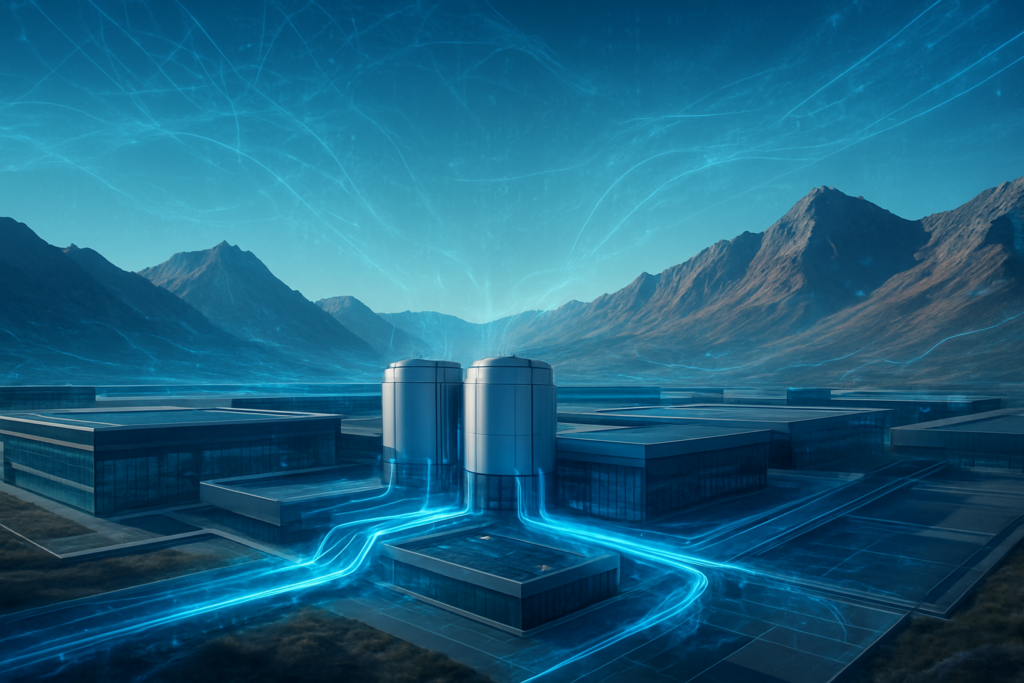
At the technical core of the HTS vision is the deployment of the Holtec SMR-300, an advanced pressurized light water reactor developed by its strategic partner, Holtec International. Unlike traditional gigawatt-scale nuclear plants that take decades to permit and build, the SMR-300 is designed for modularity and rapid deployment. Each unit produces 300 megawatts of electrical power (MWe), but HTS’s standard "dual-unit" configuration is optimized for a total output of 646 MWe. This specific scale is tailored to support a modern AI "gigawatt campus," providing a concentrated power source that matches the footprint of massive data center clusters.
A key technical differentiator in the HTS strategy is the focus on "air-cooled" condenser systems, a critical adaptation for the arid regions of the Mountain West where water scarcity often stymies industrial growth. While traditional nuclear plants require massive amounts of water for cooling, the SMR-300’s ability to operate efficiently in dry climates allows HTS to co-location power plants and data centers in locations previously considered non-viable. Furthermore, the reactor is designed with "walk-away safe" passive cooling systems. In the event of a total system failure, gravity-driven cooling ensures the reactor shuts down and remains stable without human intervention or external power, a level of safety that has significantly eased regulatory hurdles and public concerns.
Beyond the reactor itself, HTS is building what it calls a "comprehensive nuclear-AI ecosystem." This includes the METCON (Metal-Concrete) containment structures designed to withstand extreme external threats and a centralized manufacturing hub for nuclear components. Industry experts have praised this vertically integrated approach, noting that it addresses the "deliverability shock" predicted for 2026. By controlling the supply chain and the maintenance infrastructure, HTS is able to guarantee uptimes that traditional grid-connected facilities simply cannot match.
Powering the Hyperscalers: The Competitive Shift to Firm Energy
The HTS initiative comes at a time when tech giants like Microsoft (NASDAQ: MSFT), Alphabet Inc. (NASDAQ: GOOGL), and Amazon.com, Inc. (NASDAQ: AMZN) are increasingly desperate for "firm" carbon-free power. While these companies initially led the charge in wind and solar procurement, the intermittent nature of renewables has proven insufficient for the 24/7 demands of high-performance AI training. The HTS model of "nuclear-to-chip" co-location offers these hyperscalers a way to secure their energy future independently of the public grid, which is currently struggling under the weight of a 30% annual growth rate in AI energy consumption.
For companies like Amazon, which recently acquired data centers co-located with existing nuclear plants through deals with Talen Energy (NASDAQ: TLN), the HTS vision represents the next logical step: building new, dedicated nuclear capacity from the ground up. This shift creates a significant strategic advantage for early adopters. By securing long-term, fixed-price nuclear power through HTS-managed ecosystems, AI labs can insulate themselves from the volatility of energy markets and the rising costs of grid modernization. Meanwhile, utilities like Constellation Energy Corporation (NASDAQ: CEG) and Vistra Corp. (NYSE: VST) are watching closely as HTS proves the viability of "behind-the-meter" nuclear power as a standalone product.
The HTS strategy also disrupts the traditional relationship between tech companies and state governments. By partnering with the State of Utah under Governor Spencer Cox’s "Operation Gigawatt," HTS has created a blueprint for regional energy independence. This "Utah Model" is expected to attract billions in AI investment, as data center operators prioritize locations where power is not only green but guaranteed. Analysts suggest that the ability to deploy power in 300-megawatt increments allows for a more "agile" infrastructure buildout, enabling tech companies to scale their energy footprint in lockstep with their compute needs.
A National Security Imperative: The Broader AI Landscape
The emergence of the HTS nuclear-AI vision reflects a broader trend in which energy policy and national security are becoming inextricably linked to artificial intelligence. As of early 2026, the U.S. government has increasingly viewed AI sovereign power as a matter of domestic stability. The HTS Mountain West initiative is framed not just as a commercial venture, but as a "critical infrastructure" project designed to ensure that the U.S. maintains its lead in AI research without compromising the stability of the civilian electrical grid.
This move marks a significant milestone in the evolution of the AI industry, comparable to the transition from CPU-based computing to the GPU revolution. If the 2023-2024 era was defined by who had the most H100s, the 2026 era is defined by who has the most stable megawatts. HTS is the first to bridge this gap with a specialized service model that treats nuclear energy as a high-tech service rather than a legacy utility. This has sparked a "nuclear renaissance" that is more focused on industrial application than residential supply, a paradigm shift that could define the energy landscape for the next several decades.
However, the vision is not without its critics and concerns. Environmental groups remain divided on the rapid expansion of nuclear power, though the carbon-free nature of the technology has won over many former skeptics in the face of the climate crisis. There are also concerns regarding the "bifurcation" of the energy grid—where high-tech "AI islands" enjoy premium, dedicated power while the general public relies on an increasingly strained and aging national grid. HTS has countered this by arguing that their "excess capacity" strategies will eventually provide a stabilizing effect on the broader market as their technology matures.
The Road Ahead: Scaling the Nuclear-AI Workforce
Looking toward the late 2020s, the success of the HTS vision will depend heavily on its ability to scale the human element of the nuclear equation. In January 2026, HTS announced a massive expansion of its workforce development programs, specifically targeting military veterans through its SkillBridge partnership. The company aims to train thousands of specialized nuclear technicians to operate its SMR-300 fleet, recognizing that a lack of skilled labor is one of the few remaining hurdles to its "gigawatt campus" rollout.
Near-term developments include the ground-breaking of the first Master-Planned Digital Infrastructure Park in Utah, which is expected to be the world's first fully nuclear-powered AI research zone. Following this, HTS is rumored to be in talks with several defense contractors and frontier AI labs to establish similar hubs in the Pacific Northwest and the Appalachian region. The potential applications for this "isolated power" model extend beyond AI, including the production of green hydrogen and industrial-scale desalination, all powered by the same modular nuclear technology.
Final Assessment: A New Era of Energy Sovereignty
The HTS vision for a nuclear-powered AI future represents one of the most significant developments in the tech-energy sector this decade. By combining the safety and scalability of the Holtec SMR-300 with a specialized service-first business model, HTS is providing a viable path forward for an AI industry that was beginning to suffocate under its own energy requirements. The "Mountain West Crossroads" is more than just a power project; it is the first true instance of "Energy-as-a-Service" tailored for the age of intelligence.
As we move through 2026, the industry will be watching the Utah deployment closely as a proof-of-concept for the rest of the world. The key takeaways are clear: the future of AI is carbon-free, it is modular, and it is increasingly independent of the traditional electrical grid. HTS has positioned itself at the nexus of these two vital industries, and its success may very well determine the speed at which the AI revolution can continue to expand.
This content is intended for informational purposes only and represents analysis of current AI developments.
TokenRing AI delivers enterprise-grade solutions for multi-agent AI workflow orchestration, AI-powered development tools, and seamless remote collaboration platforms.
For more information, visit https://www.tokenring.ai/.