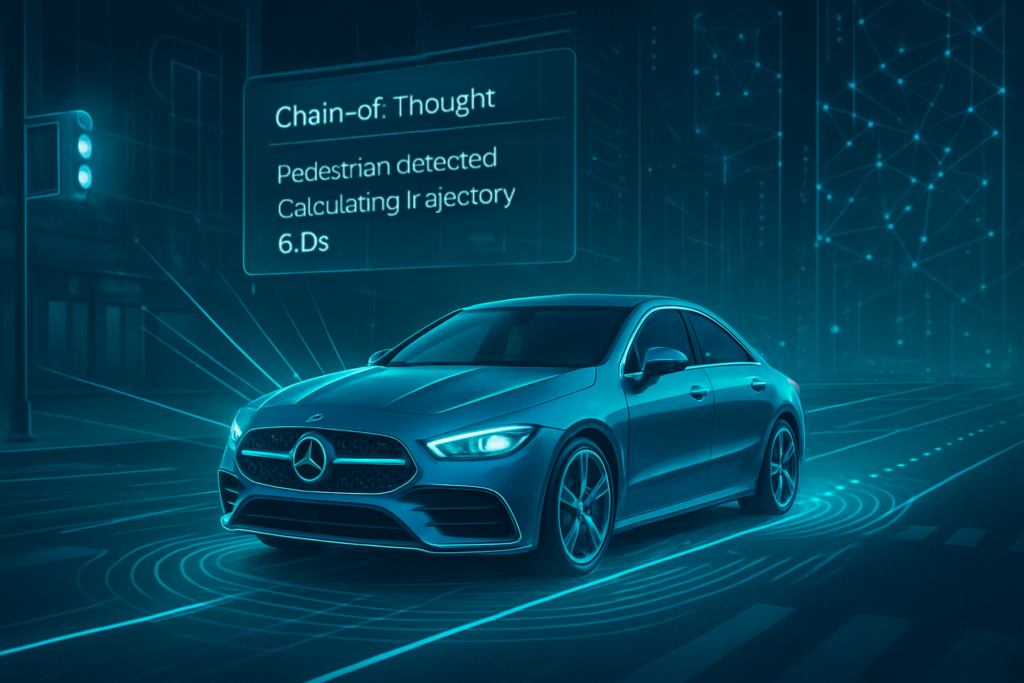
In a landmark announcement at the 2026 Consumer Electronics Show, NVIDIA (NASDAQ: NVDA) has officially unveiled the Alpamayo platform, a revolutionary leap in autonomous vehicle technology that shifts the focus from simple object detection to complex cognitive reasoning. Described by NVIDIA leadership as the "GPT-4 moment for mobility," Alpamayo marks the industry’s first comprehensive transition to "Physical AI"—systems that don't just see the world but understand the causal relationships within it.
The platform's debut coincides with its first commercial integration in the 2026 Mercedes-Benz (ETR: MBG) CLA, which will hit U.S. roads this quarter. By moving beyond traditional "black box" neural networks and into the realm of Vision-Language-Action (VLA) models, NVIDIA and Mercedes-Benz are attempting to bridge the gap between Level 2 driver assistance and the long-coveted goal of widespread, safe Level 4 autonomy.
From Perception to Reasoning: The 10B VLA Breakthrough
At the heart of the Alpamayo platform lies Alpamayo 1, a flagship 10-billion-parameter Vision-Language-Action model. Unlike previous generations of autonomous software that relied on discrete modules for perception, planning, and control, Alpamayo 1 is an end-to-end transformer-based architecture. It is divided into two specialized components: an 8.2-billion-parameter "Cosmos-Reason" backbone that handles semantic understanding of the environment, and a 2.3-billion-parameter "Action Expert" that translates those insights into a 6-second future trajectory at 10Hz.
The most significant technical advancement is the introduction of "Chain-of-Thought" (CoT) reasoning, or what NVIDIA calls "Chain-of-Causation." Traditional AI driving systems often fail in "long-tail" scenarios—rare events like a child chasing a ball into the street or a construction worker using non-standard hand signals—because they cannot reason through the why of a situation. Alpamayo solves this by generating internal reasoning traces. For example, if the car slows down unexpectedly, the system doesn't just execute a braking command; it processes the logic: "Observing a ball roll into the street; inferring a child may follow; slowing to 15 mph and covering the brake to mitigate collision risk."
This shift is powered by the NVIDIA DRIVE AGX Thor system-on-a-chip, built on the Blackwell architecture. Delivering 508 TOPS (Trillions of Operations Per Second), Thor provides the immense computational headroom required to run these massive VLA models in real-time with less than 100ms of latency. This differentiates Alpamayo from legacy approaches by Mobileye (NASDAQ: MBLY) or older Tesla (NASDAQ: TSLA) FSD versions, which traditionally lacked the on-board compute to run high-parameter language-based reasoning alongside vision processing.
Shaking Up the Autonomous Arms Race
NVIDIA's decision to launch Alpamayo as an open-source ecosystem is a strategic masterstroke intended to position the company as the "Android of Autonomy." By providing not just the model, but also the AlpaSim simulation framework and over 100 terabytes of curated "Physical AI" datasets, NVIDIA is lowering the barrier to entry for other automakers. This puts significant pressure on vertical competitors like Tesla, whose FSD (Full Self-Driving) stack remains a proprietary "walled garden."
For Mercedes-Benz, the early adoption of Alpamayo in the CLA provides a massive market advantage in the luxury segment. While the initial release is categorized as a "Level 2++" system—requiring driver supervision—the hardware is fully L4-ready. This allows Mercedes to collect vast amounts of "reasoning data" from real-world fleets, which can then be distilled into smaller, more efficient models. Other major players, including Jaguar Land Rover and Lucid (NASDAQ: LCID), have already signaled their intent to adopt parts of the Alpamayo stack, potentially creating a unified standard for how AI cars "think."
The Wider Significance: Explainability and the Safety Gap
The launch of Alpamayo addresses the single biggest hurdle to autonomous vehicle adoption: trust. By making the AI's "thought process" transparent through Chain-of-Thought reasoning, NVIDIA is providing regulators and insurance companies with an audit trail that was previously impossible. In the event of a near-miss or accident, engineers can now look at the model's reasoning trace to understand the logic behind a specific maneuver, moving AI from a "black box" to an "open book."
This move fits into a broader trend of "Explainable AI" (XAI) that is sweeping the tech industry. As AI agents begin to handle physical tasks—from warehouse robotics to driving—the ability to justify actions in human-readable terms becomes a safety requirement rather than a feature. However, this also raises new concerns. Critics argue that relying on large-scale models could introduce "hallucinations" into driving behavior, where a car might "reason" its way into a dangerous action based on a misunderstood visual cue. NVIDIA has countered this by implementing a "dual-stack" architecture, where a classical safety monitor (NVIDIA Halos) runs in parallel to the AI to veto any kinematically unsafe commands.
The Horizon: Scaling Physical AI
In the near term, expect the Alpamayo platform to expand rapidly beyond the Mercedes-Benz CLA. NVIDIA has already hinted at "Alpamayo Mini" models—highly distilled versions of the 10B VLA designed to run on lower-power chips for mid-range and budget vehicles. As more OEMs join the ecosystem, the "Physical AI Open Datasets" will grow exponentially, potentially solving the autonomous driving puzzle through sheer scale of shared data.
Long-term, the implications of Alpamayo reach far beyond the automotive industry. The "Cosmos-Reason" backbone is fundamentally a physical-world simulator. The same logic used to navigate a busy intersection in a CLA could be adapted for humanoid robots in manufacturing or delivery drones. Experts predict that within the next 24 months, we will see the first "zero-shot" autonomous deployments, where vehicles can navigate entirely new cities they have never been mapped in, simply by reasoning through the environment the same way a human driver would.
A New Era for the Road
The launch of NVIDIA Alpamayo and its debut in the Mercedes-Benz CLA represents a pivot point in the history of artificial intelligence. We are moving away from an era where cars were programmed with rules, and into an era where they are taught to think. By combining 10-billion-parameter scale with explainable reasoning, NVIDIA is addressing the complexity of the real world with the nuance it requires.
The significance of this development cannot be overstated; it is a fundamental redesign of the relationship between machine perception and action. In the coming weeks and months, the industry will be watching the Mercedes-Benz CLA's real-world performance closely. If Alpamayo lives up to its promise of solving the "long-tail" of driving through human-like logic, the path to a truly driverless future may finally be clear.
This content is intended for informational purposes only and represents analysis of current AI developments.
TokenRing AI delivers enterprise-grade solutions for multi-agent AI workflow orchestration, AI-powered development tools, and seamless remote collaboration platforms.
For more information, visit https://www.tokenring.ai/.