As of January 13, 2026, the artificial intelligence industry has reached a pivotal juncture in its hardware evolution. The "Memory Wall"—the performance gap between ultra-fast processors and the memory that feeds them—is finally being dismantled. This week marks a definitive shift as SK Hynix (KRX: 000660) and Samsung Electronics (KRX: 005930) move into high-gear production of HBM4, the next generation of High Bandwidth Memory. This transition isn't just an incremental update; it is a fundamental architectural redesign centered on a new 2,048-bit interface that promises to double the data throughput available to the world’s most powerful generative AI models.
The immediate significance of this development cannot be overstated. As large language models (LLMs) push toward multi-trillion parameter scales, the bottleneck has shifted from raw compute power to memory bandwidth. HBM4 provides the essential "oxygen" for these massive models to breathe, offering per-stack bandwidth of up to 2.8 TB/s. With major players like NVIDIA (NASDAQ: NVDA) and AMD (NASDAQ: AMD) integrating these stacks into their 2026 flagship accelerators, the race for HBM4 dominance has become the most critical subplot in the global AI arms race, determining which hardware platforms will lead the next decade of autonomous intelligence.
The Technical Leap: Doubling the Highway
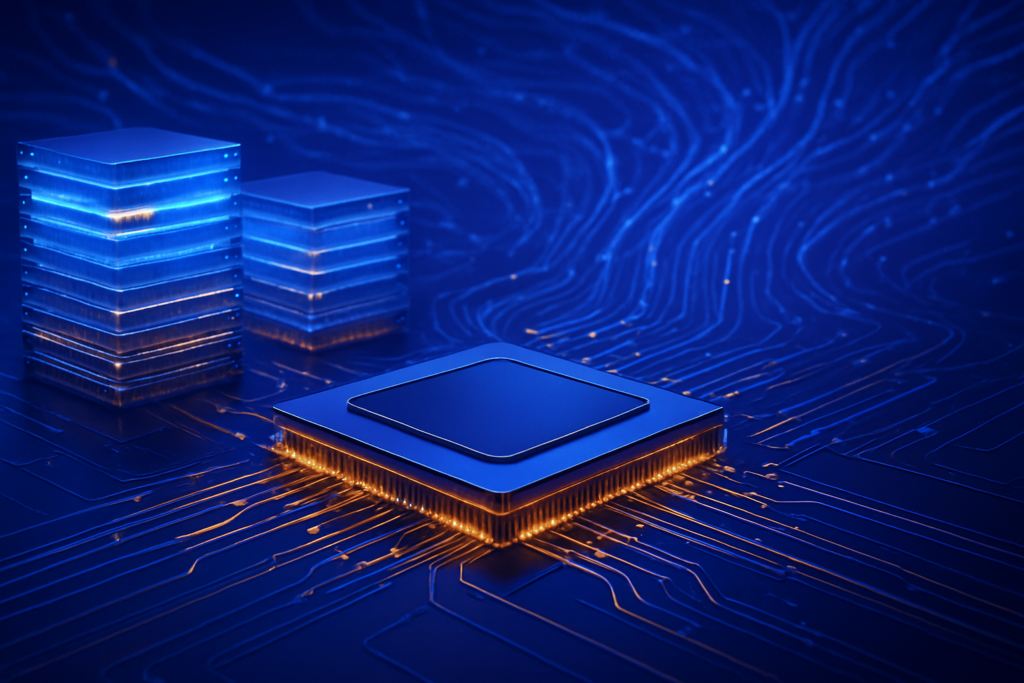
The move to HBM4 represents the most significant technical overhaul in the history of memory. For the first time, the industry is transitioning from a 1,024-bit interface—a standard that held firm through HBM2 and HBM3—to a massive 2,048-bit interface. By doubling the number of I/O pins, manufacturers can achieve unprecedented data transfer speeds while actually reducing the clock speed and power consumption per bit. This architectural shift is complemented by the transition to 16-high (16-Hi) stacking, allowing for individual memory stacks with capacities ranging from 48GB to 64GB.
Another groundbreaking technical change in HBM4 is the introduction of a logic base die manufactured on advanced foundry nodes. Previously, HBM base dies were built using standard DRAM processes. However, HBM4 requires the foundation of the stack to be a high-performance logic chip. SK Hynix has partnered with TSMC (NYSE: TSM) to utilize their 5nm and 12nm nodes for these base dies, allowing for "Custom HBM" where AI-specific controllers are integrated directly into the memory. Samsung, meanwhile, is leveraging its internal "one-stop shop" advantage, using its own 4nm foundry process to create a vertically integrated solution that promises lower latency and improved thermal management.
The packaging techniques used to assemble these 16-layer skyscrapers are equally sophisticated. SK Hynix is employing an advanced version of its Mass Reflow Molded Underfill (MR-MUF) technology, thinning wafers to a mere 30 micrometers to keep the entire stack within the JEDEC-specified height limits. Samsung is aggressively pivoting toward Hybrid Bonding (copper-to-copper direct contact), a method that eliminates traditional micro-bumps. Industry experts suggest that Hybrid Bonding could be the "holy grail" for HBM4, as it significantly reduces thermal resistance—a critical factor for GPUs like NVIDIA’s upcoming Rubin platform, which are expected to exceed 1,000W in power draw.
The Corporate Duel: Strategic Alliances and Vertical Integration
The competitive landscape of 2026 has bifurcated into two distinct strategic philosophies. SK Hynix, which currently holds a market share lead of roughly 55%, has doubled down on its "Trilateral Alliance" with TSMC and NVIDIA. By outsourcing the logic die to TSMC, SK Hynix has effectively tethered its success to the world’s leading foundry and its primary customer. This ecosystem-centric approach has allowed them to remain the preferred vendor for NVIDIA's Blackwell and now the newly unveiled "Rubin" (R100) architecture, which features eight stacks of HBM4 for a staggering 22 TB/s of aggregate bandwidth.
Samsung Electronics, however, is executing a "turnkey" strategy aimed at disrupting the status quo. By handling the DRAM fabrication, logic die manufacturing, and advanced 3D packaging all under one roof, Samsung aims to offer better price-to-performance ratios and faster customization for bespoke AI silicon. This strategy bore major fruit early this year with a reported $16.5 billion deal to supply Tesla (NASDAQ: TSLA) with HBM4 for its next-generation Dojo supercomputer chips. While Samsung struggled during the HBM3e era, its early lead in Hybrid Bonding and internal foundry capacity has positioned it as a formidable challenger to the SK Hynix-TSMC hegemony.
Micron Technology (NASDAQ: MU) also remains a key player, focusing on high-efficiency HBM4 designs for the enterprise AI market. While smaller in scale compared to the South Korean giants, Micron’s focus on power-per-watt has earned it significant slots in AMD’s new Helios (Instinct MI455X) accelerators. The battle for market positioning is no longer just about who can make the most chips, but who can offer the most "customizable" memory. As hyperscalers like Amazon and Google design their own AI chips (TPUs and Trainium), the ability for memory makers to integrate specific logic functions into the HBM4 base die has become a critical strategic advantage.
The Global AI Landscape: Breaking the Memory Wall
The arrival of HBM4 is a milestone that reverberates far beyond the semiconductor industry; it is a prerequisite for the next stage of AI democratization. Until now, the high cost and limited availability of high-bandwidth memory have concentrated the most advanced AI capabilities within a handful of well-funded labs. By providing a 2x leap in bandwidth and capacity, HBM4 enables more efficient training of "Sovereign AI" models and allows smaller data centers to run more complex inference tasks. This fits into the broader trend of AI shifting from experimental research to ubiquitous infrastructure.
However, the transition to HBM4 also brings concerns regarding the environmental footprint of AI. While the 2,048-bit interface is more efficient on a per-bit basis, the sheer density of these 16-layer stacks creates immense thermal challenges. The move toward liquid-cooled data centers is no longer an option but a requirement for 2026-era hardware. Comparison with previous milestones, such as the introduction of HBM1 in 2013, shows just how far the industry has come: HBM4 offers nearly 20 times the bandwidth of its earliest ancestor, reflecting the exponential growth in demand fueled by the generative AI explosion.
Potential disruption is also on the horizon for traditional server memory. As HBM4 becomes more accessible and customizable, we are seeing the beginning of the "Memory-Centric Computing" era, where processing is moved closer to the data. This could eventually threaten the dominance of standard DDR5 memory in high-performance computing environments. Industry analysts are closely watching whether the high costs of HBM4 production—estimated to be several times that of standard DRAM—will continue to be absorbed by the high margins of the AI sector or if they will eventually lead to a cooling of the current investment cycle.
Future Horizons: Toward HBM4e and Beyond
Looking ahead, the roadmap for memory is already stretching toward the end of the decade. Near-term, we expect to see the announcement of HBM4e (Enhanced) by late 2026, which will likely push pin speeds toward 14 Gbps and expand stack heights even further. The successful implementation of Hybrid Bonding will be the gateway to HBM5, where we may see the total merging of logic and memory layers into a single, monolithic 3D structure. Experts predict that by 2028, we will see "In-Memory Processing" where simple AI calculations are performed within the HBM stack itself, further reducing latency.
The applications on the horizon are equally transformative. With the massive memory capacity afforded by HBM4, the industry is moving toward "World Models" that can process hours of high-resolution video or massive scientific datasets in a single context window. However, challenges remain—particularly in yield rates for 16-high stacks and the geopolitical complexities of the semiconductor supply chain. Ensuring that HBM4 production can scale to meet the demand of the "Agentic AI" era, where millions of autonomous agents will require constant memory access, will be the primary task for engineers over the next 24 months.
Conclusion: The Backbone of the Intelligent Era
In summary, the HBM4 race is the definitive battleground for the next phase of the AI revolution. SK Hynix’s collaborative ecosystem and Samsung’s vertically integrated "one-stop shop" represent two distinct paths toward solving the same fundamental problem: the insatiable need for data speed. The shift to a 2,048-bit interface and the integration of logic dies mark the point where memory ceased to be a passive storage medium and became an active, intelligent component of the AI processor itself.
As we move through 2026, the success of these companies will be measured by their ability to achieve high yields in the difficult 16-layer assembly process and their capacity to innovate in thermal management. This development will likely be remembered as the moment the "Memory Wall" was finally breached, enabling a new generation of AI models that are faster, more capable, and more efficient than ever before. Investors and tech enthusiasts should keep a close eye on the Q1 and Q2 earnings reports of the major players, as the first volume shipments of HBM4 begin to reshape the financial and technological landscape of the AI industry.
This content is intended for informational purposes only and represents analysis of current AI developments.
TokenRing AI delivers enterprise-grade solutions for multi-agent AI workflow orchestration, AI-powered development tools, and seamless remote collaboration platforms.
For more information, visit https://www.tokenring.ai/.