Banking and retail technology provider Diebold Nixdorf (NYSE: DBD) announced better-than-expected revenue in Q1 CY2026, with sales up 6% year on year to $891.8 million. The company expects the full year’s revenue to be around $3.9 billion, close to analysts’ estimates. Its non-GAAP profit of $0.67 per share was 8.6% above analysts’ consensus estimates.
Is now the time to buy Diebold Nixdorf? Find out by accessing our full research report, it’s free.
Diebold Nixdorf (DBD) Q1 CY2026 Highlights:
- Revenue: $891.8 million vs analyst estimates of $857.9 million (6% year-on-year growth, 3.9% beat)
- Adjusted EPS: $0.67 vs analyst estimates of $0.62 (8.6% beat)
- Adjusted EBITDA: $99.1 million vs analyst estimates of $88.4 million (11.1% margin, 12.1% beat)
- The company reconfirmed its revenue guidance for the full year of $3.9 billion at the midpoint
- Management reiterated its full-year Adjusted EPS guidance of $5.50 at the midpoint
- EBITDA guidance for the full year is $522.5 million at the midpoint, in line with analyst expectations
- Operating Margin: 3.7%, in line with the same quarter last year
- Free Cash Flow Margin: 2.3%, up from 0.7% in the same quarter last year
- Market Capitalization: $2.89 billion
Company Overview
With roots dating back to 1859 and a presence in over 100 countries, Diebold Nixdorf (NYSE: DBD) provides automated self-service technology, software, and services that help banks and retailers digitize their customer transactions.
Revenue Growth
Reviewing a company’s long-term sales performance reveals insights into its quality. Even a bad business can shine for one or two quarters, but a top-tier one grows for years.
With $3.86 billion in revenue over the past 12 months, Diebold Nixdorf is one of the larger companies in the business services industry and benefits from a well-known brand that influences purchasing decisions. However, its scale is a double-edged sword because it’s challenging to maintain high growth rates when you’ve already captured a large portion of the addressable market. For Diebold Nixdorf to boost its sales, it likely needs to adjust its prices, launch new offerings, or lean into foreign markets.
As you can see below, Diebold Nixdorf struggled to increase demand as its $3.86 billion of sales for the trailing 12 months was close to its revenue five years ago. This shows demand was soft, a tough starting point for our analysis.
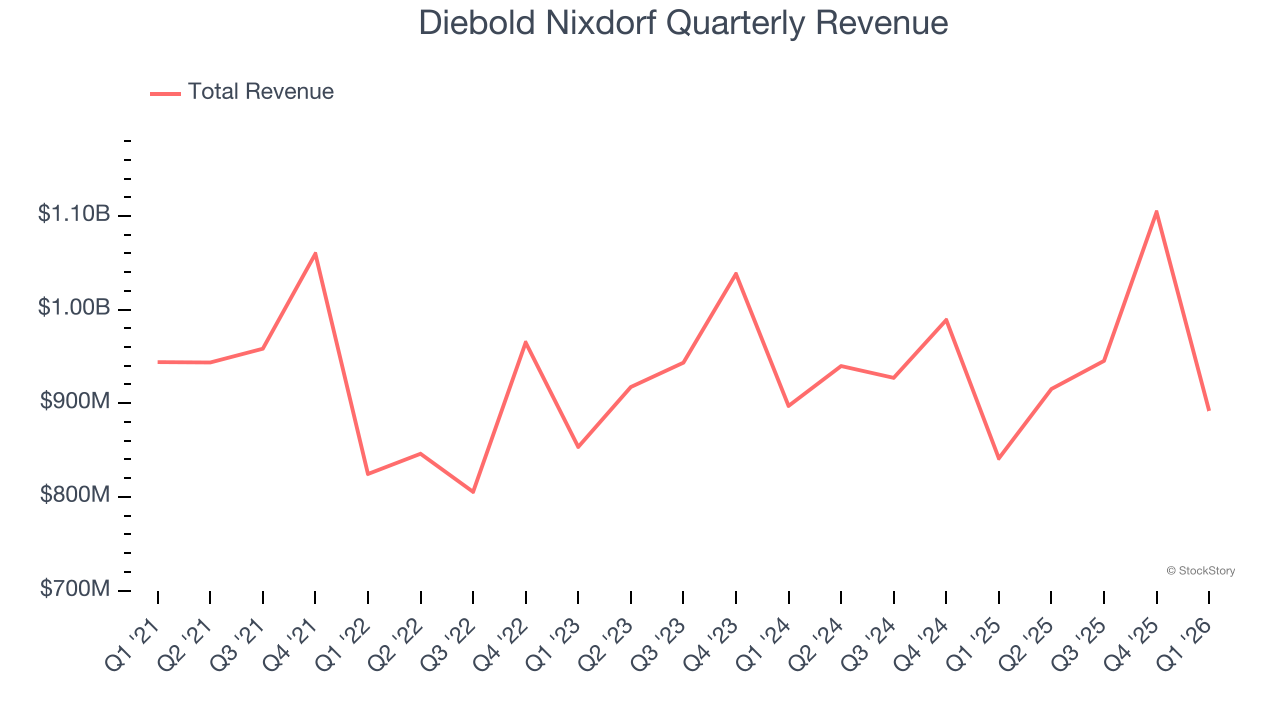
We at StockStory place the most emphasis on long-term growth, but within business services, a half-decade historical view may miss recent innovations or disruptive industry trends. Just like its five-year trend, Diebold Nixdorf’s revenue over the last two years was flat, suggesting it is in a slump. 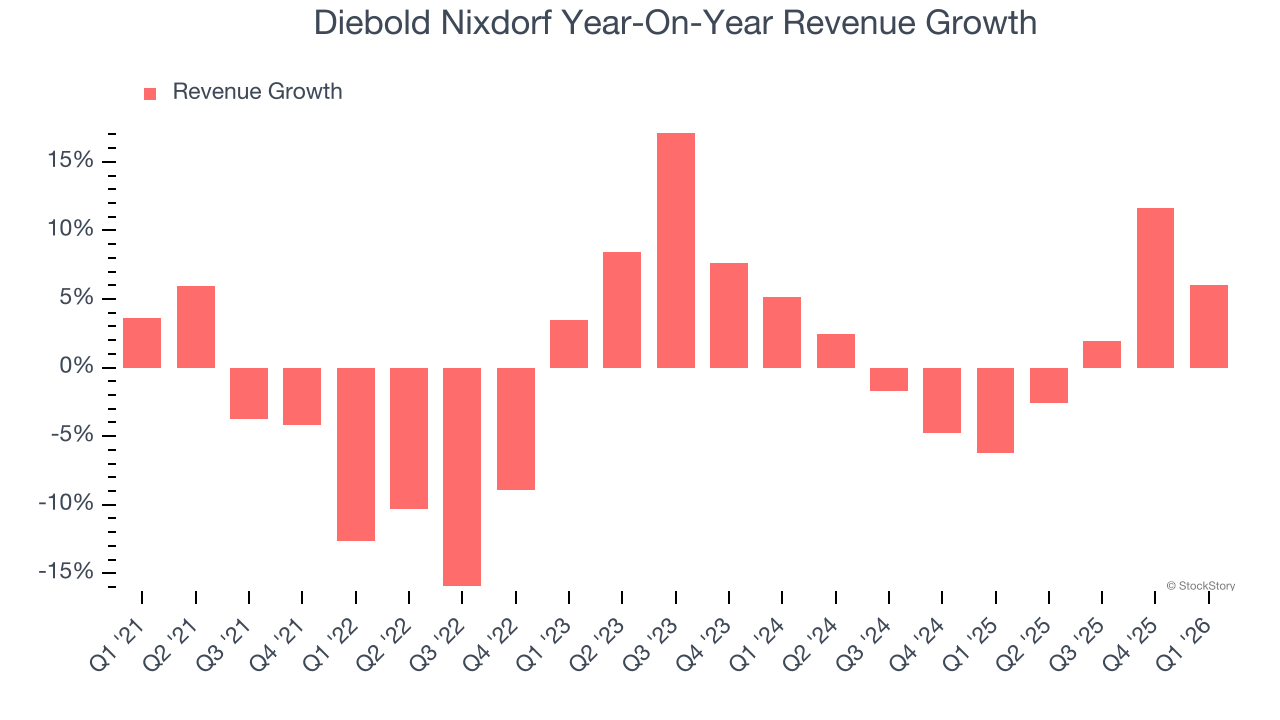
This quarter, Diebold Nixdorf reported year-on-year revenue growth of 6%, and its $891.8 million of revenue exceeded Wall Street’s estimates by 3.9%.
Looking ahead, sell-side analysts expect revenue to grow 1.8% over the next 12 months, similar to its two-year rate. While this projection suggests its newer products and services will fuel better top-line performance, it is still below the sector average.
ONE MORE THING: 3 Hidden Platforms Growing 3X Faster than Amazon, Google, and PayPal. Amazon, Google, and Meta all followed the same playbook: Dominate an ignored market. Build an unbeatable moat. Scale until you’re unstoppable.
These three platforms are running that exact playbook right now. The early investors in Amazon made fortunes. The early investors in these could do the same. Get All 3 Stocks Here for FREE.
Adjusted Operating Margin
Adjusted operating margin is an important measure of profitability as it shows the portion of revenue left after accounting for all core expenses – everything from the cost of goods sold to advertising and wages. It’s also useful for comparing profitability across companies because it excludes non-recurring expenses, interest on debt, and taxes.
Diebold Nixdorf was profitable over the last five years but held back by its large cost base. Its average adjusted operating margin of 7.7% was weak for a business services business.
On the plus side, Diebold Nixdorf’s adjusted operating margin rose by 1.7 percentage points over the last five years.
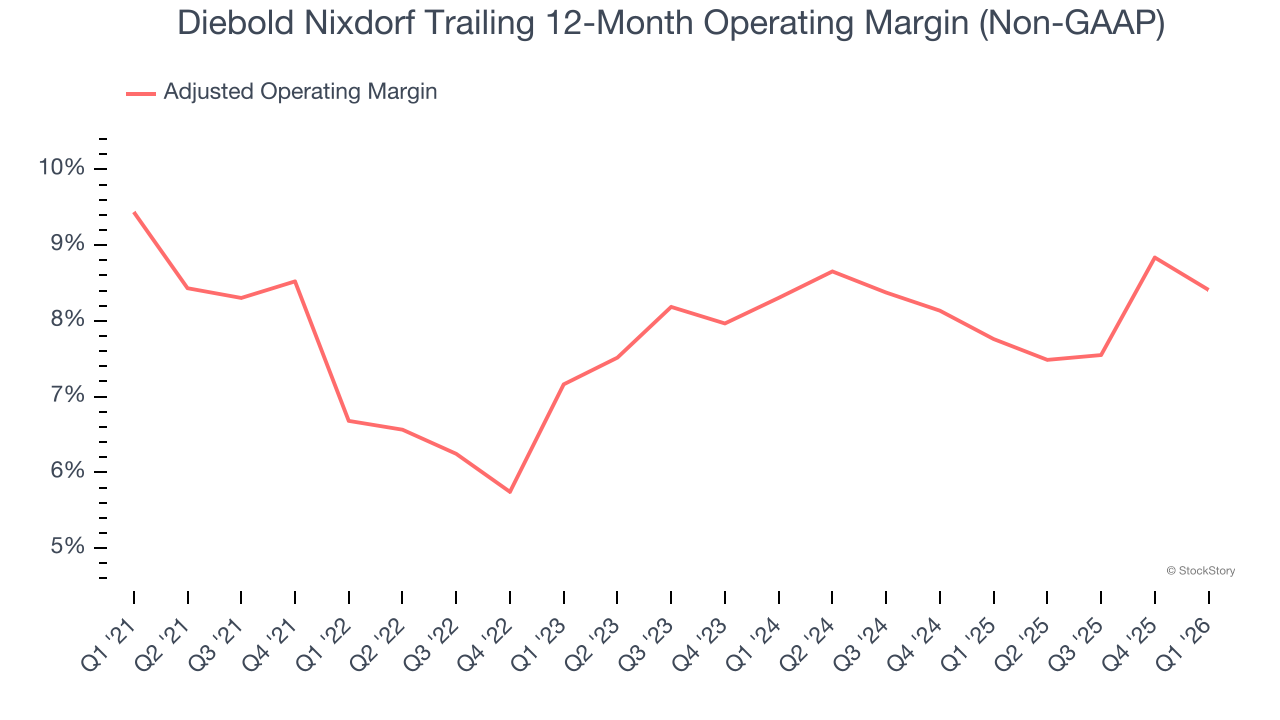
In Q1, Diebold Nixdorf generated an adjusted operating margin profit margin of 4%, down 1.7 percentage points year on year. This reduction is quite minuscule and indicates the company’s overall cost structure has been relatively stable.
Cash Is King
Free cash flow isn't a prominently featured metric in company financials and earnings releases, but we think it's telling because it accounts for all operating and capital expenses, making it tough to manipulate. Cash is king.
Diebold Nixdorf broke even from a free cash flow perspective over the last five years, giving the company limited opportunities to return capital to shareholders.
Taking a step back, an encouraging sign is that Diebold Nixdorf’s margin expanded by 8.3 percentage points during that time. The company’s improvement shows it’s heading in the right direction, and we can see it became a less capital-intensive business because its free cash flow profitability rose more than its operating profitability.
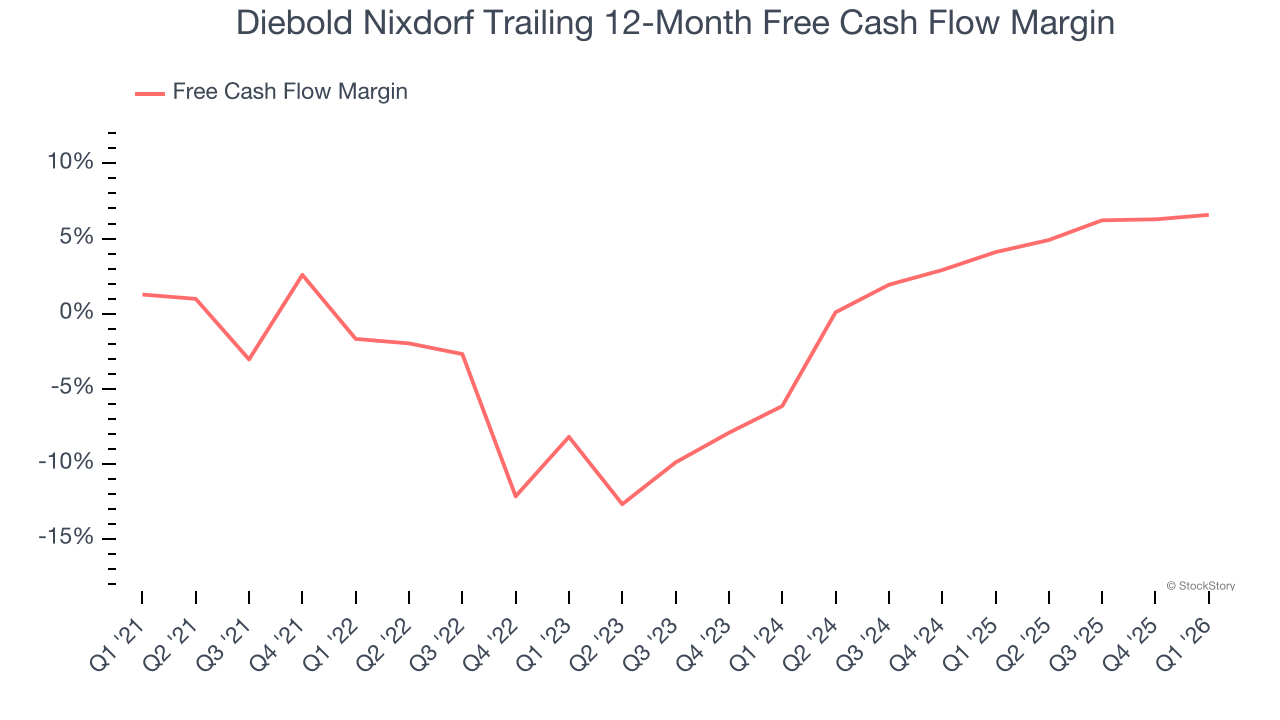
Diebold Nixdorf’s free cash flow clocked in at $20.7 million in Q1, equivalent to a 2.3% margin. This result was good as its margin was 1.6 percentage points higher than in the same quarter last year, building on its favorable historical trend.
Key Takeaways from Diebold Nixdorf’s Q1 Results
We enjoyed seeing Diebold Nixdorf beat analysts’ revenue expectations this quarter. We were also glad its EPS outperformed Wall Street’s estimates. Overall, we think this was still a solid quarter with some key areas of upside. The stock traded up 2.1% to $84.73 immediately following the results.
Diebold Nixdorf may have had a good quarter, but does that mean you should invest right now? We think that the latest quarter is only one piece of the longer-term business quality puzzle. Quality, when combined with valuation, can help determine if the stock is a buy. We cover that in our actionable full research report which you can read here (it’s free).