Beer company Molson Coors (NYSE: TAP) missed Wall Street’s revenue expectations in Q3 2026, with revenue falling 1.6% year on year to $2.93 billion. Its non-GAAP profit of $1.46 per share was in line with analysts’ consensus estimates.
For more on Molson Coors, read our free full research report.
Molson Coors (TAP) Q3 2026 highlights:
- Revenue $2.93 billion vs S&P analysts’ consensus estimates of $2.94 billion (1.6% year-on-year decline, 0.5% miss)
- Adjusted EPS $1.46 vs S&P analysts’ consensus estimates of $1.45 (in line)
- Adjusted EBITDA $592.1 million vs analysts’ consensus estimates of $596.1 million (20.2% margin, 0.7% miss)
- Operating margin 13.3%, up from -115% in the same quarter last year
- Free cash flow margin 29.1%, up from 16.3% in the same quarter last year
- Market capitalization $8.05 billion
"Since launching Horizon 2030 earlier this year, we've been laying important groundwork for long-term success by building the portfolio, capabilities, routines, and operating discipline needed to perform more consistently across the business. We've taken decisive actions intended to strengthen our share trend performance, accelerate our portfolio transformation, simplify our cost structure, and return cash to shareholders. We believe our strategy is on the right track, but these outcomes are not yet scaled enough to offset the headwinds that we experienced in the third quarter. While the road ahead may not always be linear, our objective is straightforward. Ultimately, the actions we've taken this year are intended to preserve flexibility as we execute our strategy, continue investing in the business, and build a stronger company that is positioned to create long-term value."
Revenue growth
A company’s long-term revenue performance can indicate its overall quality. Any business can deliver a good quarter or two, but the best consistently grow over the long term.
With $11.04 billion in revenue over the past 12 months, Molson Coors is one of the larger consumer staples companies and benefits from a well-known brand that influences purchasing decisions. However, its scale is a double-edged sword because it’s harder to find incremental growth when its existing brands have penetrated most of the market. To accelerate revenue growth, Molson Coors likely needs to optimize its pricing or focus on new products and international expansion.
Molson Coors’s revenue declined by 1.5% per year over the last three years as consumers bought fewer of its products.
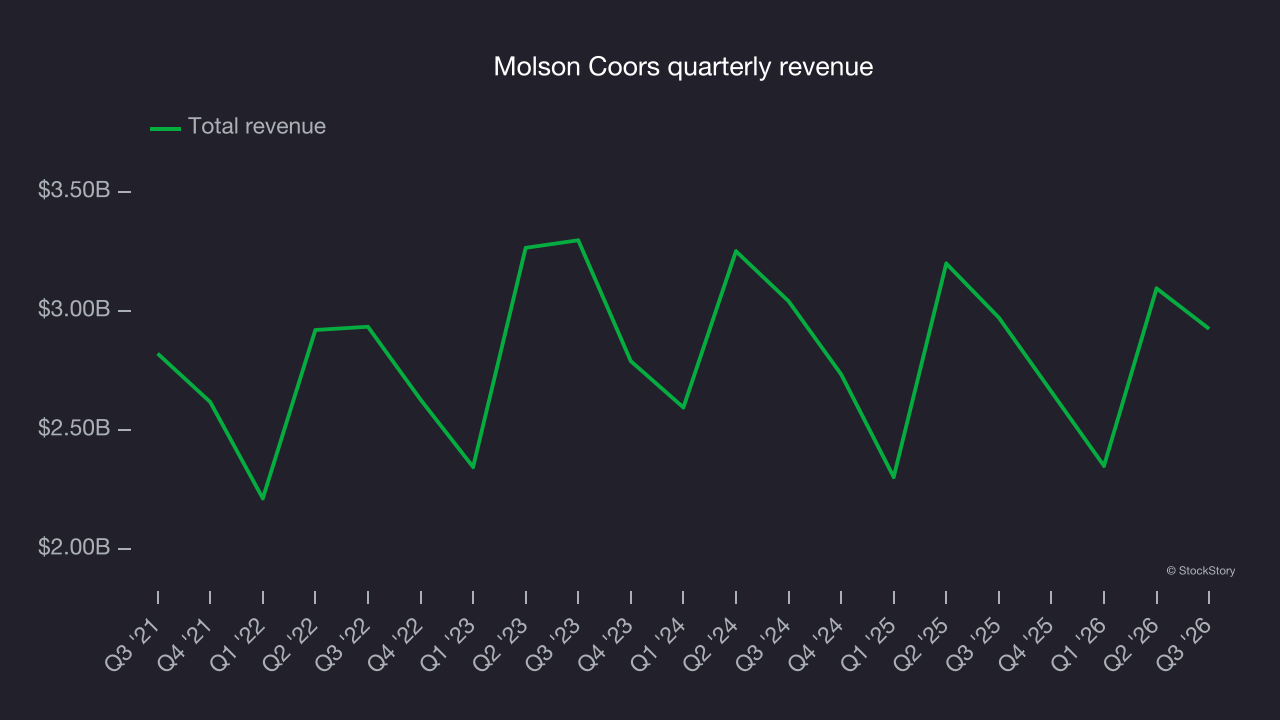
This quarter, Molson Coors missed Wall Street’s consensus estimates and reported an uninspiring 1.6% year-on-year revenue decline, generating $2.93 billion in revenue.
Looking ahead, sell-side analysts expect revenue to remain flat over the next 12 months, according to S&P. While this projection indicates its newer products will spur better top-line performance, it is still below average for the sector.
Free cash flow
Free cash flow isn’t a prominently featured metric in company financials and earnings releases, but it’s telling because it accounts for all operating and capital expenses, making it difficult to manipulate.
Molson Coors has shown strong cash profitability, driven by its attractive business model that enables it to reinvest or return capital to investors. The company’s free cash flow margin averaged 12.7% over the last two years, a high level for a consumer staples business. The divergence from its underwhelming operating margin stems from the add-back of non-cash charges like depreciation and stock-based compensation. GAAP operating profit expenses these line items, but free cash flow does not.
Molson Coors’s margin expanded by 5.6 percentage points over the last year. This is a positive development because it gives the company more flexibility.
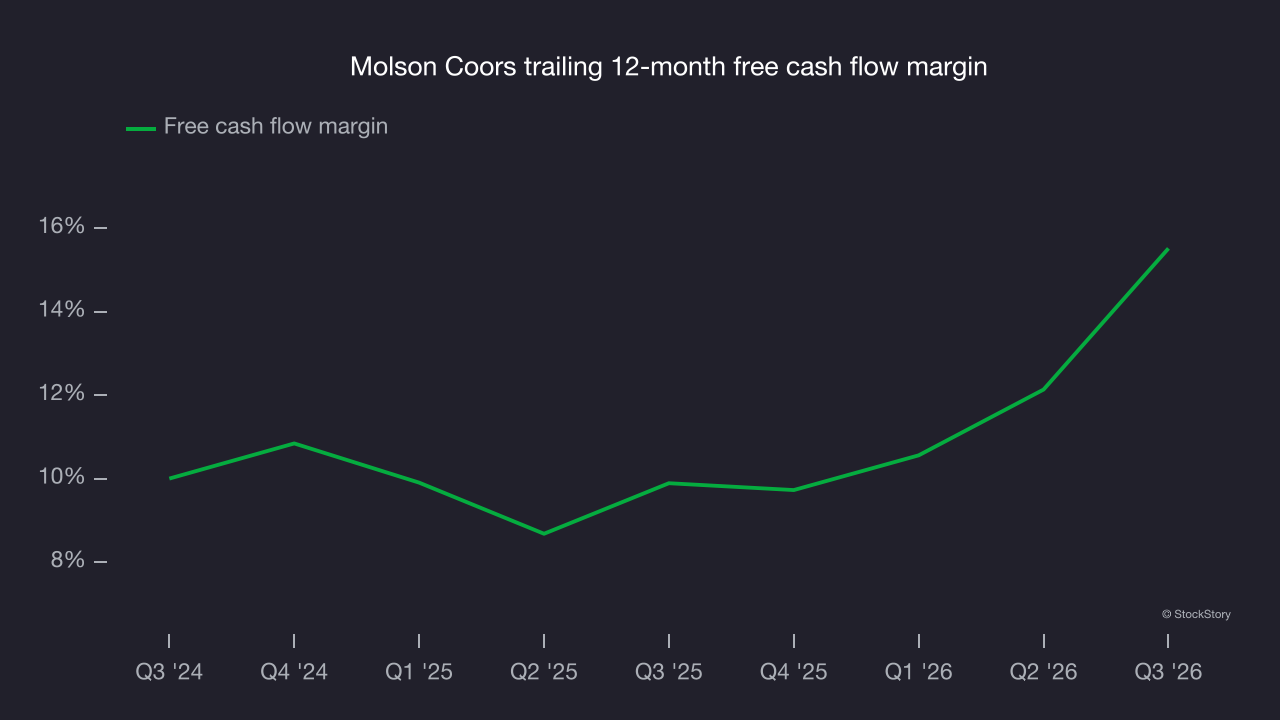
Molson Coors generated $852 million in free cash flow in Q3, equivalent to a 29.1% margin. This was a good result, with its margin 12.8 percentage points higher than in the same quarter last year, building on its favorable historical trend.
Key takeaways from Molson Coors’s Q3 results
Molson Coors’s sizable gross margin beat was a bright spot in a quarter that could have been better. EBITDA and revenue both fell slightly short of analysts’ consensus estimates. Shares fell 2.9% to $41.90 immediately after the results.
When deciding whether to buy the stock, the latest quarter matters, but not nearly as much as longer-term fundamentals and valuation. Read our full research report here (it’s free).