Toy manufacturing and entertainment company (NASDAQ: MAT) fell short of the market’s revenue expectations in Q3 2026 as revenue rose 4.1% year on year to $1.81 billion. Its non-GAAP profit of $1.30 per share was 38.3% above analysts’ consensus estimates.
For more on Mattel, read our free full research report.
Mattel (MAT) Q3 2026 highlights:
- Revenue $1.81 billion vs S&P analysts’ consensus estimates of $1.83 billion (4.1% year-on-year growth, 1.4% miss)
- Adjusted EPS $1.30 vs S&P analysts’ consensus estimates of $0.94 (38.3% beat)
- Adjusted EBITDA $542.5 million vs analysts’ consensus estimates of $453.4 million (30% margin, 19.7% beat)
- Adjusted EPS guidance Management lowered its full-year adjusted EPS guidance to $1.13 at the midpoint, a 15.4% decrease
- Operating margin 26.4%, up from 22.2% in the same quarter last year
- Free cash flow margin 1.6%, similar to the same quarter last year
- Market capitalization $4.45 billion
Roger Lynch, Chairman and CEO of Mattel, said, “My first few weeks leading Mattel have reinforced my belief in the company’s potential. I also see clearly where we must improve. We will focus our resources on our greatest opportunities and translate the strength of Mattel's portfolio and capabilities into more consistent financial performance. Our priorities are clear: strengthen our brands and win in toys, drive innovation and creativity, and invest with discipline to drive profitable growth.”
Revenue growth
A company’s long-term revenue performance is one signal of its overall quality. Even a poor business can perform well for one or two quarters, but a top-tier one grows for years. Mattel’s revenue grew at a weak 1% annualized rate over the last five years, falling short of our benchmarks.
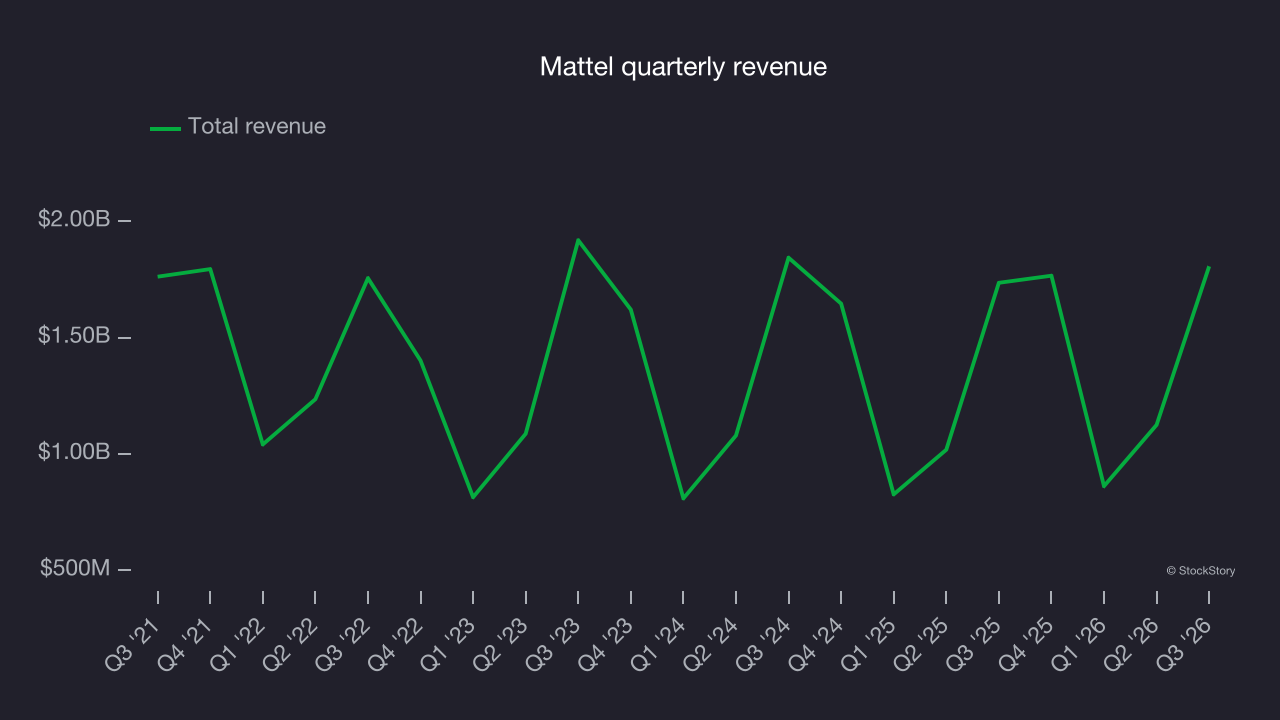
Long-term growth matters most, but within consumer discretionary, a long historical view may miss a company benefiting from a successful new product or trend. Mattel’s annualized revenue growth of 1.9% over the last two years aligns with its five-year trend, suggesting its demand was consistently weak. 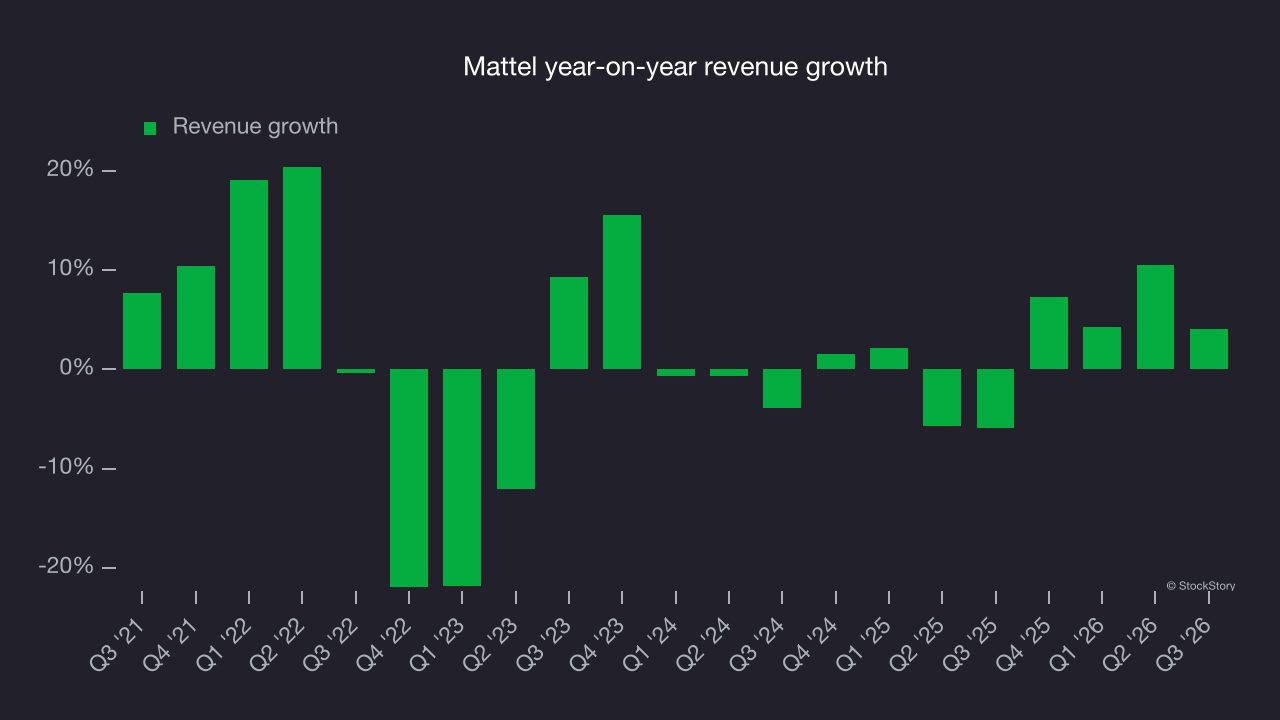
This quarter, Mattel’s revenue grew by 4.1% year on year to $1.81 billion, falling short of Wall Street’s consensus estimates.
Looking ahead, sell-side analysts expect revenue to grow 5.5% over the next 12 months, according to S&P. Although this projection implies its newer products and services will spur better top-line performance, it is still below the sector average.
Operating margin
Operating margin is an important measure of profitability as it shows the portion of revenue left after accounting for all core expenses, from the cost of goods sold to advertising and wages. It’s also useful for comparing profitability across companies with different levels of debt and tax rates because it excludes interest and taxes.
Mattel’s operating margin has shrunk over the last 12 months and averaged 10.6% over the last two years. The company’s profitability was mediocre for a consumer discretionary business and shows it couldn’t pass its higher operating expenses onto its customers.
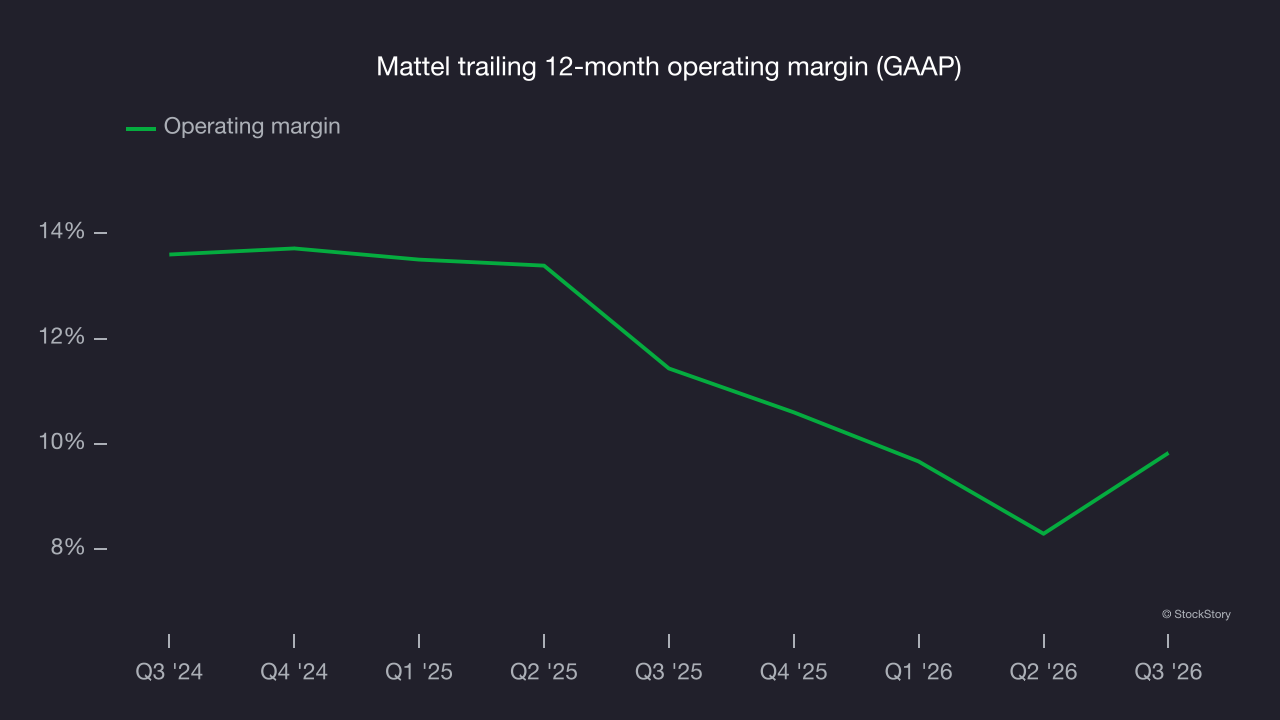
In Q3, Mattel generated an operating margin of 26.4%, up 4.2 percentage points year on year. This improvement shows it was more efficient.
Earnings per share
The long-term change in earnings per share, or EPS, matters for the same reason as long-term revenue growth. Compared to revenue, however, EPS highlights whether a company’s growth is profitable.
Mattel’s EPS grew at a 5.1% compounded annual growth rate over the last five years. On the positive side, this performance outpaced its 1% annualized revenue growth, indicating the company became more profitable on a per-share basis as it expanded.
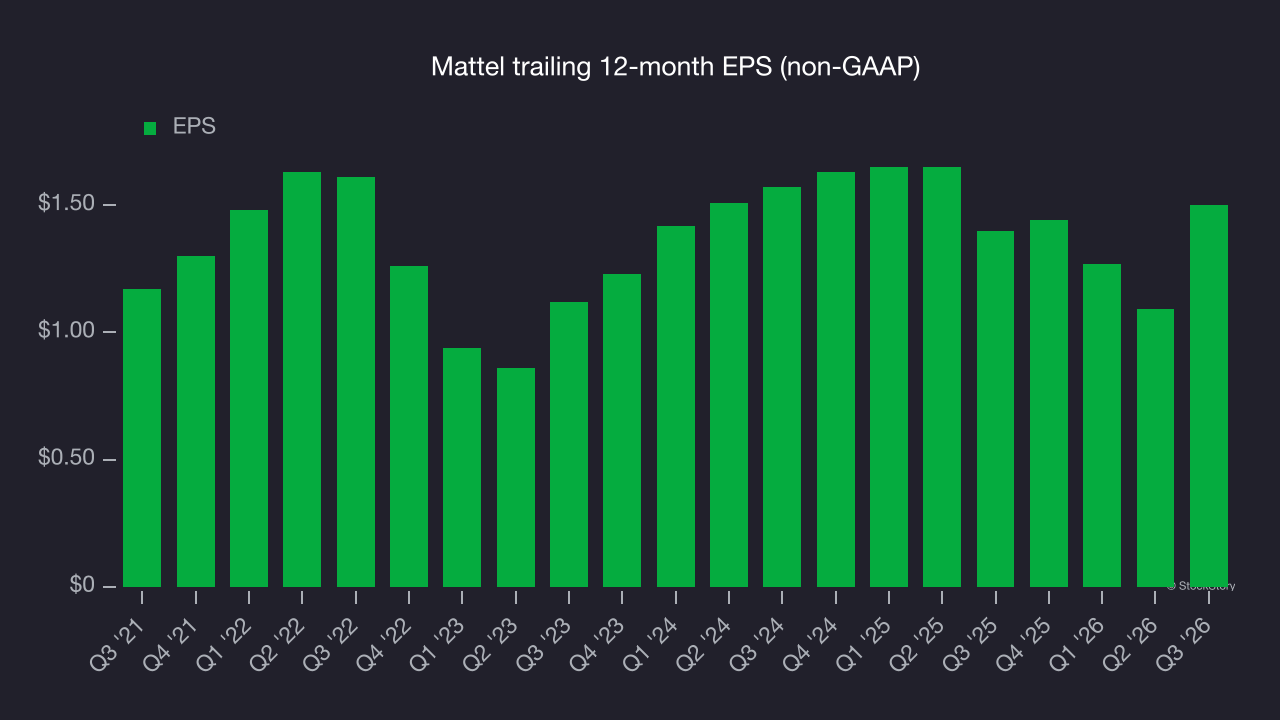
In Q3, Mattel reported adjusted EPS of $1.30, up from $0.89 in the same quarter last year. This result came in well above analysts’ consensus estimates. Over the next 12 months, Wall Street expects Mattel’s full-year EPS to stay about the same, moving from $1.50 to $1.49, according to S&P.
Key takeaways from Mattel’s Q3 results
Mattel’s EPS and EBITDA beats were bright spots in an otherwise weaker quarter. Full-year EPS guidance missed expectations, and quarterly revenue fell slightly short of Wall Street’s consensus estimates. Shares fell 3.2% to $14.47 immediately after the release.
To assess Mattel at its current price, the latest quarter is only one part of the longer-term business quality picture. Quality, combined with valuation, can help determine whether the stock is a buy. For more, read our full research report here (it’s free).