Cloud technology company Akamai Technologies (NASDAQ: AKAM) met Wall Street’s revenue expectations in Q3 2026, with revenue up 6.4% year on year to $1.12 billion. On the other hand, next quarter’s revenue guidance of $1.16 billion was less impressive, coming in 3.5% below analysts’ consensus estimates. Its non-GAAP profit of $1.77 per share was 5.8% above analysts’ consensus estimates.
For more on Akamai, read our free full research report.
Akamai (AKAM) Q3 2026 highlights:
- Revenue $1.12 billion vs S&P analysts’ consensus estimates of $1.12 billion (6.4% year-on-year growth, in line)
- Adjusted EPS $1.77 vs S&P analysts’ consensus estimates of $1.67 (5.8% beat)
- Adjusted EBITDA $435.3 million vs analysts’ consensus estimates of $433.6 million (38.8% margin, in line)
- Revenue guidance $1.16 billion at the midpoint for Q4 2026, below analysts’ consensus estimates of $1.2 billion
- Adjusted EPS guidance Management lowered its full-year adjusted EPS guidance to $6.57 at the midpoint, a 2.2% decrease
- Operating margin 9.7%, down from 15.7% in the same quarter last year
- Free cash flow -$172.1 million, down from $100.5 million in the previous quarter
- Billings $1.12 billion at quarter end, up 7.8% year on year
- Market capitalization $12.35 billion
“Akamai delivered solid third quarter results, driven by continued momentum across security and Cloud Infrastructure Services (CIS),” said Dr. Tom Leighton, Akamai's Chief Executive Officer. “We are especially excited by the exceptional progress in Cloud Infrastructure Services, with more than $14 billion worth of multi-year commitments signed so far this year. We also recently expanded our cloud portfolio with the launch of Akamai Inference and Akamai Agent Sandbox. These new services enable enterprises to build and tune open-weight models based on their proprietary data and run agents within strictly enforced boundaries — all secured and powered on Akamai's AI-optimized cloud platform.
Revenue growth
A company’s long-term revenue performance can indicate its overall quality. Any business can deliver a good quarter or two, but the best consistently grow over the long haul. Over the last five years, Akamai grew its revenue at a weak 5.2% compounded annual growth rate, falling short of the software sector benchmark.
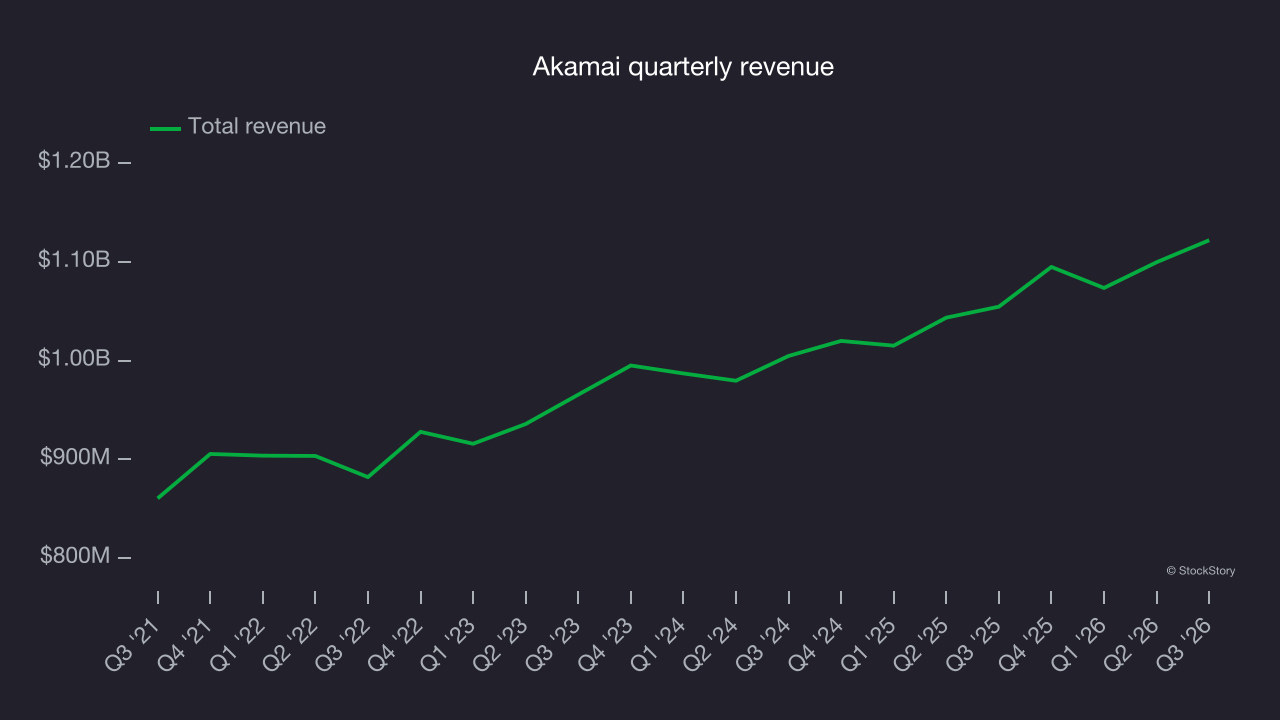
Long-term growth is the most important, but within software, a half-decade historical view may miss new innovations or demand cycles. Akamai’s annualized revenue growth of 5.2% over the last two years aligns with its five-year trend, suggesting its demand was consistently weak. 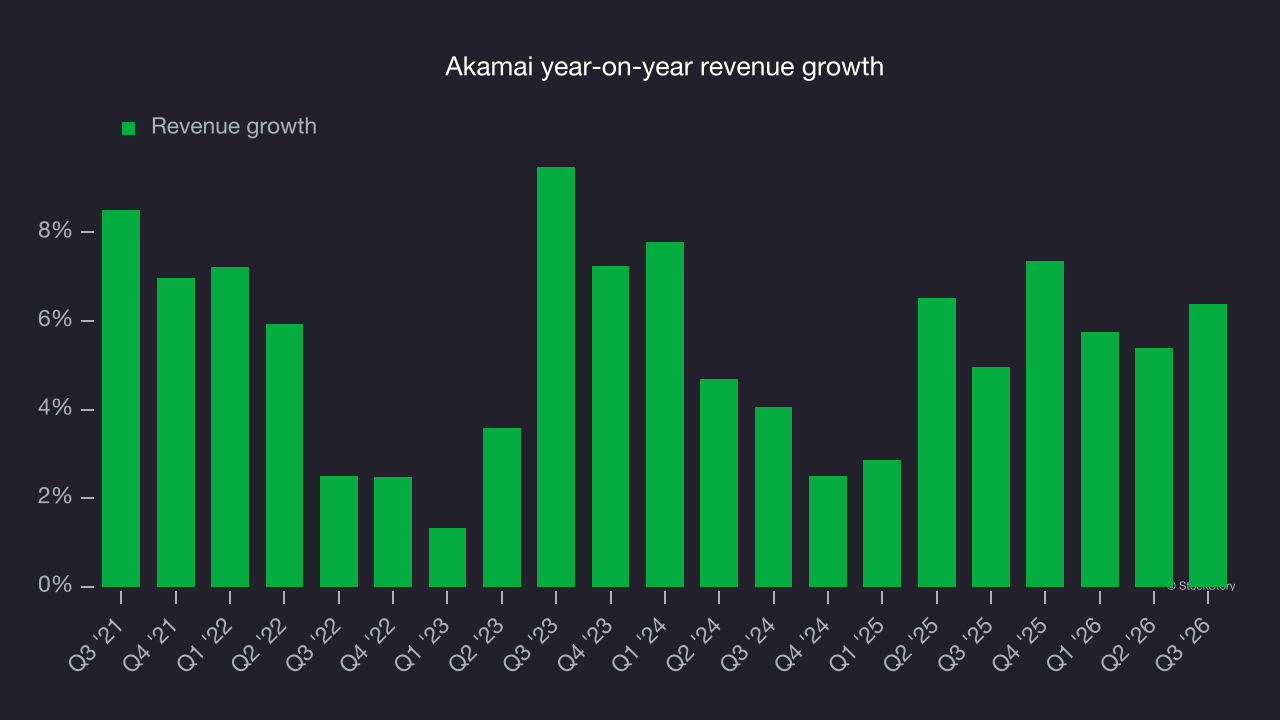
This quarter, Akamai grew its revenue by 6.4% year on year, and its $1.12 billion of revenue was in line with Wall Street’s consensus estimates. Management is guiding for a 5.7% year-on-year increase in revenue next quarter.
Looking further ahead, sell-side analysts expect revenue to grow 12.9% over the next 12 months, according to S&P. While this projection implies its newer products and services will spur better top-line performance, it is still below average for the sector.
Billings
Billings is a non-GAAP metric that is often called “cash revenue” because it shows how much money the company has collected from customers in a certain period. This is different from revenue, which must be recognized in pieces over the length of a contract.
Akamai’s billings came in at $1.12 billion in Q3, and over the last four quarters, its growth was underwhelming as it averaged 6.7% year-on-year increases. This performance mirrored its total revenue growth and suggests that increasing competition is making it harder to acquire and retain customers. 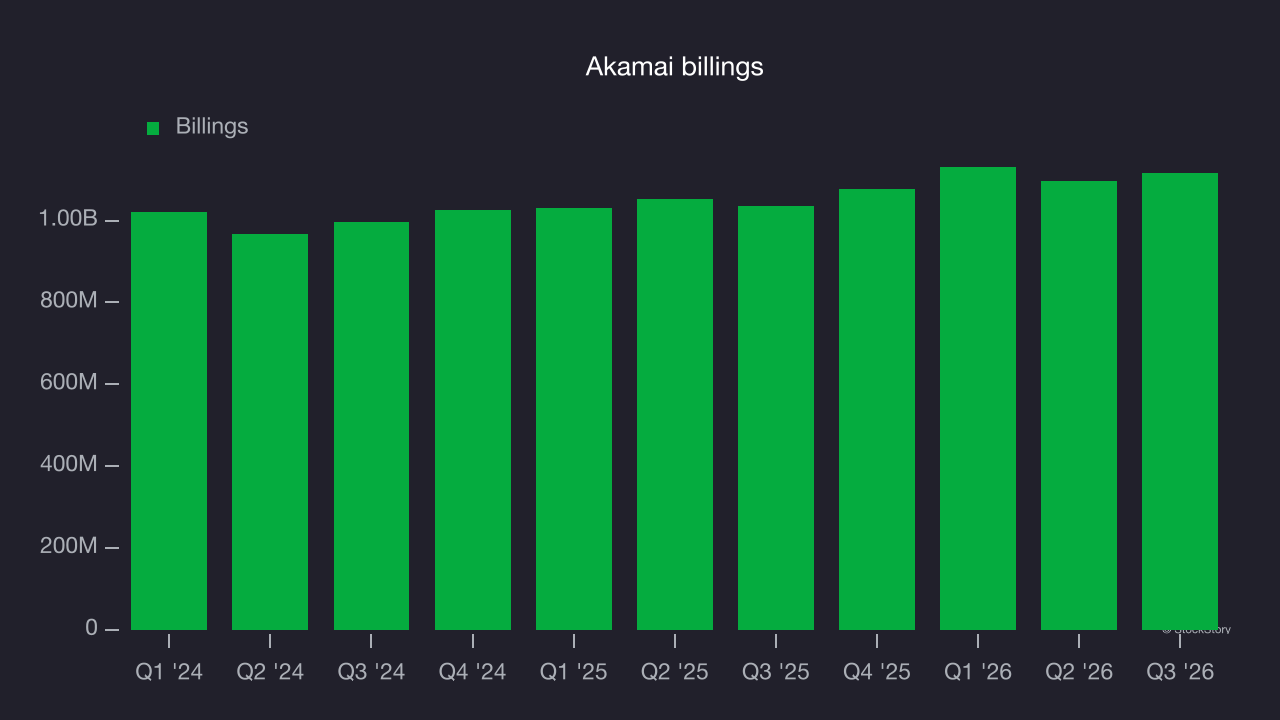
Customer acquisition efficiency
The customer acquisition cost, or CAC, payback period measures the months a company needs to recoup the money spent on acquiring a new customer. This metric helps assess how quickly a business can break even on its sales and marketing investments.
Akamai is highly efficient at acquiring new customers, and its CAC payback period was 13.7 months this quarter. The company’s rapid recovery of its customer acquisition costs means it can attempt to spur growth by increasing its sales and marketing investments.
Key takeaways from Akamai’s Q3 results
Akamai’s outlook set a softer tone for the quarter, with both revenue and EPS guidance for next quarter falling short of Wall Street’s consensus estimates. The positive was adjusted operating income, which beat analysts’ consensus estimates in Q3. Shares tumbled 5.7% to $73.68 immediately after the results.
Akamai underperformed this quarter, but does the stock offer value at its current price? The latest quarter matters, but not nearly as much as longer-term fundamentals and valuation when deciding whether to invest. For more on Akamai, read the full research report here (it’s free).