Freight delivery company ArcBest (NASDAQ: ARCB) beat Wall Street’s revenue expectations in Q3 2026, with revenue up 15.5% year on year to $1.21 billion. Its non-GAAP profit of $2.62 per share was 4.5% above analysts’ consensus estimates.
For more on ArcBest, read the full research report for free.
ArcBest (ARCB) Q3 2026 highlights:
- Revenue $1.21 billion vs S&P analysts’ consensus estimates of $1.20 billion (15.5% year-on-year growth, 0.6% beat)
- Adjusted EPS $2.62 vs S&P analysts’ consensus estimates of $2.51 (4.5% beat)
- Adjusted EBITDA $119.7 million vs analysts’ consensus estimates of $119.2 million (9.9% margin, in line)
- Operating margin 6.1%, in line with the same quarter last year
- Free cash flow margin 9.1%, up from 3.2% in the same quarter last year
- Sales volumes fell 3% year on year (4.3% in the same quarter last year)
- Market capitalization $3.01 billion
“The third quarter reflected the progress we’ve been making across ArcBest and the commitment of our people,” said Seth Runser, ArcBest President and CEO. “Stronger earnings and profitability were driven by disciplined execution, continued momentum in Asset-Light and ongoing savings from actions to simplify our organization and improve efficiency. We also continued to invest in technology and innovation to better serve our customers and support long-term profitable growth.”
Revenue growth
Examining a company’s long-term performance can provide clues about its quality. Any business can deliver a good quarter or two, but many enduring ones grow for years. ArcBest’s revenue grew at a sluggish 3.9% annualized rate over the last five years, falling short of the industrials sector standard.
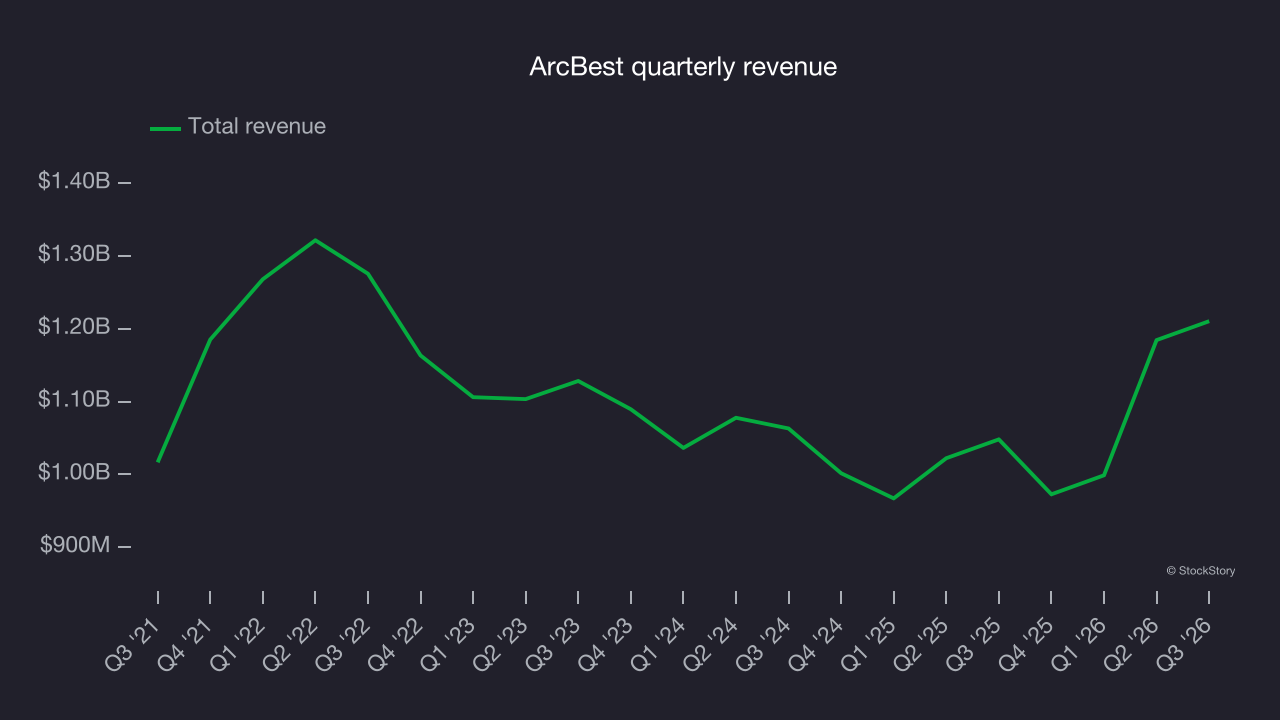
Long-term growth is the most important, but within industrials, a half-decade historical view may miss new industry trends or demand cycles. ArcBest’s recent performance shows its demand has slowed as its annualized revenue growth of 1.2% over the last two years was below its five-year trend. Decelerating revenue growth in the sector warrants caution, as it could signal changing consumer tastes aided by low switching costs. 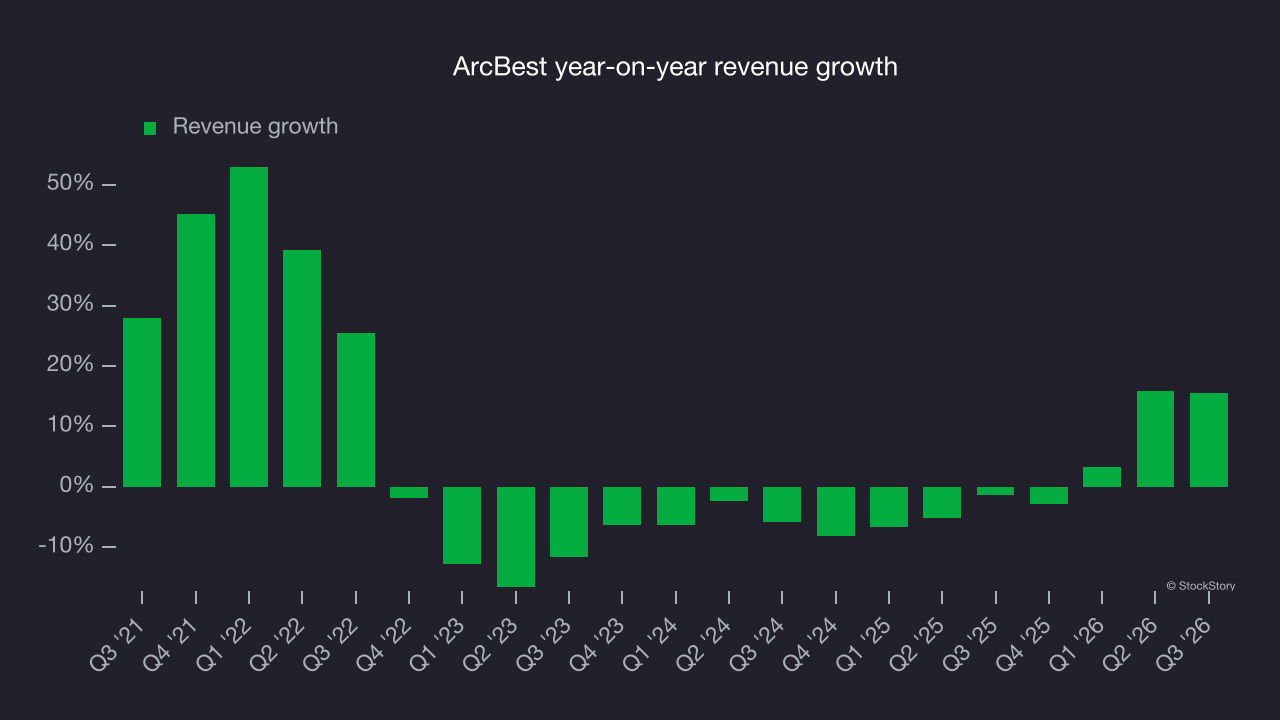
Another measure of the company’s revenue dynamics is its number of units sold, which reached 20,460 in the latest quarter. Over the last two years, ArcBest’s units sold averaged 1.1% year-on-year growth. This was in line with revenue growth, indicating that prices stayed fairly consistent. 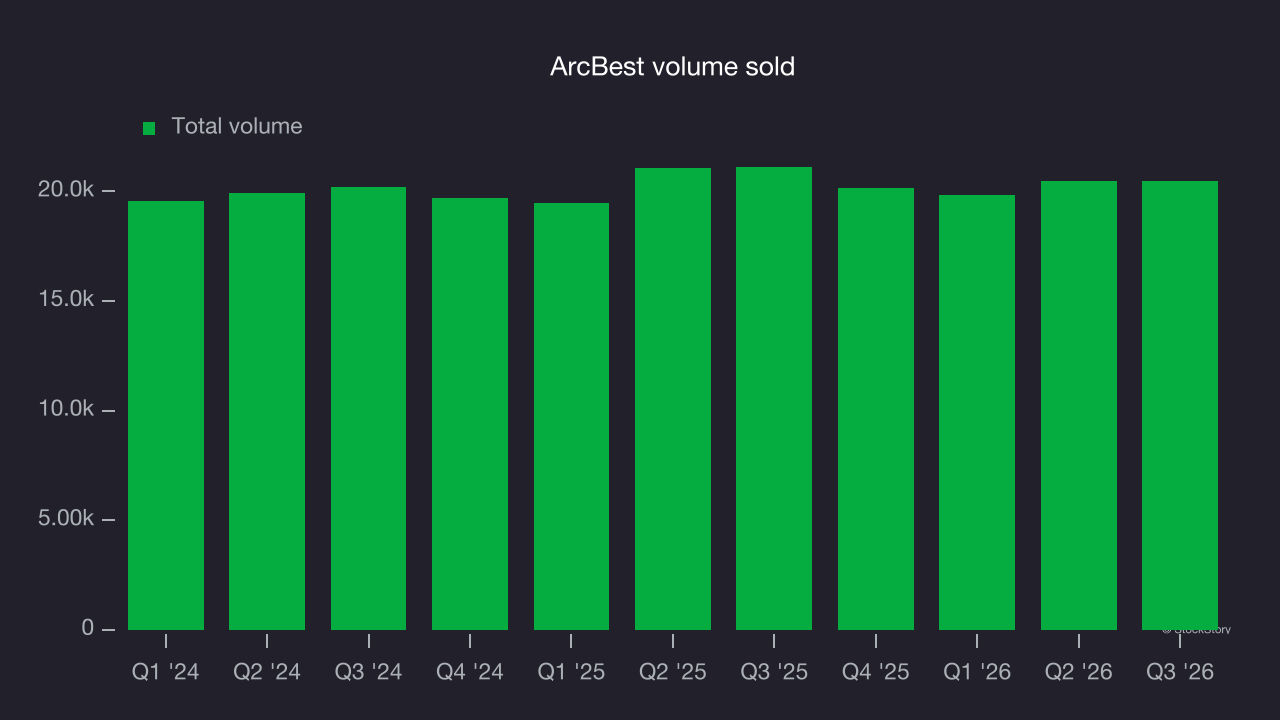
This quarter, ArcBest reported year-on-year revenue growth of 15.5%, and its $1.21 billion of revenue exceeded Wall Street’s consensus estimates by 0.6%.
Looking ahead, sell-side analysts expect revenue to grow 9% over the next 12 months, according to S&P, an improvement versus the last two years. This projection is above average for the sector and suggests its newer products and services will spur better top-line performance.
Operating margin
ArcBest was profitable over the last five years but held back by its large cost base. Its average operating margin of 4.7% was weak for an industrials business. That outcome is unsurprising given its low gross margin baseline.
Looking at the trend in its profitability, ArcBest’s operating margin decreased by 7.4 percentage points over the last five years. This raises questions about the company’s expense base because its revenue growth should have given it leverage on its fixed costs, resulting in better economies of scale and profitability. That poor performance shows that costs were rising and it couldn’t pass them on to its customers.
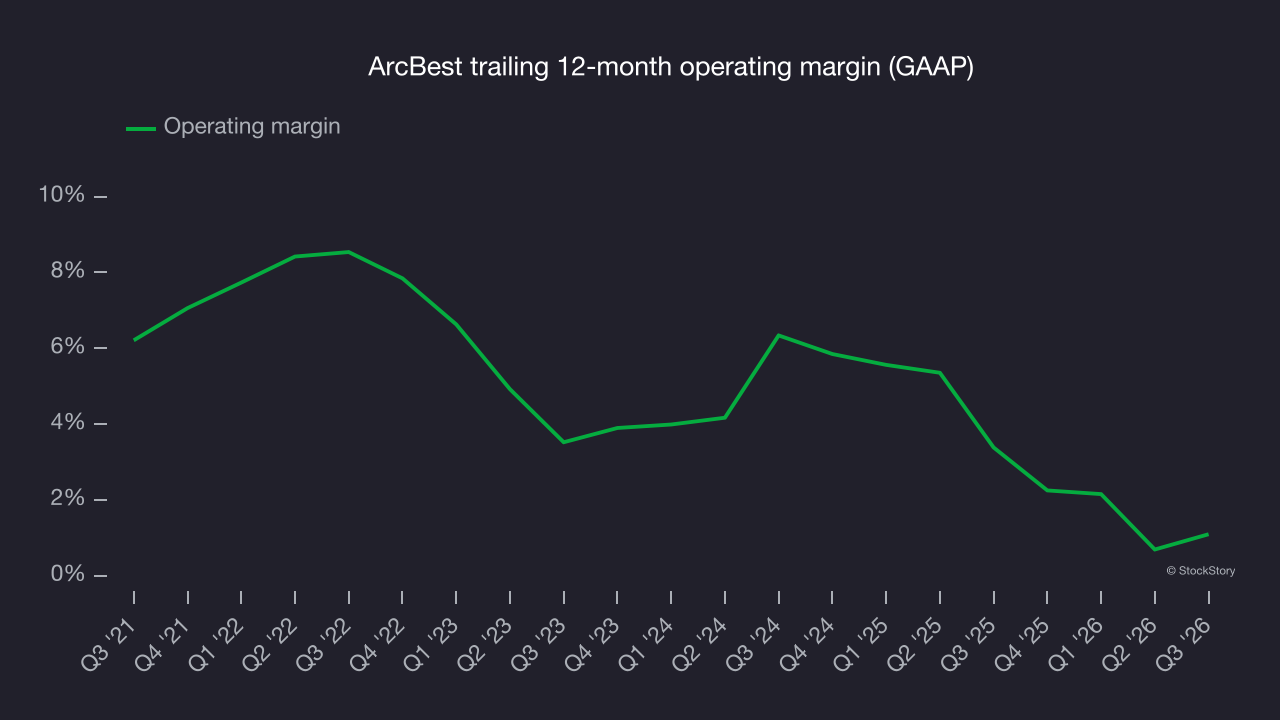
In Q3, ArcBest generated an operating margin of 6.1%, in line with the same quarter last year. This indicates the company’s cost structure has recently been stable.
Earnings per share
We track the long-term change in earnings per share, or EPS, for the same reason as long-term revenue growth. Compared to revenue, however, EPS highlights whether a company’s growth is profitable.
ArcBest’s EPS declined by 2.8% annually over the last five years while its revenue grew by 3.9%. This indicates the company became less profitable on a per-share basis as it expanded due to non-fundamental factors such as interest expenses and taxes.
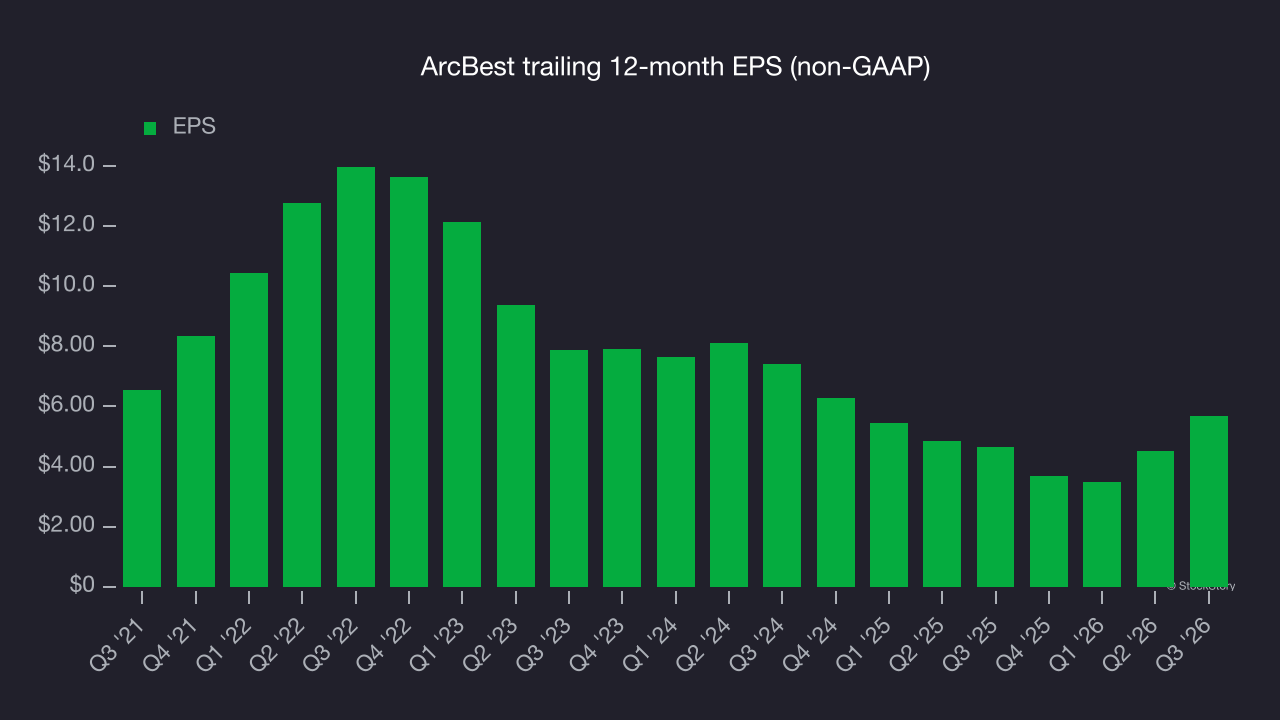
A closer look at ArcBest’s earnings helps explain its performance. As noted earlier, ArcBest’s operating margin was flat this quarter but declined by 7.4 percentage points over the last five years. This was the most relevant factor (aside from the revenue impact) behind its lower earnings; interest expenses and taxes can also affect EPS but don’t tell us as much about a company’s fundamentals.
As with revenue, we analyze EPS over a shorter period to check for a change in the business.
ArcBest’s annual EPS declines of 12.6% over two years show it has continued to underperform. Its performance was poor over both periods.
In Q3, ArcBest reported adjusted EPS of $2.62, up from $1.46 in the same quarter last year. This result beat analysts’ consensus estimates by 4.5%. Over the next 12 months, Wall Street expects ArcBest’s full-year EPS to grow 59% from $5.68 to $9.03, according to S&P.
Key takeaways from ArcBest’s Q3 results
ArcBest’s Q3 results had some key positives: EPS beat analysts’ consensus estimates, and revenue narrowly topped Wall Street’s consensus. But the market seemed to be hoping for more. Shares fell 3.2% to $130.23 immediately after the report.
ArcBest’s latest quarter matters, but longer-term business quality and valuation matter more when deciding whether to invest in the stock. For more on these factors, read the full research report here (it’s free).