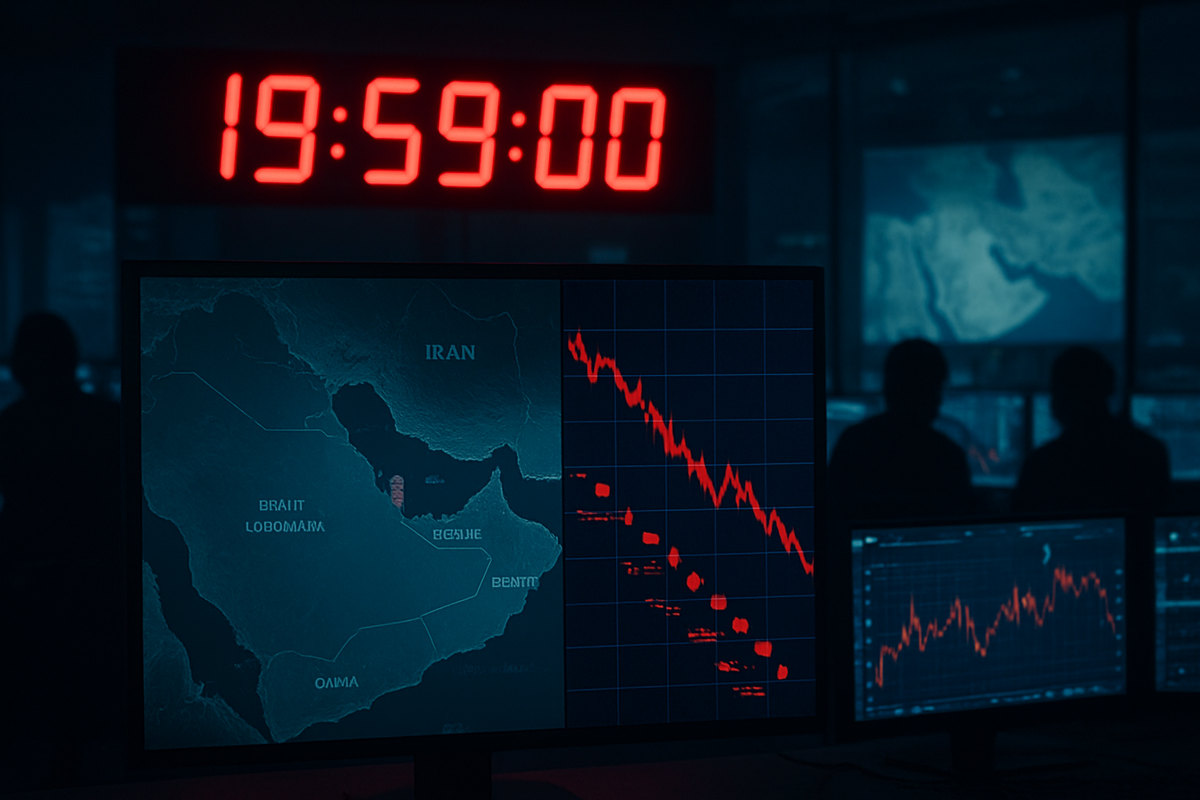
As the sun sets over Washington D.C. on April 7, 2026, the global financial community is fixated on a singular, looming deadline: 8:00 p.m. ET. President Donald Trump has issued a final ultimatum to the Iranian government, demanding the immediate and unconditional reopening of the Strait of Hormuz to all international shipping. Failure to comply, the administration warns, will trigger "Power Plant Day and Bridge Day," a massive military operation designed to systematically dismantle Iran’s civilian and dual-use infrastructure.
The immediate implications are staggering. With approximately 20% of the world’s seaborne oil currently trapped behind an Iranian naval blockade, the threat of a full-scale regional war has sent shockwaves through the global markets. Investors are frantically repositioning as the prospect of a catastrophic supply shock looms, potentially dwarfing the energy crises of the 1970s. For the American public, the geopolitical brinkmanship is already being felt at the pump, but the true economic fallout may depend on what happens in the minutes following the 8:00 p.m. expiration.
The Path to the Brink: A Timeline of Escalation
The current crisis is the culmination of the Trump administration's "Maximum Pressure 2.0" strategy, which was reinstated shortly after the 2024 election. Throughout 2025, the U.S. tightened sanctions to unprecedented levels, aiming to force Tehran into a more restrictive nuclear and ballistic missile agreement. Tensions boiled over in late February 2026, when Iran’s Islamic Revolutionary Guard Corps (IRGC) deployed naval mines and swarming tactics to restrict passage through the Strait of Hormuz, effectively creating a "controlled transit" system that excluded vessels from "hostile" nations.
In the weeks leading up to today’s deadline, international mediation efforts have repeatedly failed. A proposal brokered by Pakistan and Oman for a 45-day ceasefire was rejected by Tehran on April 3, with Iranian leadership demanding reparations for recent U.S. and Israeli precision strikes on Kharg Island, their primary oil export hub. President Trump responded via social media and official White House channels, declaring that the U.S. "doesn't need the oil" but will not allow "bullies to hold the world's economy hostage."
As of this afternoon, the military posture is unmistakable. The Pentagon has confirmed the deployment of additional carrier strike groups to the North Arabian Sea, while U.S. Air Force assets in Qatar and Saudi Arabia have been placed on the highest readiness level. The "Power Plant Day" threat specifically targets the Iranian electrical grid and logistics network—a move the administration argues is necessary to "paralyze the regime's ability to wage war," but which critics fear will cause a humanitarian disaster.
Market Winners and Losers in a Period of Peril
The looming 8:00 p.m. deadline has created a stark divide in the equity markets. Defense contractors are seeing significant speculative interest as the likelihood of sustained military engagement rises. Lockheed Martin Corp (NYSE: LMT), Northrop Grumman Corp (NYSE: NOC), and General Dynamics (NYSE: GD) have all seen increased trading volume as investors anticipate new government contracts for munitions, drone systems, and naval repairs. These companies traditionally act as a hedge during geopolitical instability, and their stock prices often decouple from the broader market during the initial phases of a conflict.
Conversely, the energy sector is experiencing a period of extreme volatility. While Exxon Mobil Corp (NYSE: XOM) and Chevron Corp (NYSE: CVX) initially saw stock gains alongside rising Brent Crude prices—which hit $120 per barrel this morning—the long-term outlook is clouded by the threat to global demand. If the Strait remains closed and oil spikes toward $200, the resulting global recession could eventually crater consumption. For now, however, the "upstream" players in the oil and gas sector remain some of the only green spots on traders' screens.
The clear losers in this scenario are sectors sensitive to fuel costs and consumer discretionary spending. The airline industry is under immense pressure; Delta Air Lines (NYSE: DAL) and United Airlines Holdings (NASDAQ: UAL) have seen their shares tumble as jet fuel prices mirror the surge in crude. Additionally, the broader technology sector, represented by the Nasdaq 100, is reeling from the prospect of increased inflationary pressure. If energy costs push the U.S. Consumer Price Index (CPI) toward 3.7% by summer 2026, the Federal Reserve may be forced to maintain high interest rates, further devaluing the future earnings of high-growth tech firms.
Wider Significance: A New Era of Geopolitical Risk
This event marks a significant departure from previous Middle Eastern conflicts. Unlike the 1990 Gulf War or the 2003 invasion of Iraq, the 2026 crisis involves a direct challenge to the "freedom of navigation" in one of the world's most critical maritime chokepoints. It fits into a broader trend of "weaponized interdependence," where nations use their control over global supply chains and energy routes as primary tools of statecraft. The ripple effects are already reaching China and Japan, which are far more dependent on Persian Gulf oil than the United States, creating a diplomatic vacuum that President Trump has challenged them to fill with their own naval forces.
The regulatory and policy implications are equally profound. A sustained closure of the Strait of Hormuz will likely accelerate the transition to alternative energy sources in Europe and Asia, but in the short term, it may force emergency rollbacks of environmental regulations in the U.S. to boost domestic production. Historically, markets have shown resilience to "localized" wars, but the 1973 Arab Oil Embargo serves as a sobering precedent: when energy becomes a weapon of war, the resulting stagflation can haunt the S&P 500 for years rather than months.
Market volatility, as measured by the VIX, has spiked to levels not seen since the early days of the 2022 Ukraine conflict. S&P 500 futures are currently down 0.5%, while Nasdaq futures have slipped 0.6% in the last hour alone. Traders are increasingly pricing in a "worst-case" scenario where the 8:00 p.m. deadline passes without a concession from Tehran, leading to an immediate kinetic response from U.S. forces.
What Comes Next: Scenarios and Strategic Pivots
In the short term, the primary focus is on the tactical success of the threatened strikes. If the U.S. can successfully reopen the Strait through a "limited" engagement, markets might see a relief rally similar to the one following the initial phase of the 2003 Iraq War. However, a prolonged campaign that involves Iranian retaliation against regional oil infrastructure—such as refineries in Saudi Arabia or desalination plants in the UAE—would likely send the global economy into a tailspin.
Strategically, companies will be required to pivot toward "near-shoring" and diversifying their supply chains even further. The "just-in-time" delivery models that defined the early 21st century are proving to be major liabilities in an era of high-intensity geopolitical friction. Investors should look for opportunities in domestic energy infrastructure and cybersecurity firms, as the threat of Iranian cyber-retaliation against the U.S. financial and energy sectors is considered "highly likely" by the Department of Homeland Security.
Final Assessment: A Global Market on the Edge
The 8:00 p.m. ET deadline represents more than just a military ultimatum; it is a stress test for the modern globalized economy. The key takeaway for investors is that the era of "low-cost energy" is under its most significant threat in decades. The market's reaction in the coming hours will be a referendum on whether it believes the U.S. can quickly restore order or if we are entering a period of protracted chaos.
Moving forward, the S&P 500's trajectory will be dictated by the price of crude and the Federal Reserve's reaction to the resulting inflation. If oil stays above $110 for more than a quarter, a technical recession in 2026 becomes almost a certainty. Investors should watch for the 8:00 p.m. "flash" reports and pay close attention to the Brent Crude spot market and the performance of the U.S. Treasury 10-year yield. The coming months will require a defensive posture, prioritizing liquidity and assets that can withstand a high-inflation, high-volatility environment.
This content is intended for informational purposes only and is not financial advice.