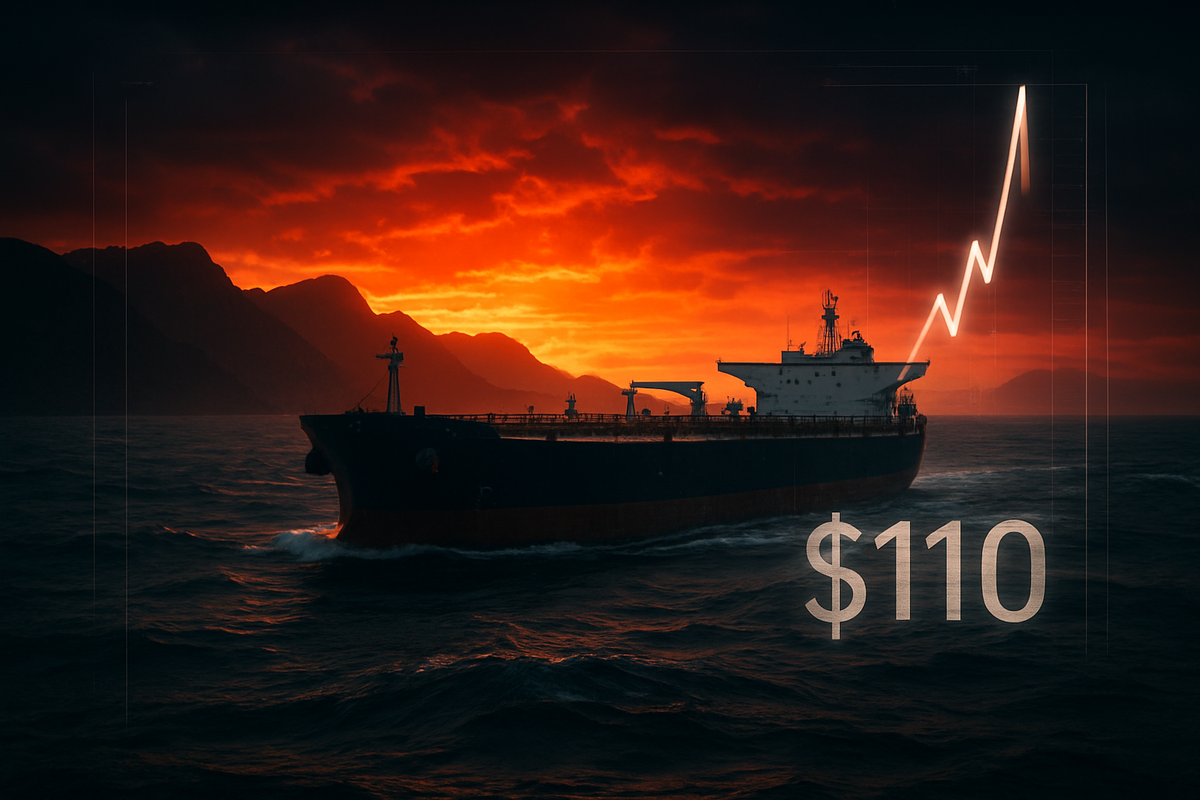
The global energy landscape was thrust into chaos this week as Brent Crude prices surged past the $110 per barrel mark, closing at $112.96 on April 2, 2026. The dramatic spike follows an official "full blockade" of the Strait of Hormuz by Iranian forces, a retaliatory move against a month-long campaign of U.S. and Israeli airstrikes targeting regional military infrastructure. With approximately 20 million barrels of oil per day—nearly 20% of the world’s daily consumption—currently trapped within the Persian Gulf, markets are bracing for a prolonged supply deficit that threatens to derail the global economic recovery.
The immediate implications are staggering: gas prices at the pump are expected to climb to multi-year highs within days, and the "soft landing" narrative previously championed by central banks has effectively evaporated. As the U.S. administration issues a 14-day ultimatum to reopen the waterway, the "war premium" on physical crude has sent spot prices as high as $141 in some regions, reflecting a desperate scramble for available supply among European and Asian refiners.
A Month of Escalation: The Path to $110
The current crisis did not emerge in a vacuum but is the culmination of intensifying military friction that began in late February 2026. Following a series of joint U.S.-Israeli operations aimed at degrading Iranian drone and missile facilities, Tehran escalated its response, culminating in the March 27 declaration of a total naval blockade. Iranian officials characterized the move as a defense of sovereign waters against the "Axis of Aggression," deploying advanced anti-ship cruise missiles and sea mines across the narrowest points of the Strait.
By April 1, the situation reached a fever pitch when the U.S. President delivered a hawkish televised address, promising "extremely hard" military intervention if the blockade is not lifted within two weeks. This direct threat of a large-scale naval engagement sent West Texas Intermediate (WTI) crude climbing to $111.54, its highest level since the early days of the 2022 energy shock. Market participants who had previously dismissed the possibility of a total closure of the Strait were forced into a violent repricing of risk.
The physical reality of the disruption is profound. While Saudi Arabia and the United Arab Emirates have attempted to mitigate the impact by rerouting crude through trans-peninsular pipelines to Red Sea terminals, these routes currently handle less than 40% of the usual volume. The resulting bottleneck has left global inventories at critically low levels, particularly in the Asia-Pacific region, which remains heavily dependent on Middle Eastern imports.
The Divergence of Fortunes: Winners and Losers
The surge in energy prices has created a stark divide in the equity markets. Energy giants have seen their valuations skyrocket as they capitalize on the highest margins in years. ExxonMobil (NYSE: XOM) has emerged as a primary beneficiary, with shares rising nearly 36% year-to-date to trade in the $165 range. Similarly, Chevron (NYSE: CVX) touched an all-time high of $211.15 in late March, as investors pivoted toward companies with significant non-Middle Eastern production capacity. In Europe, Shell (NYSE: SHEL) has benefited from a parallel surge in natural gas prices, which have doubled alongside the oil spike.
Conversely, the transportation and consumer sectors are reeling. The aviation industry, in particular, is facing an existential threat from ballooning fuel costs. United Airlines (NASDAQ: UAL) saw its stock price tumble toward $92 after warning that $100+ oil represents an $11 billion annual headwind for the company. While Delta Air Lines (NYSE: DAL) has shown relative resilience due to its premium route structure and better-hedged fuel positions, it nonetheless reported an additional $400 million in fuel expenses for the month of March alone.
Beyond airlines, logistics firms and retailers are also under pressure. The cost of shipping goods globally is expected to rise as bunker fuel prices follow the upward trajectory of crude. This "energy tax" on the consumer is expected to stifle discretionary spending, leading to a rotation out of consumer cyclical stocks and into defensive havens like utilities and precious metals.
Wider Significance and the Ghost of Stagflation
This event marks a significant shift in the broader economic trend of 2026. For much of the past year, the market had been focused on a return to 2% inflation targets and the prospect of Federal Reserve rate cuts. Those expectations have been summarily "deleted." The OECD recently revised its 2026 U.S. headline inflation forecast upward to 4.2%, citing the fact that every 10% increase in oil prices typically adds roughly 40 basis points to global inflation.
The situation draws chilling parallels to the 1980–1988 "Tanker War" and the 2008 oil peak of $147. However, unlike 2008, when demand from emerging markets drove prices, the current spike is almost entirely supply-driven and politically motivated. Furthermore, the role of U.S. shale as a "swing producer" is being tested; while domestic production remains high, it cannot immediately fill a 20-million-barrel-per-day hole in the global market.
Regulatory implications are also emerging, with renewed calls for the expansion of the Strategic Petroleum Reserve (SPR) and increased subsidies for renewable energy transitions. However, in the short term, these policy shifts offer little relief. The immediate concern for central banks is "stagflation"—a toxic combination of stagnant economic growth and high inflation that makes traditional monetary policy tools significantly less effective.
What Comes Next: Scenarios and Strategic Pivots
The market is now focused on the 14-day window established by the U.S. administration. Analysts from Goldman Sachs and Macquarie have warned that if the blockade persists through June 2026, Brent Crude could realistically test the $150 to $200 range. Such a scenario would likely trigger a global recession, forcing a massive strategic pivot across industries. Airlines may be forced to drastically reduce capacity or implement aggressive "war surcharges" on tickets to survive.
In the short term, the possibility of a "breakout" naval operation to clear the Strait remains the most watched catalyst. If the U.S. Navy successfully reopens the passage with minimal damage to oil infrastructure, a sharp "relief sell-off" could see prices plummet back toward $85. However, if the conflict expands to include strikes on production facilities in Saudi Arabia or the UAE, the current $110 price point may merely be the floor for a much larger ascent.
Investors should also watch for a potential "demand destruction" phase. Historically, when oil prices remain above 5% of global GDP for a sustained period, consumer behavior shifts permanently toward efficiency and alternative energy. This could accelerate the long-term decline of internal combustion engine sales, benefiting electric vehicle manufacturers and renewable infrastructure firms in the latter half of the decade.
Market Wrap-Up and Investor Outlook
As of early April 2026, the energy market is in the midst of its most significant supply shock in decades. The surge past $110 per barrel is not just a commodity story; it is a geopolitical event that has fundamentally altered inflation expectations and the path of interest rates. The key takeaway for investors is that the "soft landing" is no longer the base case; instead, market participants must navigate a high-volatility environment where geopolitical headlines carry more weight than corporate earnings.
Moving forward, the market will remain hyper-sensitive to any news regarding the Strait of Hormuz and the U.S. military's response. Investors should monitor the performance of (NYSE: XOM) and (NYSE: CVX) as barometers for energy risk, while keeping a close eye on the (NYSE: DAL) and (NASDAQ: UAL) as indicators of consumer and transportation health. The coming months will determine whether this is a temporary spike or the beginning of a new, high-cost energy era that will redefine the global economy for years to come.
This content is intended for informational purposes only and is not financial advice.