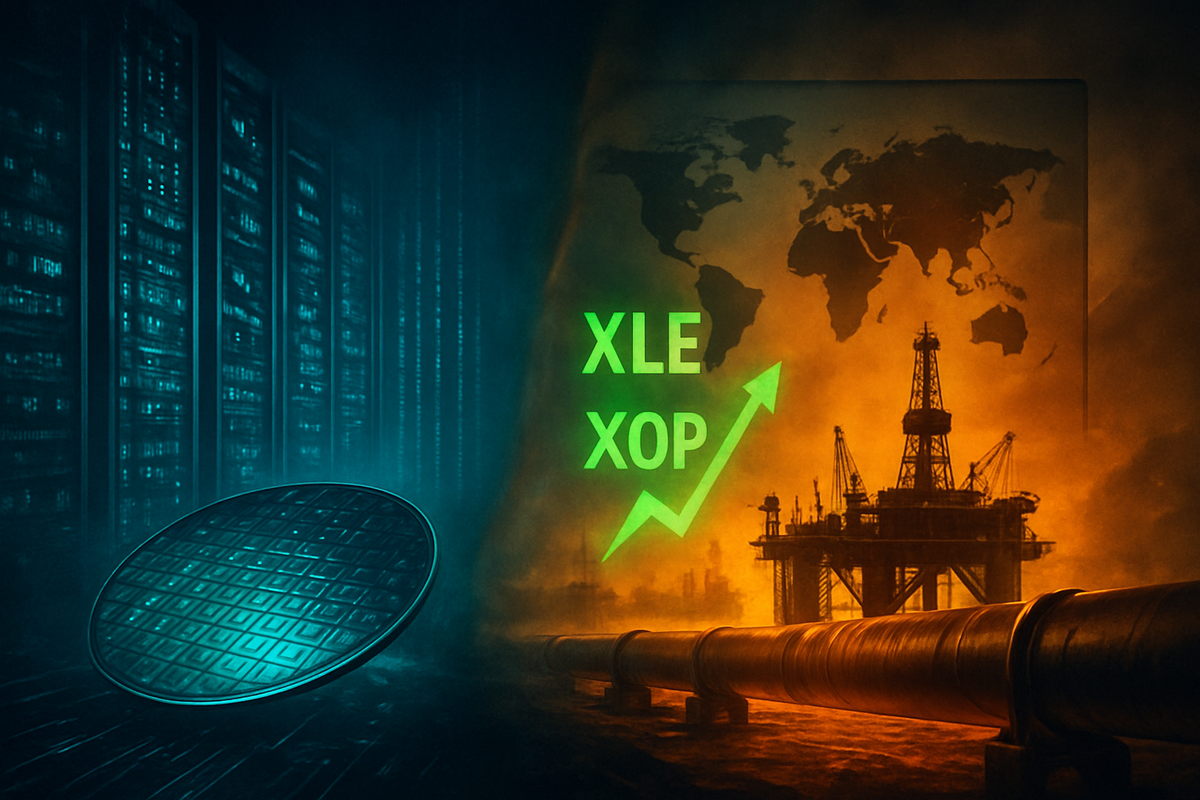
As of April 13, 2026, a profound shift is rattling global financial markets. Investors are aggressively rotating out of high-beta technology stocks and into the energy sector, which has emerged as the premier "bunker asset" in an increasingly volatile world. Driven by escalating military tensions in the Middle East and a massive "AI power crunch" that has strained the U.S. electrical grid, capital is flowing into the Energy Select Sector SPDR Fund (NYSE Arca: XLE) and the SPDR S&P Oil & Gas Exploration & Production ETF (NYSE Arca: XOP) at rates not seen since the 2022 energy crisis.
This "Great Rotation" marks a significant departure from the tech-heavy bull market of 2024 and 2025. With Brent crude oil prices surging past $105 per barrel and the "Magnificent Seven" losing nearly 11% of their value in the first quarter of the year, the market is signaling a return to the "industrial bedrock" of the global economy. In this environment, oil and gas companies are no longer viewed merely as cyclical trades but as essential insurance policies against geopolitical instability and inflationary shocks.
The Geopolitical Catalyst and the Flight to Physical Assets
The immediate catalyst for this market upheaval is the direct military escalation in the Middle East, which has culminated in a partial blockade of the Strait of Hormuz. Analysts estimate that this disruption has threatened approximately 20% of the world’s daily oil supply, leading to production shut-ins of over 9 million barrels per day. The timeline of this escalation began in early March 2026, when maritime incidents in the Persian Gulf triggered a massive risk premium in energy futures. By April, the "geopolitical bunker" mentality had taken full hold of Wall Street, with investors treating energy stocks as the ultimate safe haven.
The Energy Select Sector SPDR Fund (NYSE Arca: XLE), which counts titans like Exxon Mobil Corp. (NYSE: XOM) and Chevron Corp. (NYSE: CVX) among its largest holdings, has posted a staggering 38.2% total return year-to-date. Meanwhile, the SPDR S&P Oil & Gas Exploration & Production ETF (NYSE Arca: XOP) has performed even better, rising 43.4% as smaller, nimble U.S.-based producers benefit from the "energy independence" narrative. The reaction from institutional players has been swift, with multi-billion-dollar hedge funds liquidating long positions in artificial intelligence and semiconductor stocks to fund a massive "re-weighting" into fossil fuels and physical infrastructure.
Winners and Losers: From Silicon to Crude
The clear winners in this landscape are the integrated oil giants and independent explorers. Exxon Mobil Corp. (NYSE: XOM) has seen its valuation swell as it generates record cash flows, while Chevron Corp. (NYSE: CVX) has benefited from its robust footprint in the Permian Basin, which is increasingly viewed as a critical strategic asset for the U.S. economy. These companies, trading at forward price-to-earnings ratios as low as 11x, offer a stark contrast to the stretched valuations found in the technology sector. Beyond the producers, the "bunker" theme has extended to Liquefied Natural Gas (LNG) infrastructure, with billions flowing into the equipment and services that facilitate the global transport of fuel.
Conversely, the technology sector—specifically high-growth software and hardware—has become the primary source of funds for this energy rotation. NVIDIA Corp. (NASDAQ: NVDA), a darling of the 2024 AI boom, has faced selling pressure as the market shifts its focus from AI chips to the actual electricity required to power them. Software companies that rely on high-multiple valuations are also being punished, as the renewed inflationary environment caused by $100+ oil has effectively halted any remaining hopes of a Federal Reserve "soft landing." Investors are now prioritizing tangible earnings and dividends over the "future promise" of AI growth.
The AI Power Crunch and the Return of Industrial Bedrock
The significance of this trend extends beyond simple war-time hedging. A major driver of the 2026 energy bull market is the realization that the artificial intelligence revolution is hitting a "hard wall" of power availability. The massive expansion of data centers over the last two years has pushed the U.S. national power grid to its limits, turning "energy security" into a corporate necessity. This has led to a narrative shift where energy is now called the "industrial bedrock"—the foundational layer of the economy that makes all other technological advancements possible.
This event mirrors the energy shocks of the 1970s but with a modern twist: the demand is not just from consumers, but from machines. Historically, such rotations away from growth toward value have lasted for several years, especially when underpinned by structural supply shortages and geopolitical conflict. The current policy environment in Washington has also pivotally shifted; after years of focus on the green transition, there is now a bipartisan "strategic autonomy" movement focused on rebuilding domestic fossil fuel and nuclear capacity to ensure the nation remains competitive against foreign adversaries.
What Comes Next: $170 Oil and Strategic Pivots
Looking ahead to the remainder of 2026, the short-term outlook depends heavily on whether the Strait of Hormuz remains contested. Some analysts at Kpler and Goldman Sachs have warned that a full closure could send crude prices toward $170 per barrel, a level that would almost certainly trigger a global recession. In the interim, expect energy companies to continue using their windfall profits to increase buybacks and dividends, further enticing income-starved investors away from the tech sector.
For the technology giants, a strategic pivot toward "energy efficiency" or even direct investment in power generation may be required to maintain growth. We may see more tech companies partnering directly with natural gas producers or nuclear energy firms to secure their own private power supplies. The market is entering a phase where "ownership of the energy source" is becoming more valuable than the "ownership of the software," creating a new set of challenges for traditional Silicon Valley business models.
A Market Transformed by Reality
The events of April 2026 represent a "reality check" for a market that had become perhaps too comfortable with the ephemeral growth of the digital economy. The massive capital flows into XLE and XOP signify a collective acknowledgement that physical resources still dictate the terms of global power and economic stability. While tech will inevitably return to favor, the current rotation highlights a structural re-rating of the energy sector as a permanent, defensive core of the modern portfolio.
Moving forward, investors should watch for the sustainability of current oil price levels and any shifts in OPEC+ production quotas. The key takeaway is that "energy is the new tech"—it is the sector currently providing the most robust growth, the strongest cash flows, and the most effective hedge against a fractured geopolitical landscape. As long as the Middle East remains a tinderbox and the AI power demand remains insatiable, the "bunker" assets of the energy world will likely remain the brightest spots in the market.
This content is intended for informational purposes only and is not financial advice.