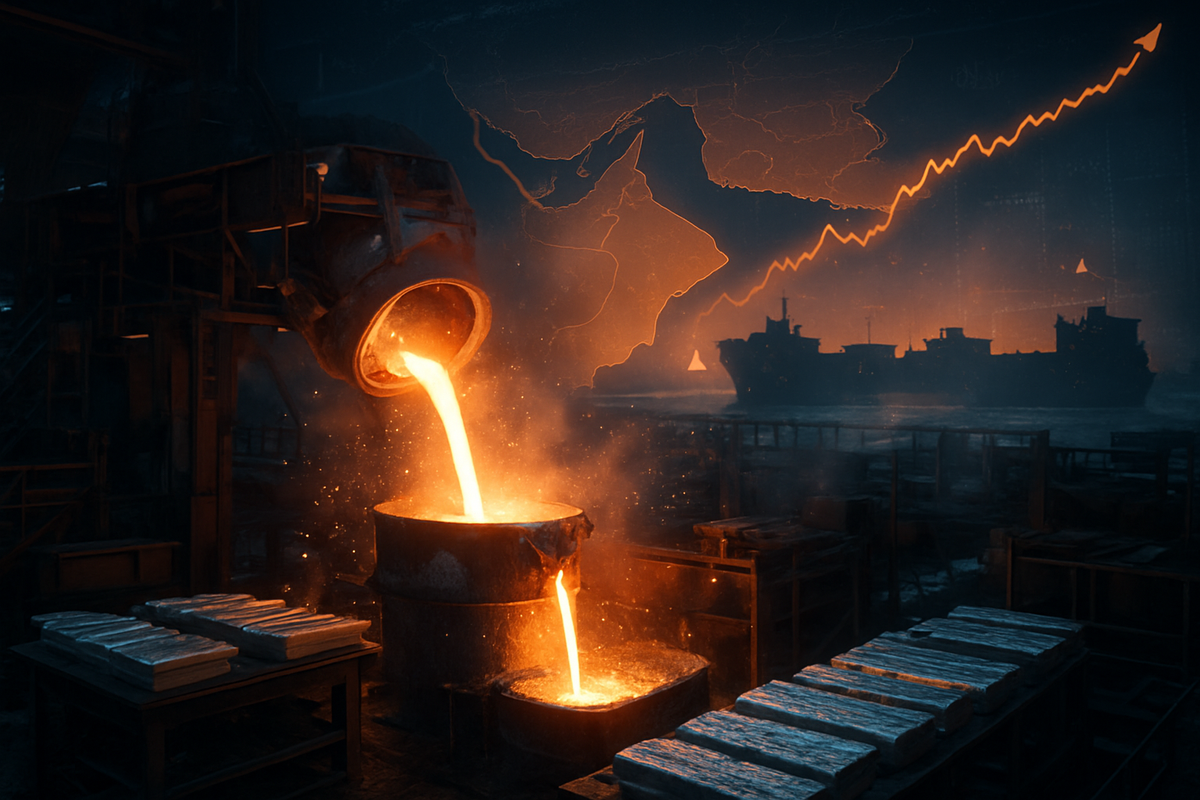
As of April 10, 2026, the global aluminum market is grappling with a supply shock of historic proportions. Industrial metal prices have surged to multi-year highs following a dramatic escalation of geopolitical tensions in the Middle East that has transformed from a logistical inconvenience into a direct threat to global production capacity. With the Strait of Hormuz effectively blockaded and major smelting facilities in the United Arab Emirates and Bahrain reporting significant physical damage, the aluminum market is entering a period of prolonged deficit.
Recent data from leading financial institutions underscores the severity of the shift. UBS (NYSE: UBS) recently raised its 2026 London Metal Exchange (LME) aluminum price forecast by 13% to $3,250 per ton, identifying the metal as the commodity most vulnerable to Middle Eastern volatility. Meanwhile, the VanEck CMCI Commodity Strategy ETF (NYSE: CMCI) has reported a staggering 16.18% year-to-date return, driven largely by the "moderate to extreme" gains in industrial metals as regional hurdles evolved into structural barriers.
The Siege of the Strait: From Logistical Friction to Structural Deficit
The current crisis did not emerge in a vacuum. Throughout late 2024 and 2025, the industry contended with the "Red Sea Crisis," where Houthi-led attacks forced aluminum exports from the Gulf Cooperation Council (GCC) to bypass the Suez Canal. This initial disruption added roughly 14 days to transit times and increased freight costs by over 250% for European buyers. However, the situation reached a breaking point in March 2026 during what analysts have dubbed the "Weekend of Fire."
Direct missile and drone strikes targeted critical infrastructure at Emirates Global Aluminium (EGA) sites in Al Taweelah and Jebel Ali. The resulting power failures caused the "freezing" of smelting pots—a catastrophic operational event where molten aluminum solidifies inside the cells, often requiring years of labor and massive capital expenditure to rectify. Following these strikes, a de facto blockade of the Strait of Hormuz was established, halting the 9% of global aluminum production that flows from the GCC to vital markets in Japan, South Korea, and the United States. Aluminium Bahrain (Alba) has since issued force majeure notices, citing an inability to secure safe passage for its output.
Industrial Winners and Losers in a Fragmented Market
The dislocation of Middle Eastern supply has created a stark divide between producers located in stable, "safe-haven" jurisdictions and those reliant on the fragile energy corridors of the Gulf. Alcoa Corporation (NYSE: AA) has emerged as a primary beneficiary, with its shares surging 12.7% in the wake of the Hormuz blockade. Investors have flocked to Alcoa not only for its geographic insulation but also because 86% of its operations are powered by renewable energy, protecting the firm from the natural gas price spikes that have crippled its competitors.
Similarly, Rio Tinto (NYSE: RIO) has seen its valuation climb as its low-cost, hydroelectric-powered smelters in Canada and New Zealand operate at maximum capacity to fill the vacuum left by the GCC. Other regional players, such as Century Aluminum Company (NASDAQ: CENX) and Norsk Hydro (OTC: NHYDY), are also reaping the rewards of a "flight-to-stability" premium. Conversely, the losers extend beyond the GCC producers themselves to include European industrial giants in the automotive and aerospace sectors. These manufacturers are now facing a global aluminum deficit estimated by Goldman Sachs at 900,000 metric tons—the largest since 2019—forcing them to pay exorbitant physical premiums to secure remaining spot-market supply.
The Paradigm Shift: Geopolitics Meets 'Green-flation'
This event is more than a temporary price spike; it represents a fundamental shift in how industrial metals are valued. For years, the Middle East was viewed as a "swing supplier" capable of providing high volumes of low-cost metal thanks to cheap natural gas. That narrative has been shattered. The current crisis fits into a broader trend of "Green-flation," where the market places a permanent premium on aluminum that is both carbon-neutral and geopolitically secure.
The disruption has also exposed the fragility of global "just-in-time" supply chains for base metals. Regulatory bodies in the EU and the U.S. are already discussing new policy frameworks to incentivize domestic smelting capacity, viewing the current shortage as a matter of national security. Historically, this mirrors the energy shocks of the 1970s, but with a modern twist: the transition to a green economy—which requires massive amounts of aluminum for electric vehicles and solar panels—is now being throttled by the very geopolitical risks it sought to mitigate by reducing oil dependency.
The Road Ahead: Rebuilding or Relocating?
In the short term, the market remains on high alert for any further escalation that could impact the remaining operational capacity in Qatar or Oman. Analysts suggest that if the Strait of Hormuz remains closed through the summer of 2026, aluminum prices could test the $4,000-per-ton threshold. Strategic pivots are already underway; Rio Tinto is reportedly evaluating the restart of idled capacity at its Tiwai Point facility, while Alcoa is fast-tracking maintenance at its North American sites to ensure uninterrupted production.
Long-term, the industry may see a permanent relocation of investment away from the Middle East. The "frozen" pots at EGA represent a multi-year recovery timeline, and insurers are likely to demand prohibitively high premiums for future projects in the region. This creates a massive market opportunity for secondary (recycled) aluminum producers and for new primary smelting projects in regions like Scandinavia and Quebec, though these will take years to come online, suggesting that the current supply deficit will persist through at least 2028.
Conclusion: A New Era for Industrial Metals
The events of early 2026 have redefined the aluminum industry. The transition from logistical friction to a full-scale production crisis in the Middle East has validated the cautious forecasts of UBS and VanEck, proving that geopolitical risk can no longer be sidelined in commodity valuation. The immediate takeaway is a market characterized by high volatility and a structural scarcity of "safe" metal.
Moving forward, the market will likely settle into a higher-priced equilibrium where the "security premium" is a permanent fixture. For investors, the next several months will be critical to watch. Key indicators will include LME inventory levels—which are currently at dangerously low levels—and the ability of Western producers like Alcoa and Rio Tinto to ramp up production. The "Weekend of Fire" may have been a singular event, but its impact on the global industrial landscape will be felt for a generation.
This content is intended for informational purposes only and is not financial advice.