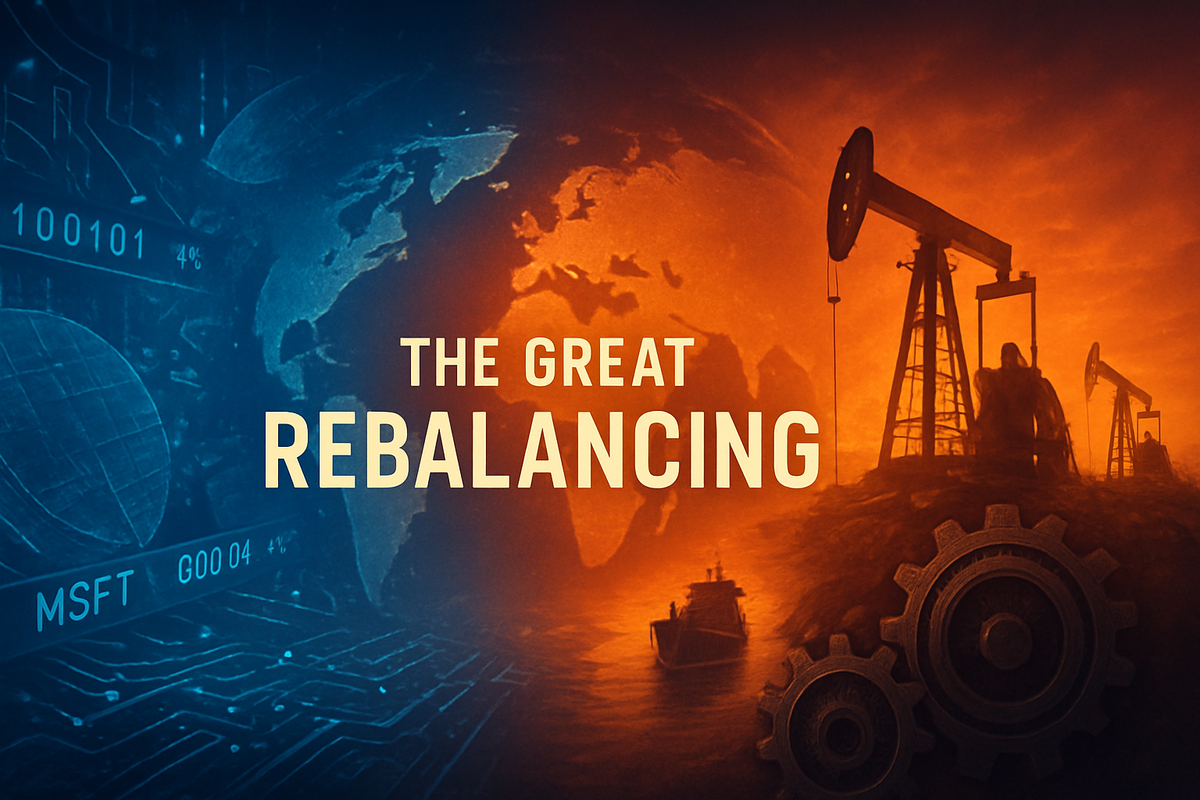
NEW YORK — March 26, 2026 — The long-anticipated "Great Broadening" of the financial markets has arrived with a geopolitical vengeance. As of today, the dominance of mega-cap technology has officially yielded to a robust resurgence in tangible assets, as a rapidly escalating conflict with Iran forces a historic rotation into energy, materials, and industrials. Investors who spent years tethered to the growth of the digital frontier are now scrambling to secure positions in the physical world, driven by supply chain vulnerabilities and a tectonic shift in global energy security.
The immediate implications of this rotation are profound: while the tech-heavy benchmarks have entered a period of cooling and consolidation, the "Old Economy" sectors are seeing their highest capital inflows in nearly a decade. This shift, occurring on the heels of the de facto closure of the Strait of Hormuz, has transformed the market landscape from one of speculative AI growth to one of strategic resource preservation, fundamentally altering the risk-reward calculus for global portfolios.
The current market upheaval can be traced back to the "February Strikes," a series of joint military operations by the U.S. and Israel targeting Iranian nuclear infrastructure that began late last month. By early March 2026, the situation transitioned from a localized military engagement to a global economic crisis. Following retaliatory threats from Tehran, the Strait of Hormuz—the world’s most critical maritime chokepoint for oil and LNG—saw a significant reduction in commercial traffic, eventually reaching a near-total blockade by the second week of March.
The timeline of events leading to today’s market opening has been breathless. On March 15, Brent crude prices breached the $110 mark for the first time in years, and as of this morning, they are hovering near $122 per barrel. Key stakeholders, including the G7 energy ministers and leadership at the European Central Bank, have been in emergency sessions to address the stagflationary pressures. Initial market reactions were chaotic, with an initial "flash crash" in high-valuation growth stocks on March 20, followed by a sustained, orderly migration of capital into value-oriented and defensive sectors.
The Federal Reserve, previously expected to signal a series of rate cuts this spring, is now in a "hawkish pause." The surge in energy costs has added an estimated 0.9% to headline inflation in just three weeks, complicating the central bank’s mission. Traders have largely abandoned the "soft landing" narrative in favor of a "geopolitical hedge" strategy, prioritizing companies with strong pricing power and domestic supply chains.
The shift in leadership has created a stark divide between the winners of the "Atoms" era and the losers of the "Bits" era. In the energy sector, Exxon Mobil Corp (NYSE: XOM) and Chevron Corp (NYSE: CVX) have emerged as the primary beneficiaries of the supply crunch. With global oil supplies tightening, these domestic giants are seeing their margins expand to record levels, as they are less reliant on the destabilized Middle Eastern logistics than their European counterparts. Similarly, Freeport-McMoRan Inc (NYSE: FCX) has seen a surge in demand for copper and other critical materials as investors bet on a massive military and industrial rearmament.
In the industrials and defense space, the conflict has provided a grim but potent tailwind. Lockheed Martin Corp (NYSE: LMT) and Northrop Grumman Corp (NYSE: NOC) have both seen their stock prices reach all-time highs this week as the Pentagon accelerates procurement cycles to replenish stockpiles and support regional allies. Conversely, Caterpillar Inc (NYSE: CAT) is benefiting from the "U.S. Manufacturing Renaissance," fueled by the 2025 One Big Beautiful Bill Act (OBBBA), which redirected federal spending toward domestic infrastructure—a move that now looks prescient given the global trade disruptions.
The casualties of this rotation are the former market darlings. NVIDIA Corporation (NASDAQ: NVDA) and Apple Inc (NASDAQ: AAPL) have faced significant selling pressure as investors move away from high-multiple growth stocks. While their long-term AI and consumer stories remain intact, the immediate cost of capital and the risk of semiconductor supply chain interruptions in a broader conflict have cooled investor enthusiasm. Furthermore, the Energy Select Sector SPDR Fund (NYSEARCA:XLE) has officially outperformed the technology-heavy QQQ for the first time since the early 2020s, signaling a regime change that many analysts believe is here to stay.
This event fits into a broader industry trend known as "The Bits to Atoms Shift," where the digital economy's reliance on physical infrastructure has finally come home to roost. For years, the market ignored the growing divergence between sky-high software valuations and the underfunded energy and materials sectors. The 2026 Iran conflict acted as the ultimate catalyst, proving that the digital revolution cannot thrive without a stable, physical foundation. This ripple effect is being felt globally, as countries like Germany and Japan face localized recessions due to their heavy reliance on energy imports.
Historically, this moment draws comparisons to the 1973 oil embargo, which also forced a radical re-evaluation of market leadership. However, unlike the 70s, the current shift is occurring in an era of massive fiscal stimulus and an ongoing energy transition. The policy implications are significant: the U.S. government is expected to pivot further toward energy independence and "friend-shoring," potentially introducing new tax credits for domestic mineral extraction and refining. This regulatory shift will likely favor domestic incumbents over international competitors for years to come.
Furthermore, the broadening of the market—long called for by analysts at firms like Goldman Sachs—is finally providing the diversification that many portfolios lacked. The "S&P 493" (the index excluding the tech giants) is finally pulling its weight, with earnings growth in the industrials and materials sectors projected to exceed 15% for the first half of 2026. This rebalancing reduces the systemic risk of a single-sector bubble bursting, even as it introduces new volatility linked to geopolitical tensions.
Looking ahead, the market faces two primary scenarios. In the short term, a diplomatic resolution to the Strait of Hormuz blockade could lead to a relief rally in technology and a sharp, temporary correction in energy prices. However, many strategists believe the strategic pivot has already occurred. Companies like Walmart Inc (NYSE: WMT) and The Procter & Gamble Company (NYSE: PG) are already adapting their supply chains to account for permanent increases in logistics costs, suggesting that the "higher-for-longer" inflation environment is being baked into corporate strategy.
In the long term, the market will likely see a continued "multi-polar" growth model. The focus will shift from "AI for the sake of AI" to "AI for industrial efficiency." Strategic pivots are already visible; tech firms are increasingly investing in their own energy production—such as small modular reactors—to decouple from the volatile public grid. This convergence of tech and energy could create a new class of "hybrid" stocks that dominate the latter half of the decade.
The challenges will remain focused on the "geopolitical risk premium." As long as the Middle East remains a flashpoint, the "safe-haven" status of the U.S. Dollar and Gold will persist. Investors should prepare for a market that is less about "growth at any price" and more about "resilience at a reasonable price." The opportunities will emerge in mid-cap companies that provide the nuts and bolts of the new industrial economy, often overlooked during the decade-long tech boom.
The key takeaway from the events of March 26, 2026, is that the era of hyper-concentrated market leadership in technology has met its match in the reality of global geopolitics. The "Great Broadening" is not just a statistical anomaly; it is a fundamental realignment of capital toward the sectors that power and protect the modern world. While the Iran conflict has provided the immediate spark, the underlying tinder was a decade of underinvestment in the "Old Economy."
Moving forward, the market will be defined by its ability to navigate a world where energy security and industrial capacity are just as valuable as code and data. Investors should watch closely for any signs of de-escalation in the Middle East, as well as the Federal Reserve’s response to the current energy-led inflation spike. The coming months will likely be a period of intense volatility, but for those positioned in the broadening base of the market, it also represents the beginning of a new cycle of sustainable, diversified growth.
This content is intended for informational purposes only and is not financial advice.