MARCH 16, 2026 — The global commodity landscape is undergoing a radical and costly transformation as the effective closure of the Strait of Hormuz enters its third week. What was once the world's most vital maritime artery for energy and industrial metals has become a "no-go zone," forcing major producers to abandon traditional shipping lanes in favor of an emergency "Land-Bridge" network. By bypassing the chokepoint through the Port of Sohar in Oman and Jeddah Islamic Port in Saudi Arabia, companies are attempting to keep the wheels of global industry turning, albeit at a staggering logistical premium that is already trickling down to the price of finished goods.
The immediate implications are a bifurcated market: while regional producers scramble to secure trucking capacity across the Arabian Peninsula, global buyers are facing a "stranding" of inventory within the Persian Gulf. Base metals, particularly aluminum and copper, have seen their physical premiums skyrocket as the costs of these overland workarounds—estimated to be 300% higher than traditional maritime freight—are baked into every tonne. For the automotive and aerospace industries, which rely heavily on high-purity aluminum from the Middle East, the crisis has moved from a speculative risk to a daily operational nightmare.
A Fortress Breached: The Timeline of the Hormuz Blockade
The current crisis traces its origins to February 28, 2026, following a sharp escalation in regional military activity that led the Islamic Revolutionary Guard Corps (IRGC) to declare the Strait of Hormuz closed to all Western-aligned commercial traffic. By March 5, major global shipping lines, including A.P. Møller - Mærsk A/S (CPH:MAERSK-B) and Hapag-Lloyd AG (XETRA:HLAG), officially suspended all transits after marine insurers withdrew Protection & Indemnity (P&I) coverage for the area. This "double-lock" on regional trade—compounded by ongoing instability in the Red Sea—has effectively severed the primary maritime link between the massive industrial hubs of the United Arab Emirates, Qatar, and Bahrain and their primary markets in Europe and Asia.
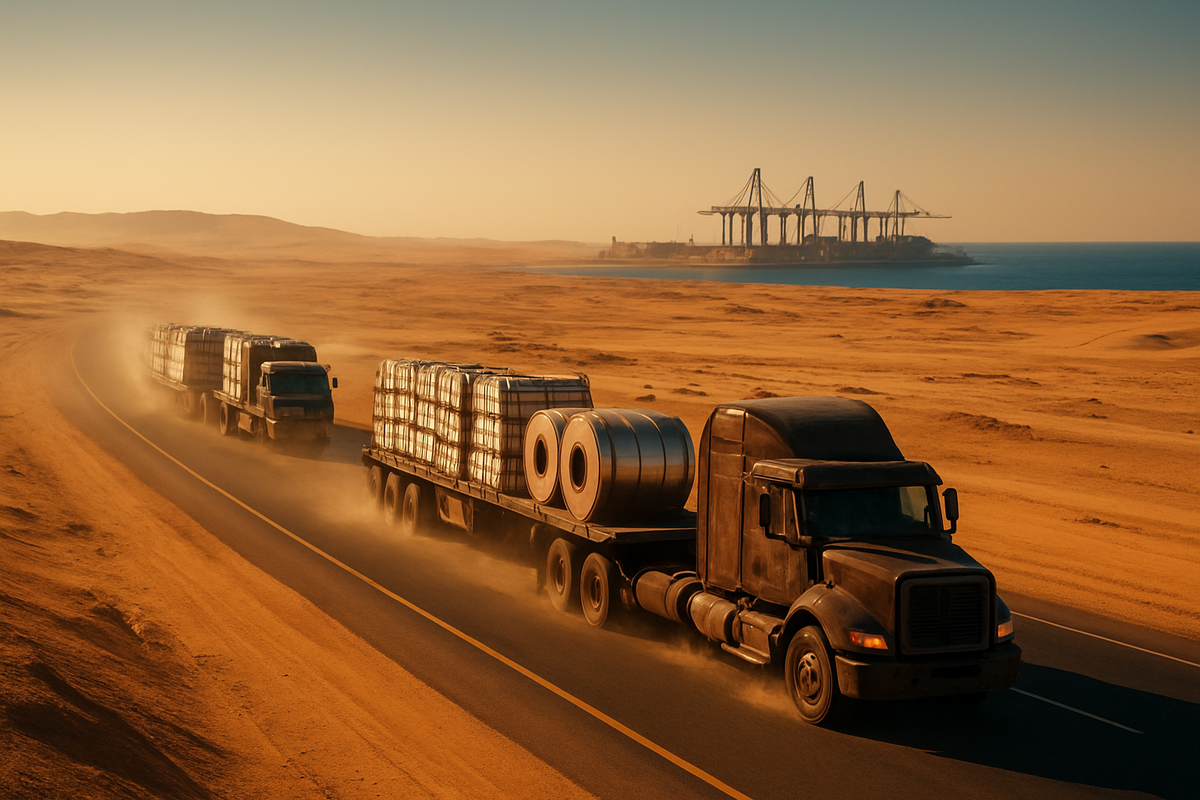
In response, a desperate scramble for land-based alternatives has centered on two primary hubs: the Port of Sohar in Oman and Jeddah Islamic Port in Saudi Arabia. The "Sohar Corridor" has become the primary exit for goods originating in the UAE, with cargo being offloaded at Oman’s deep-water ports and trucked 350 kilometers overland to Jebel Ali. Conversely, the "Jeddah Gateway" serves as the primary export point for Saudi Arabia’s interior industrial zones. This requires a massive logistical feat: trucking thousands of tonnes of refined metal across 1,200 kilometers of desert to reach the Red Sea, effectively bypassing the naval blockade entirely.
The logistics of this shift are Herculean. Logistics providers, led by DP World and regional partners, have established "emergency bonded trucking corridors" to move containers that were previously intended for sea transit. However, the sheer volume of base metals—which are heavy and require specialized transport—has strained the region’s trucking fleet to its breaking point. As of March 12, wait times at the Saudi-Omani border have swelled to 48 hours, even with expedited customs protocols in place.
Corporate Fallout: Winners, Losers, and the High Price of Resilience
The primary victims of this maritime paralysis are the region’s "Big Three" aluminum producers. Aluminium Bahrain (BHB:ALBH), or Alba, has been hit hardest, declaring Force Majeure on several export contracts on March 4. Unlike its neighbors with direct land connections to the Red Sea, Bahrain’s island geography makes it uniquely vulnerable. Alba has reportedly begun a controlled shutdown of nearly 20% of its smelting capacity to preserve its dwindling raw material inventory, as the alumina required to feed its pots remains trapped on vessels outside the Strait.
In contrast, the Saudi Arabian Mining Company (TADAWUL:1211), known as Ma'aden, has emerged as a resilient, albeit burdened, player. By leveraging the internal "Landbridge" rail and road infrastructure, Ma'aden has managed to redirect a significant portion of its aluminum and phosphate exports to the Red Sea port of Yanbu. While this ensures the flow of product, the company’s margins are taking a significant hit; internal estimates suggest that the shift to overland transport is adding $45 to $60 per tonne in additional freight costs. Global giants like Alcoa Corporation (NYSE: AA) and Rio Tinto Group (NYSE: RIO), which hold various joint ventures and supply agreements in the region, are also feeling the pinch as their equity shares of Middle Eastern production become harder to deliver to global customers.
The "winners," if they can be called such in a time of crisis, are the diversified logistics firms and Omani port operators. The Port of Sohar has seen a 400% increase in transshipment volume in a fortnight. Companies providing "multi-modal" solutions are seeing record demand. However, for most public companies in the manufacturing sector, these workarounds represent a "least-worst" scenario that prevents a total shutdown but erodes the cost-competitiveness that Gulf producers have enjoyed for decades due to low energy costs.
A Paradigm Shift in Global Logistics
The shift to land-bridges is more than just a temporary fix; it represents a fundamental change in how the industry views "chokepoint risk." Historically, the Strait of Hormuz was seen as a risk that would be solved by naval escorts or geopolitical de-escalation. The 2026 crisis has proven that in an era of asymmetric warfare and high-precision missiles, maritime dominance is no longer a guarantee of trade flow. This event fits into a broader trend of "de-risking" supply chains that began after the 2021 Suez Canal blockage, but with a far more permanent geopolitical weight.
The ripple effects are being felt in the regulatory and policy spheres. Saudi Arabia has announced an emergency acceleration of the "Saudi Landbridge Project," a multi-billion dollar rail initiative aimed at connecting the Persian Gulf coast directly to the Red Sea. What was originally a 10-year infrastructure goal is now being treated as a national security priority. Furthermore, the reliance on Oman’s Sohar Port highlights the growing importance of "neutral hubs" in global trade—countries that can maintain functional ports when larger neighbors are in conflict.
This crisis also highlights the fragility of the "just-in-time" model for base metals. Unlike consumer goods, industrial metals are the foundation of manufacturing; a two-week delay in aluminum ingots can shut down an entire automotive assembly line in Germany or Japan. The historical precedent of the 1967-1975 Suez Canal closure is often cited, but the scale of modern industrial dependency makes the 2026 Hormuz closure a significantly more volatile event for global markets.
The Road Ahead: Strategic Pivots and Market Realities
In the short term, the industry is preparing for a "long haul" through the desert. Logistics costs are expected to remain elevated even if the Strait partially re-opens, as insurance premiums will take months, if not years, to normalize. We are likely to see a strategic pivot where major producers like Ma'aden and EGA seek to permanently diversify their export gateways, investing heavily in Red Sea infrastructure to ensure they are never again reliant solely on the 21-mile-wide passage of Hormuz.
Market opportunities are emerging for producers outside the conflict zone. Aluminum smelters in North America and Iceland are ramping up production to capture the supply gap, but they cannot fully replace the 9% of global primary aluminum that typically flows through the Gulf. In the long term, we may see the emergence of a "two-tier" pricing system for metals: "Strait-free" metal that commands a premium for its reliable delivery, and "Gulf-trapped" metal that trades at a discount due to the high cost and risk of extraction from the region.
The next few months will be a test of the "Land-Bridge" capacity. If the trucking and rail infrastructure can scale to meet 50-60% of previous maritime volumes, the global shock may be blunted. If not, the world may face a structural shortage of base metals that could trigger a global industrial slowdown.
Summary and Investor Outlook
The closure of the Strait of Hormuz in 2026 has forced a historic relocation of trade routes. By utilizing land-bridges to Jeddah and Sohar, the base metals industry has avoided a total collapse, but at a cost that is reshaping the economics of the sector. The key takeaways for the market are clear: logistics are no longer a background cost but a primary driver of commodity pricing, and geographic diversification is the new mandate for industrial survival.
Moving forward, investors should watch for the sustainability of these land-bridges. Specifically, keep an eye on the quarterly earnings of Ma'aden (TADAWUL:1211) and Alba (BHB:ALBH) to see the true impact of "logistics creep" on their bottom lines. Additionally, any movement in the stock of major shippers like Maersk (CPH:MAERSK-B) regarding "conflict surcharges" will be a bellwether for how long these high costs will persist. The 2026 crisis is a stark reminder that in the modern world, the shortest distance between two points is no longer a straight line—it’s the route that avoids the chokepoint.
This content is intended for informational purposes only and is not financial advice.