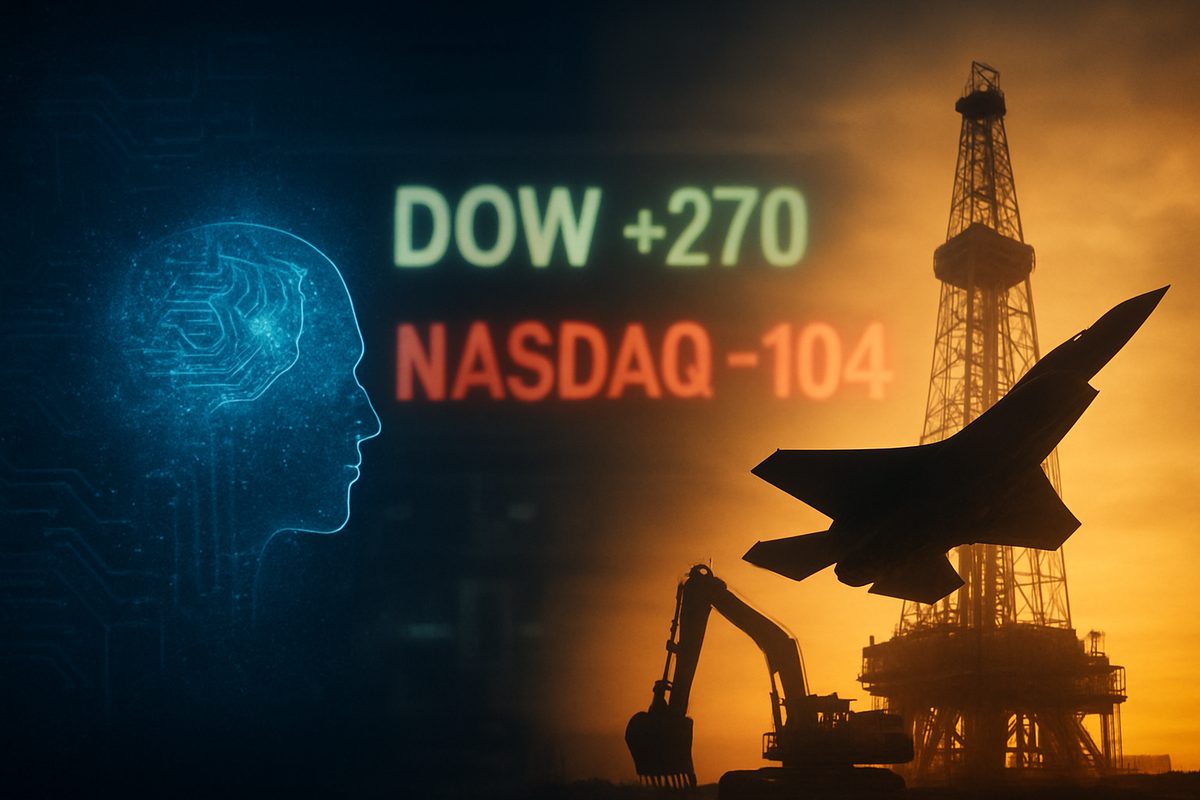
On January 8, 2026, the U.S. stock market witnessed a stark divergence in investor sentiment, marking what analysts are calling the "Great Decompression." The blue-chip Dow Jones Industrial Average (INDEXDJX:.DJI) surged 270.03 points, or 0.55%, to close at 49,266.11, while the tech-heavy Nasdaq Composite (INDEXNASDAQ: .IXIC) slipped 104.26 points, or 0.44%, to 23,480.02. This rotation signals a massive migration of capital away from high-valuation technology growth stocks and into the pragmatic, cash-flow-heavy sectors of defense and energy.
The immediate implications of this shift are profound, suggesting that the "AI-at-any-price" era may be giving way to a more defensive posture. As geopolitical instability rises and federal spending priorities undergo a radical transformation, the market is repricing risk. For the first time in several years, the "Magnificent Seven" tech giants are finding themselves on the defensive, while traditional industrial and energy titans are reclaiming their role as the market's primary engines of growth.
A Perfect Storm: Budgets, Boots, and Valuation Resets
The primary catalyst for this dramatic rotation was a late-Wednesday announcement from the White House regarding a proposed $1.5 trillion defense budget for the 2027 fiscal year. This figure represents a staggering 50% increase over the $901 billion approved for 2026. Aimed at building what the administration calls a "Dream Military," the proposal fundamentally recalibrated the long-term revenue expectations for the nation’s largest defense contractors. The sheer scale of the proposed spending caught Wall Street off guard, forcing an immediate reallocation of funds into the aerospace and defense sectors.
Compounding this domestic policy shift was a surge in global geopolitical volatility. Earlier in the week, a U.S. military operation in Venezuela—which resulted in the capture of key leadership—sent shockwaves through global commodity markets. Venezuela, home to the world’s largest proven oil reserves, became the epicenter of a "Safe Haven" trade. Investors, fearing potential supply disruptions or long-term regional instability, fled the uncertainty of tech and piled into energy producers and defense firms capable of navigating and profiting from a more fractured global order.
Simultaneously, the tech sector began to buckle under the weight of its own success. After years of relentless gains driven by artificial intelligence, "AI fatigue" has finally set in. Market participants are increasingly demanding tangible proof of profitability from the massive capital expenditures poured into AI infrastructure. With mixed economic data—including cooling JOLTS reports and steady jobless claims—investors are betting that the Federal Reserve will maintain current interest rates rather than cutting them. This "higher-for-longer" reality is toxic for high-multiple growth stocks but serves as a tailwind for value-oriented sectors like energy and industrials.
Industrial Titans Ascend as Silicon Valley Stumbles
The clear winners of this rotation are the stalwarts of the military-industrial complex and the oil patch. Lockheed Martin (NYSE: LMT) saw its shares climb by as much as 8% following the budget news, while Northrop Grumman (NYSE: NOC) surged more than 10%. Other major beneficiaries included RTX Corporation (NYSE: RTX) and General Dynamics (NYSE: GD), which both saw gains exceeding 5%. A standout performer in the mid-cap space was Kratos Defense & Security Solutions (NASDAQ: KTOS), which jumped 17% on expectations that the new budget will prioritize autonomous systems and drone warfare.
The energy sector also rode the wave of the "Venezuela Shock," with crude oil prices rebounding 4.5% to settle near $59 per barrel. ExxonMobil (NYSE: XOM) gained approximately 3.7%, but it was Chevron (NYSE: CVX) that drew the most attention, rising 2.6%. Chevron is uniquely positioned as the only U.S. major with significant historical ties to Venezuelan infrastructure, making it a primary vehicle for investors looking to play a potential restructuring of that nation's energy output.
Conversely, the technology sector faced a grueling session. Nvidia (NASDAQ: NVDA), the poster child of the AI revolution, saw a significant pullback as investors locked in profits following a massive multi-year run. Apple (NASDAQ: AAPL) fell roughly 1%, further dampened by the news that Alphabet (NASDAQ: GOOGL) had surpassed it in market capitalization for the first time since 2019. The pain extended to the semiconductor space, where Micron (NASDAQ: MU), Applied Materials (NASDAQ: AMAT), and Intel (NASDAQ: INTC) each dropped by more than 3.6%, reflecting a broader retreat from the hardware providers that have powered the AI buildout.
A Structural Shift in the Market Architecture
This rotation is not merely a one-day anomaly; it fits into a broader industry trend of "Value over Growth" that has been simmering beneath the surface of the market for months. For much of the 2020s, the market was bifurcated between a handful of tech giants and "everything else." The current event suggests a normalization where the "everything else"—specifically sectors tied to national security and energy independence—is finally catching up. This move mimics historical precedents, such as the early 2000s post-dot-com bubble era, where the market shifted from speculative tech to tangible commodities and industrial strength.
The ripple effects on competitors and partners will be significant. As the federal government pivots toward a $1.5 trillion defense spend, non-defense discretionary spending may face cuts, potentially hurting tech firms that rely on government research grants or civilian contracts. Furthermore, the regulatory environment is shifting; while tech companies face ongoing antitrust scrutiny, defense and energy firms are seeing a deregulation push aimed at accelerating production and deployment.
Historically, such sharp rotations often precede a period of broader market consolidation. When the "leadership" of the market changes so abruptly, it creates a period of price discovery that can be volatile. The fact that the Dow is hitting near-record highs while the Nasdaq struggles suggests that while the "bull market" remains intact, its internal plumbing is being entirely replaced.
Navigating the New Geopolitical Economy
Looking ahead, the short-term focus will remain on the viability of the proposed defense budget as it moves through Congress. Any signs of bipartisan support or, conversely, significant pushback will dictate the next leg of the defense rally. In the long term, tech companies like Microsoft (NASDAQ: MSFT) and Nvidia will likely need to pivot their narratives from "growth potential" to "operational efficiency" and "capital return" to win back investors who are now prioritizing cash flow and dividends over speculative future earnings.
Market opportunities are emerging in "dual-use" technologies—firms that bridge the gap between Silicon Valley innovation and Pentagon requirements. Companies focusing on cybersecurity, satellite communications, and battlefield AI may become the new darlings of Wall Street, offering the growth of tech with the stability of government-backed defense contracts. However, the challenge remains for the broader Nasdaq; if the "Magnificent Seven" cannot find a new catalyst, the index may enter a prolonged period of underperformance relative to the Dow.
Potential scenarios for the coming months include a "Catch-Up" trade where the rest of the market rises to meet tech valuations, or a "Mean Reversion" where tech valuations fall significantly to align with the rest of the market. Given the current geopolitical climate, the latter seems more likely for the high-multiple software and hardware sectors.
Summary for the Strategic Investor
The events of January 8, 2026, mark a definitive turning point in the post-pandemic market cycle. The 270-point gain in the Dow against the Nasdaq's slip is a clear signal that the market's "center of gravity" has moved. The key takeaways are simple: defense is no longer a sleepy value play but a high-growth sector fueled by unprecedented federal spending, and energy remains the ultimate hedge against a volatile global landscape.
Moving forward, the market will likely be characterized by increased sector dispersion. Investors should move away from broad index tracking and toward active sector management. The dominance of the Nasdaq is being challenged by a world that once again values physical assets, national security, and energy reliability over digital expansion.
In the coming months, investors should watch for the quarterly earnings reports of the major defense contractors to see if the "Dream Military" budget is already impacting their backlogs. Additionally, keep a close eye on oil price stability; if crude breaks above $70, the energy rotation could turn into a full-scale stampede. The "Great Decompression" is here, and the map of Wall Street is being redrawn in real-time.
This content is intended for informational purposes only and is not financial advice.