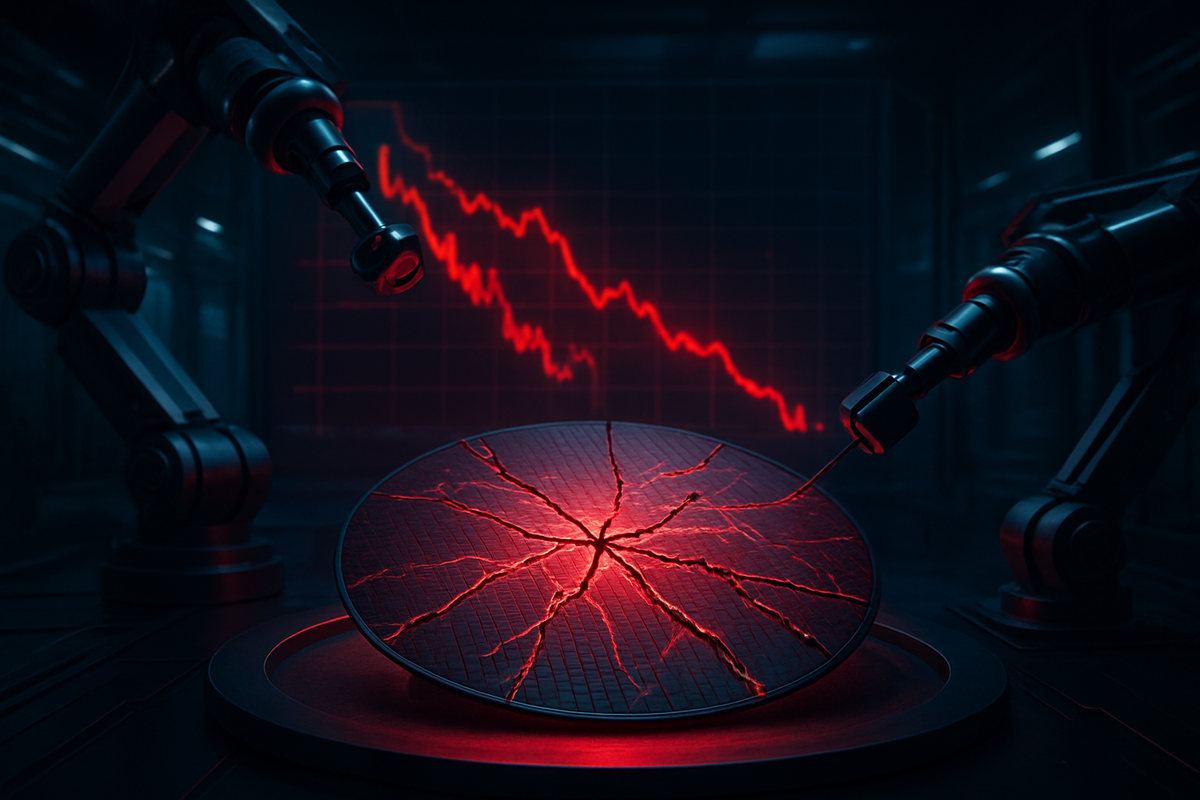
The semiconductor industry was sent into a tailspin this week as Intel Corp. (Nasdaq: INTC) reported fourth-quarter 2025 financial results that, while exceeding immediate expectations, painted a grim picture for the year ahead. Despite a revenue beat and a surprising jump in adjusted earnings for the final quarter of 2025, the company’s guidance for the first quarter of 2026—projecting a stunning zero-cent adjusted earnings per share (EPS)—sent investors rushing for the exits.
The immediate implications were severe. On January 23, 2026, Intel’s stock plummeted by over 12%, wiping out more than $30 billion in market capitalization in a single trading session. The sell-off reflects a deepening skepticism regarding Intel’s multi-year "IDM 2.0" turnaround strategy, as the company grapples with persistent manufacturing yield issues and a supply chain that management describes as being in a "stranglehold."
The "Execution Valley": Inside the Q4 Report and the 2026 Warning
On January 22, 2026, Intel reported Q4 2025 revenue of $13.7 billion, down 4% year-over-year but ahead of the $13.4 billion consensus. Non-GAAP earnings per share came in at $0.15, nearly double the $0.08 expected by analysts. However, the optimism was short-lived. Chief Financial Officer David Zinsner revealed that the company had completely depleted its "buffer inventory" of chips during the holiday quarter, entering 2026 with no margin for error in its manufacturing facilities.
The timeline leading to this moment has been one of radical transition. Following the departure of Pat Gelsinger in early 2025, new CEO Lip-Bu Tan has overseen a period of unprecedented external intervention. In late 2025, Intel accepted a $5 billion equity stake from NVIDIA Corp. (Nasdaq: NVDA) and a $2 billion investment from SoftBank Group Corp. (TYO: 9984) to stabilize its foundry business. Most significantly, the U.S. Government exercised its authority under the CHIPS Act to take a passive 10% stake in the company, effectively designating Intel a "national champion" too critical to fail.
Despite these lifelines, the fundamental problem remains manufacturing. The company's 18A process node, which was supposed to be the "TSMC-killer," entered high-volume manufacturing in late 2025 with yields reportedly stuck between 65% and 75%. These suboptimal yields, combined with the $10.3 billion operating loss recorded by the Intel Foundry division in 2025, have created a financial anchor that the company’s design side can no longer offset. Market reaction has been one of exhaustion; investors are increasingly weary of "transition years" that seem to extend indefinitely.
The Competitive Divide: Winners and Losers in the Wake of Intel’s Stumble
As Intel struggles to find its footing, its primary rivals are accelerating. NVIDIA continues to dominate the AI landscape, having recently unveiled its "Rubin" platform at CES 2026. While NVIDIA is technically a strategic investor in Intel, the relationship is one of "co-opetition." NVIDIA is utilizing Intel’s advanced packaging services to hedge against capacity limits at Taiwan Semiconductor Manufacturing Company (NYSE: TSM), but it remains the apex predator in the data center. By using Intel as a secondary packaging provider, NVIDIA wins by securing its own supply while Intel absorbs the low-margin overhead of the manufacturing process.
Advanced Micro Devices, Inc. (Nasdaq: AMD) appears to be the most direct beneficiary of Intel's guidance revision. With Intel projecting zero profit for Q1 2026, AMD has been aggressively targeting Intel’s remaining strongholds in the server market with its "Zen 5" and upcoming "Zen 6" architectures. Analysts estimate that AMD’s server market share has now surpassed 30%, a historic high. Unlike Intel, AMD remains a "fabless" entity, allowing it to leverage TSMC’s superior 2nm yields without the multi-billion dollar capital expenditure burden that is currently crushing Intel’s balance sheet.
For Taiwan Semiconductor Manufacturing Company, Intel's struggles reinforce its monopoly-like status at the leading edge. While Intel had hoped to attract external customers like Apple (Nasdaq: AAPL) or Qualcomm (Nasdaq: QCOM) to its 18A node, the ongoing yield concerns make such a transition risky for major chip designers. Consequently, the "Foundry Winner" remains the incumbent in Taiwan, as the barrier to entry for domestic U.S. manufacturing continues to look prohibitively expensive.
A National Interest Conflict: Broader Industry and Policy Implications
Intel’s current predicament is no longer just a corporate story; it is a matter of national industrial policy. The 10% stake held by the U.S. government marks a return to "state-supported capitalism" in the high-tech sector. This provides a safety net that prevents Intel from bankruptcy, but it also introduces regulatory complexity. There are growing concerns among investors that government oversight may prioritize domestic jobs and "sovereign silicon" over shareholder returns and margin expansion.
The situation also highlights a significant shift in the AI hardware trend. As the market moves from training massive models—where NVIDIA reigns supreme—to "inference" at the edge, Intel had hoped its Core Ultra Series 3 (Panther Lake) chips would lead the "AI PC" revolution. However, the financial weakness revealed in this earnings report suggests that even if Intel has the right product, it lacks the manufacturing efficiency to profit from it. This disconnect is a cautionary tale for the industry: design excellence is irrelevant without execution at the foundry level.
Historically, this resembles the "Execution Valley" faced by other industrial giants during technological pivots, such as IBM’s transition in the early 1990s. The difference is the capital intensity of modern semiconductors; a single mistake in a process node today costs billions and takes years to rectify, leaving little room for the "strategic pivots" that saved tech companies in previous decades.
The Road Ahead: Jaguar Shores and the Fight for Survival
The short-term outlook for Intel is undeniably bleak. The Q1 2026 guidance suggests that the company is effectively running its operations at break-even to maintain market share while it waits for the 18A node to mature. Analysts will be closely watching for "Jaguar Shores," Intel’s next-generation AI accelerator scheduled for mid-2026. If Jaguar Shores fails to gain traction with hyperscalers like Microsoft (Nasdaq: MSFT) or Meta (Nasdaq: META), Intel may be forced to consider a radical "structural split," completely spinning off its foundry business into a separate government-backed entity.
In the long term, the success of Intel depends on whether it can transform from a struggling chipmaker into a reliable "System Foundry." This requires not just matching TSMC’s technology, but matching their operational discipline. The potential for a recovery exists, particularly if the AI PC market takes off in late 2026 as Windows-based AI features become more ubiquitous. However, the margin of error has vanished. Intel is now in a race against its own balance sheet.
Conclusion: A Watershed Moment for Silicon Valley
Intel’s Q4 2025 earnings report will likely be remembered as the moment the market realized the sheer scale of the company’s "foundry trap." The paradox of beating revenue targets while guiding for zero profit illustrates a business that is growing in volume but shrinking in value. For the broader market, Intel's weakness is a signal that the semiconductor industry is bifurcating: those who design and those who manufacture. Intel’s attempt to do both at the leading edge is currently under the most intense pressure in the company's 58-year history.
Moving forward, investors should keep a microscopic focus on two metrics: 18A yield improvements and the pace of the "Foundry" division's losses. The survival of Intel as a private, profit-driven entity may depend on its ability to stop the bleeding in its manufacturing arm before the U.S. government feels the need to take a more active role in its management. For now, the "National Champion" remains in the intensive care unit of the global markets.
This content is intended for informational purposes only and is not financial advice.