
US small business bank accounts are dropping monthly fees because the economics changed and traditional banks are losing customers. Fintechs make money on interchange, deposits, and premium tiers rather than maintenance fees, so they compete by giving the base account away. With roughly two-thirds of small businesses shopping for a new banking relationship, charging $10-30 a month for a checking account has become a liability, not a revenue line.
Here is what is actually driving the shift, how "free" providers still make money, and what a $0 account does and does not cover.
The short answer: the business model changed
The monthly maintenance fee is a legacy of an era when a bank's costs were branches, tellers, and paper. Digital-first providers carry none of that overhead, so the fee stopped being necessary to cover costs. Once one provider dropped it to win customers, the rest had to follow. In 2026, the fee is a competitive disadvantage more than a revenue stream.
How fintechs make money without monthly fees
A $0 account is not charity. Providers earn in four main ways:
Interchange. Every debit card swipe pays the issuer a small percentage. Across a business's spend, that adds up without the business ever seeing a fee.
Deposits and float. Providers earn a spread on the balances held in the network, which is why higher deposits and savings features are actively courted.
Premium tiers. Invoicing, bookkeeping, higher APY, and priority support sit behind paid plans, so power users subsidize the free base account.
Lending and add-ons. Lines of credit, cards, and partner products generate revenue for accounts that use them.
The result: the base account can be free because the business is monetized through activity, not access.
The competitive pressure forcing banks to follow
Small businesses are moving, and the numbers explain the urgency. Roughly two-thirds are actively shopping for a new banking relationship, and 74% now reach for non-bank lenders over traditional banks when they need working capital, per 2026 industry data from BAI and OnDeck. About 80% of financial institutions say they plan to expand their small business offerings in response.
When customers can open a fully featured account elsewhere in minutes for $0, a monthly fee becomes the reason they leave. Dropping it is defensive as much as competitive.
What "free" actually covers in 2026 - and what it does not
The $0 tier now bundles what used to be premium: wires, high payment limits, multiple team logins, and spend controls. The table below shows where a few leading providers land, and where the paid layers begin.
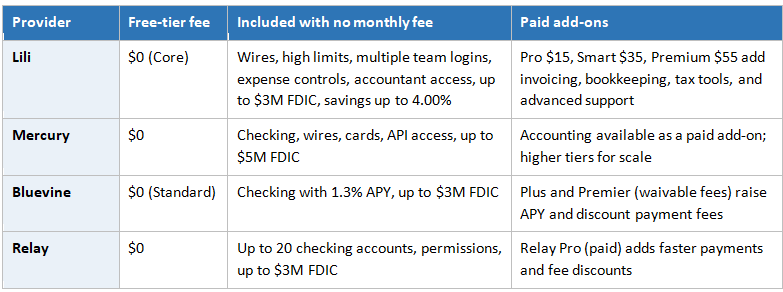
The catch: free monthly maintenance does not mean free everything. Watch for per-wire and per-ACH charges, out-of-network ATM and cash-deposit fees, expedited-transfer costs, and features gated behind paid tiers. The real comparison is total cost for how you actually operate, not the headline $0.
Is a $0 monthly fee account too good to be true?
No, but read two things carefully. First, most no-fee providers are fintech companies, not banks; they deliver banking services through FDIC-member partner banks, and your funds are insured through those banks subject to pass-through conditions. Second, sweep-network coverage of $3-5 million is a real benefit but depends on the structure being set up correctly. Verify the partner bank and the coverage before parking large operating balances.
What to check before switching to a no-fee account
Transaction fees. Wires, ACH, expedited transfers, and cash deposits - the costs a $0 headline hides.
Deposit protection. The partner bank, the sweep structure, and the total insured amount.
Free-tier features. Whether team access, spend controls, and limits are included or gated.
Paid-tier value. Whether the upgrade pays for itself in hours saved or yield earned.
Support quality. How fast you get a human when something goes wrong.
How Lili helps
Lili is a clear example of the $0 monthly fee model built for teams. Its Core plan is free and already includes what a growing business needs: multiple team logins, expense controls, accountant access, high payment limits, domestic and international wires, up to $3 million in FDIC insurance through its sweep network with Sunrise Banks, and savings paying up to 4.00% APY. Paid tiers (Pro $15/mo, Smart $35/mo, Premium $55/mo) add invoicing, bookkeeping, and tax tools only where a scaling team needs them.
That structure reflects exactly why fees are falling: the base account is free because value is delivered through features and activity, not access. As always, compare total costs and deposit protection against your own numbers before switching.
Frequently asked questions
Why are US small business bank accounts dropping monthly fees?
Digital providers have no branch overhead and earn through interchange, deposits, premium tiers, and lending instead of maintenance fees. With most small businesses shopping for new banking, a monthly fee has become a reason to leave rather than a revenue line.
How do free business bank accounts make money?
Through card interchange on debit spend, a spread on deposits held in the network, paid premium tiers for tools like invoicing and bookkeeping, and lending or partner products. The base account is free because activity is monetized, not access.
Is a $0 monthly fee business account safe?
Generally yes, but most are fintech platforms, not banks. They provide banking through FDIC-member partner banks, and funds are insured through those banks subject to pass-through conditions. Verify the partner bank and coverage before depositing large balances.
Does no monthly fee mean no fees at all?
No. Free maintenance can still come with per-wire, per-ACH, expedited-transfer, and cash-deposit charges, plus features gated behind paid tiers. Compare total cost for how you actually operate, not just the $0 headline.
Which business accounts have no monthly fee in 2026?
Lili, Mercury, Bluevine, Relay, and Novo all offer a $0 monthly tier. They differ in what is included free versus behind paid tiers, and in deposit protection and yield.
Should I switch to a no-fee business account?
Often yes, if the free tier covers your needs and the transaction fees and deposit protection check out. Confirm wire and ACH costs, the FDIC structure, and whether team features are included before moving.