The Strategic Importance of Software Investment
In today’s business environment, software is no longer simply a tool used to support daily operations. It has become a strategic asset that influences efficiency, competitiveness, security, and long-term financial performance. Organizations of all sizes are under increasing pressure to control costs while improving productivity, and modern software investments provide a pathway to achieve both objectives.
Traditional cost-cutting approaches often focus on reducing immediate expenses. However, delaying technology improvements can create higher costs in the future through system failures, inefficient processes, security vulnerabilities, and reduced employee productivity. A well-planned IT investment strategy focuses on creating sustainable value rather than simply minimizing short-term spending.
The most successful organizations view software spending as an investment in business capability rather than an unavoidable expense.
Evaluating Software Through Total Cost of Ownership (TCO)
One of the most important factors in technology decision-making is understanding Total Cost of Ownership (TCO). Many companies evaluate software based only on purchase price, but the actual financial impact extends far beyond the initial investment.
TCO includes implementation costs, employee training, maintenance requirements, security management, upgrades, technical support, and the potential productivity losses caused by outdated systems. A solution with a lower initial price may become more expensive over time if it requires frequent repairs or creates operational limitations.
The following comparison illustrates why businesses need a broader financial perspective when evaluating software investments.
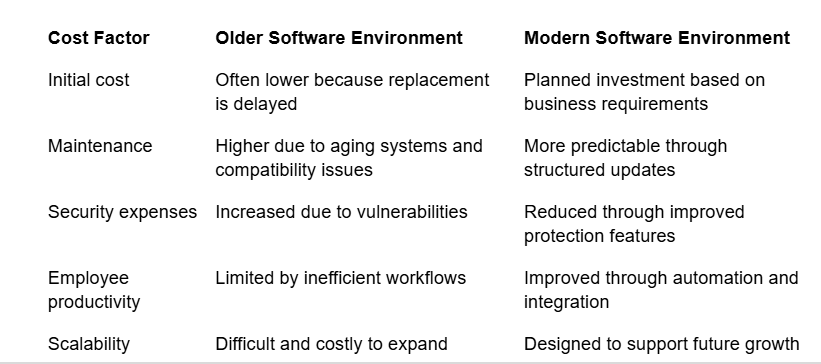
For example, a company continuing to operate outdated systems may spend significant resources troubleshooting technical problems instead of focusing on business development. A modern software environment can reduce these hidden expenses by improving reliability and simplifying management.
Software Lifecycle Planning and Financial Control
Software lifecycle planning is essential for maintaining predictable technology costs. Every software platform eventually reaches stages where updates become limited, security risks increase, and replacement becomes necessary.
Organizations that lack a lifecycle strategy often experience unexpected expenses because they are forced to upgrade systems urgently after failures occur. A planned approach allows companies to schedule investments, allocate budgets, and minimize operational disruption.
For businesses managing server environments, long-term planning is especially important because infrastructure decisions affect security, performance, and application availability. Organizations evaluating updated server solutions may consider options such as Windows Server 2025 Standard as part of their broader infrastructure planning.
The objective of lifecycle management is not constant replacement of technology. Instead, it is about ensuring that software remains reliable, secure, and financially sustainable throughout its useful life.
Infrastructure Modernization as a Business Advantage
Infrastructure modernization has become a central part of digital transformation strategies. Many companies still depend on technology systems that were designed for previous business conditions and may not efficiently support today’s demands.
For instance, a logistics company using outdated systems may experience delays in inventory tracking, communication, and reporting. By modernizing its infrastructure, the company can connect different business processes, improve visibility, and make faster decisions.
A comparison between traditional and modern infrastructure highlights the difference:
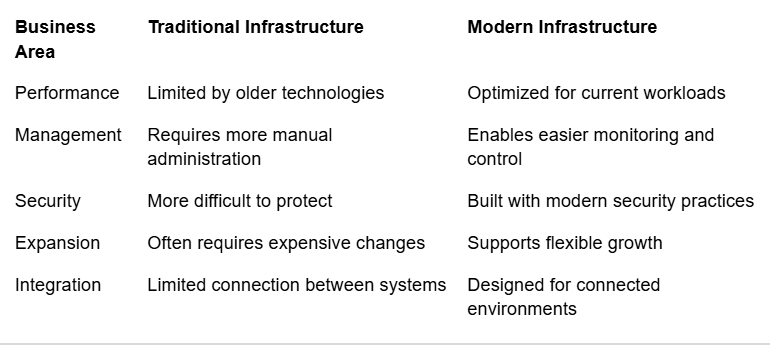
Infrastructure modernization should not be viewed as a technology upgrade alone. It is a business improvement initiative that helps organizations operate more efficiently.
Cybersecurity Investments and Operational Protection
Cybersecurity has become a critical component of business strategy. As organizations rely more heavily on digital systems, the financial consequences of security incidents continue to increase.
A cybersecurity investment protects more than technical infrastructure. It protects business continuity, customer trust, confidential information, and regulatory compliance.
Companies that postpone security improvements often face higher costs when incidents occur. Data recovery, business interruptions, legal obligations, and reputation damage can significantly affect financial performance.
Security should therefore be considered a long-term investment that supports operational stability rather than simply an additional technology expense.
Enterprise Software Licensing and Cost Management
Enterprise software licensing decisions can have a major effect on technology budgets. Organizations frequently overspend because they purchase more features or user licenses than they actually require.
Productivity software is a common example. Organizations need solutions that support communication, document management, and collaboration while remaining financially efficient. Software options such as Office 2024 Standard can be evaluated within a broader productivity and licensing strategy.
The goal of enterprise licensing management is not simply reducing software costs. It is ensuring that every technology investment contributes measurable value to business operations.
Digital Transformation and Productivity Improvement
Digital transformation represents a fundamental change in how organizations use technology to improve business performance. It is not limited to adopting new software but involves redesigning processes to become more efficient and responsive.
Modern software improves productivity by reducing repetitive work and allowing employees to focus on activities that create greater value. Automated reporting, integrated communication systems, digital customer management, and improved data access all contribute to stronger performance.
A professional services company, for example, may previously rely on manual spreadsheets and disconnected communication channels to manage projects. By implementing integrated digital systems, the company can improve project visibility, reduce administrative work, and make better decisions.
Practical Strategies for Successful Implementation
Successful software investment requires careful preparation. Businesses should begin by identifying operational challenges and determining how technology can address those challenges.
Technology decisions should always be connected to measurable business goals. Whether the objective is reducing processing time, improving security, or increasing employee productivity, organizations need clear expectations before implementation begins.
Employee adoption is another important factor. Even the most advanced software cannot deliver value if employees do not understand how to use it effectively. Training, communication, and gradual implementation can improve acceptance and maximize results.
Companies should also create long-term technology roadmaps. A roadmap allows businesses to prioritize investments, forecast expenses, and avoid unexpected technology disruptions.
Measuring the Long-Term ROI of Modern Software
The return on investment from modern software extends beyond immediate cost reduction. The strongest benefits often appear through improved efficiency, stronger security, better decision-making, and increased adaptability.
Long-term ROI depends on how effectively organizations use technology to support business goals. A company that invests in modern software but fails to integrate it into its operations may not achieve significant benefits.
However, businesses that combine technology investment with strategic planning can create lasting advantages. Improved workflows, reduced downtime, stronger security, and better customer experiences all contribute to stronger financial performance.
Conclusion
Modern software investments are an important driver of cost reduction and long-term productivity. Businesses that carefully evaluate technology decisions through TCO analysis, lifecycle planning, cybersecurity considerations, infrastructure modernization, and licensing management are better positioned for sustainable growth.
The purpose of software investment is not simply adopting new technology. It is creating a more efficient, secure, and adaptable business environment.
Organizations that approach software decisions strategically can reduce unnecessary expenses, improve operational performance, and build a foundation for future success in an increasingly digital economy.