
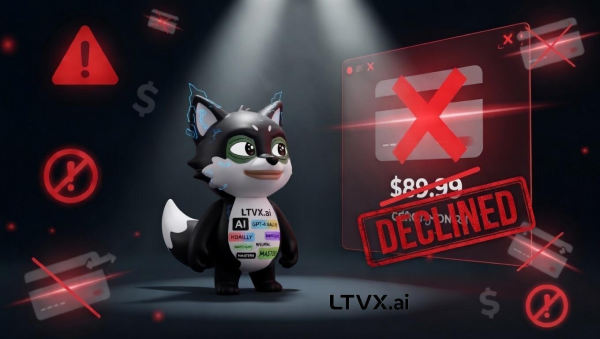
We’ve all been there. You spend months building the perfect customer journey. The customer clicks “Buy,” and the payment gets declined.
Declined payments quietly cost merchants billions of dollars every year. In fact, research shows that 62% of customers who experience a failed transaction will not return to the same website again.
However, a large share of those failed payments is false declines.
“Most merchants still treat false declines as revenue lost forever,” says the founder of LTVX.ai. “But in reality, a large percentage of those declined transactions are recoverable through intelligent payment recovery systems and authorization optimization.”
What Is a Declined Transaction vs. a False Decline?
A declined transaction occurs whenever a payment authorization fails during your checkout. This can happen for many reasons - from insufficient funds and expired cards to even bank-side issues.
But a false decline is much more frustrating. A false decline, on the other hand, occurs when a completely legitimate transaction is incorrectly rejected by the payments ecosystem. The customer is real, the card is valid, and funds are available, but the payment still fails.
Why Do False Declines Occur?
The truth is that the modern payment infrastructure is incredibly messy. In the few seconds it takes to process a payment, that transaction jumps through gateways, processors, issuing banks, and fraud engines. Every single one of those layers is a potential point of failure that can reduce payment acceptance.
Banks use automated fraud systems to protect themselves, but those systems can be over-cautious. If a customer’s behavior looks even slightly ‘off’ to an algorithm, it gets blocked. This is especially common in high-growth industries like SaaS, gaming, travel, and subscriptions, where fraud filters are naturally more aggressive.
Another growing issue is payment stack fragmentation. Many merchants now operate across multiple processors, gateways, MIDs, and acquirers, which creates inconsistent payment performance and lowers authorization rates.
“In many cases, merchants do not actually know why payments are failing,” says the Founder. “They only see generic decline codes without understanding the issuer-side logic behind them.”
How AI Can Help Recover Declined Payments
Traditional payment systems are reactive. A payment fails, the customer receives an error message, and the checkout session often ends there.
AI-powered payment recovery is changing that model entirely. Instead of treating a decline as a final outcome, intelligent recovery systems analyze the transaction context in real time to determine whether a failed payment is actually recoverable.
This is where LTVX.ai focuses its infrastructure. “Our view is simple,” says the founder. “A declined transaction should not automatically mean a lost customer.” According to the company, merchants using its infrastructure can recover up to 20% of declined transactions that would otherwise result in lost revenue.
Rather than just retrying the same failed path, the system intelligently determines whether to reroute the payment, delay it slightly, or offer a seamless alternative recovery flow.
“In many cases, the problem isn't that the customer can't pay - it's just that the system failed to process it correctly at that exact moment,” adds LTVX.ai’s Founder.
If the original authorization path is unlikely to succeed, LTVX.ai’s system can trigger another checkout or recovery method without creating friction for the customer.
Final Words
As fraud systems become stricter and payment ecosystems more fragmented, AI-powered payment recovery infrastructure is rapidly becoming a core layer of modern payment operations.
The future of payments will not simply be about blocking fraud faster. It will be about making sure the good transactions actually go through.
“The industry spent years optimizing fraud prevention,” says the founder of LTVX.ai. “The next evolution is optimizing legitimate transaction acceptance without compromising security.”