
Your savings account pays almost nothing. Your credit card charges plenty. You probably know that, but look at the actual gap.
The average card balance costs about 22.36% a year as of August 2026. The average savings account pays about 0.38%. Debt grows roughly 59 times faster than savings do, and most money advice skips right past that.
These personal finance tips for beginners start from that gap. You don’t need a big salary. Some take ten minutes, and a couple needs a calculator. Every dollar figure is an example, so swap in your own.
Get a Clear Picture First
1. The Two-Number Budget
A budget with twelve categories usually dies in week two. Use two numbers.
Number one is everything fixed: rent, bills, loan payments, and the amount you save. Subtract it from your take-home pay. Number two is what’s left, divided by the days until payday. Say you take home $2,400 and your fixed total is $1,800. That leaves $600, or $20 a day over 30 days. Look at that number each morning. Overspend on Monday and Tuesday, and the number shrinks. Underspend, and it grows.
2. Write Down Why You Bought It
Most money management tips say to track what you spend. Tracking why is more useful. For one week, put one word next to every purchase: hungry, bored, tired, social, or planned. Count them on day seven. If “tired” wins by a mile, your problem is your evenings, not your willpower, and no budget fixes that.
3. Turn Prices Into Hours
Divide your take-home pay by the hours you work. $2,400 over 160 hours comes to $15 an hour. A $90 pair of shoes costs six hours of your life. A $1,200 phone costs 80 hours, two full work weeks. Some trades feel fine at that price, and some don’t. It’s the easiest version of personal finance management I know, and it needs no app.
4. Find Your Pinch Week
Write every bill on a calendar by due date. You’ll probably spot one week where three or four land before your paycheck does. Call one company and ask to push its due date to just after payday. Most say yes. Do that once a month and your cash flow evens out without earning anything extra.
Build a Cushion That Holds
5. Start Your Emergency Fund at $400
“Save six months of expenses” scares beginners because it counts everything, including the streaming apps. Count only the must-haves instead: housing, food, utilities, transport, insurance, and minimum debt payments. That’s your survival number. Aim for one month of it.
Before that, aim for $400. It’s the amount the Federal Reserve uses to test readiness, and 63% of adults said they could cover it with cash or its equivalent. About 13% couldn’t pay it at all. Meanwhile, 55% said they had three months of savings. Keep the money in its own account and give it a boring name like “Emergencies Only.” Source: Federalreserve Publication
6. Pay High-Interest Debt Before You Save Big
People argue about this endlessly. A simple order settles it:
Save a $400 starter fund.
Pay off any debt above roughly 10% interest.
Build one month of survival costs.
Grow toward three months, then start investing.
The reason is the gap from the intro. A $1,000 card balance at about 22% costs roughly $224 a year. That same $1,000 in an average savings account earns about $3.80. Paying the card is the best guaranteed return most beginners will ever get. Treat this as a rule of thumb, not advice for your exact situation.
7. Automate Savings, Then Check the Rate
Set a transfer for the day your pay lands. Start at 2% if that’s all you’ll keep up. A small transfer you leave alone beats a big one you cancel in week three.
Then look at where the money sits. A $2,400 fund earns $9.12 a year at 0.38%. At 4%, it earns $96. One rate tracker put top online savings accounts at roughly 3.1% to 4% in September 2026. Rates move, so compare before you switch.
8. Give Every Raise a Cut
You can’t miss money you never saw. Decide now that half of your next raise goes to savings before the bigger paycheck arrives.
The Save More Tomorrow study saw average saving rates climb from 3.5% to 13.6% over 40 months. A U.S. Department of Labor review rated the causal evidence as low, so don’t bank on those exact numbers. The idea holds up, though. I ran my own version: ucsddol
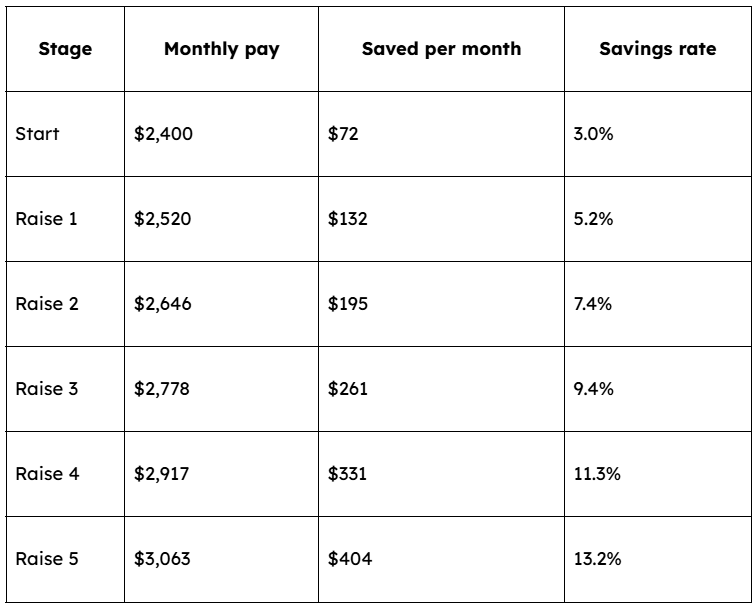
That assumes a 5% raise each year and half of each raise saved. Your take-home pay after saving still grows every year, from $2,328 to $2,659.
9. Turn Yearly Bills Into Monthly Ones
Many “emergencies” are yearly bills in disguise: insurance renewals, school fees, festival gifts, car servicing. Add them up and divide by 12. If the total is $2,400, move $200 a month into its own pot. This is one of the most overlooked answers to how to manage personal finances without constant stress, because the money is already there when the bill shows up.
Spending and Debt
10. Audit Subscriptions in Four Places
People guess low. In one C+R Research survey, respondents guessed $86 a month on subscriptions, but their real total averaged $219. About 74% said recurring charges are easy to forget.
Check your bank and card statements, your phone’s app store, your email (search “receipt,” “renewal,” and “trial”), and any payment apps. A 2026 survey found about 60% of people had at least one unused subscription, costing around $26.79 a month on average. If you can’t remember the last time you used it, cancel it. You can always sign up again.
11. Plug the $5 Leak
Everyone has one: a daily coffee, a delivery fee, a snack run. Five dollars a day adds up to $1,825 a year. Invest that for 20 years at a steady 7%, and it grows to roughly $79,000 from only $36,500 paid in. Real returns rise and fall, so read that as a picture of compounding, not a promise.
To plug it, add friction. Delete saved cards from shopping sites, log out of the apps, and unsubscribe from sale emails. Before any non-essential buy, divide the price by the number of times you’ll truly use it. A $60 item used 60 times costs $1 a use. Used twice, it costs $30.
12. Read the Minimum-Payment Trap
Minimum payments look gentle. They’re not. This is my calculation for a $1,000 balance at 22.36% APR, with the minimum set at the monthly interest plus 1% of the balance, never under $25:
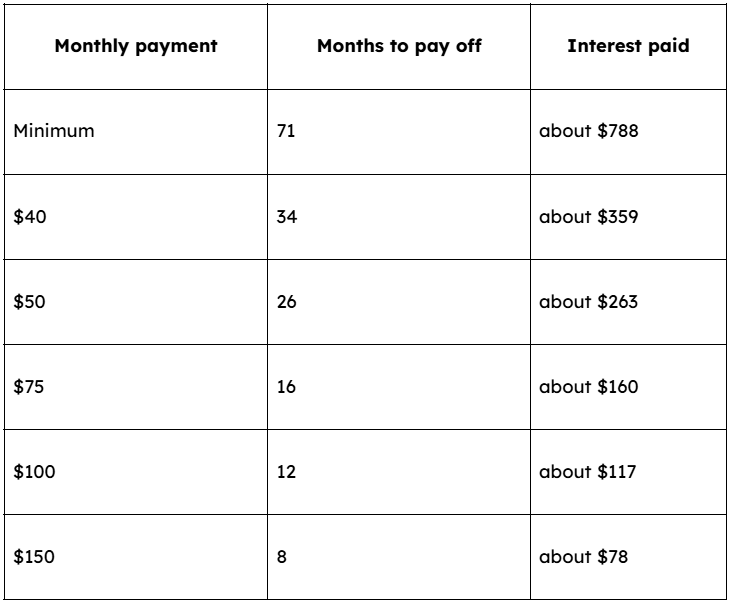
Going from $50 to $75 saves about $100 and ten months. Your card’s terms will differ, so run your own numbers.
13. Autopay the Minimum, Chase One Debt
Set automatic payments for the minimum on every card and bill. That blocks late fees and protects your credit record, wherever credit reports apply. Then make extra payments by hand so you keep watching your balances.
Pick one method for that extra money. The snowball kills your smallest balance first and builds momentum. The avalanche hits your highest rate first and saves more interest. Whichever you pick, stick to it. If payments become impossible, call your lender early.
Growing What’s Left
14. Start Early, and Mind the Fees
Time beats amount. Person A saves $100 a month for ten years, from age 22 to 32, then stops. Person B waits until 32 and saves $100 a month for thirty years. Assume a steady 7% return. At 62, A holds about $140,000 after paying in $12,000. B holds about $122,000 after paying in $36,000.
Fees work the same way in reverse. Take $100 a month for 30 years at a 7% return before fees. With a 0.1% yearly fund fee, you end with about $119,600. With a 1% fee, you end with about $100,500. That’s roughly $19,000 gone to a fee that sounds tiny.
Before you invest, learn what stocks, bonds, and funds are, what they cost, and how far they can drop. Follow one fund on paper for three months before spending anything. If someone promises guaranteed returns, assume it’s a scam. And never invest money you may need soon.
15. Hold a Payday Money Meeting
Pick one date a month and ask yourself four things. What came in? Did my fixed total change? What surprised me? What’s the one thing I’ll change? Then reset your daily number from tip 1. Fifteen minutes is plenty. A small habit you keep beats a big overhaul you never start.
Final Thoughts
Don’t try all 15 this week. Pick two: the two-number budget and a payday transfer to savings. Those give you a daily number you can act on and a cushion that grows.
The best budgeting tips for beginners are the ones you’re still using in six months. Keep what works, drop what doesn’t, and check what your own debt really costs. This is general information, not financial advice, so talk to a qualified professional about your own situation.