This article is dated April 13, 2026.
Introduction
As we enter the second quarter of 2026, Netflix, Inc. (NASDAQ: NFLX) stands as the undisputed champion of the "Streaming Wars"—a title many thought might be surrendered to legacy media titans just a few years ago. Once viewed as a high-growth but cash-burning disruptor, Netflix has evolved into a disciplined, multi-faceted entertainment powerhouse. The company’s story in 2026 is no longer just about subscriber counts; it is about the mastery of monetization through a burgeoning advertising business and a high-stakes pivot into live events and sports. With a stock price that has seen a resurgence following a strategic 10-for-1 split in late 2025, Netflix is currently in focus for its ability to generate massive free cash flow while simultaneously dismantling the traditional linear television model.
Historical Background
Founded in 1997 by Reed Hastings and Marc Randolph as a DVD-by-mail service, Netflix’s history is defined by radical pivots. The first major shift occurred in 2007 with the launch of its streaming service, which effectively cannibalized its own physical disc business. In 2013, the company transitioned from a content aggregator to a creator with House of Cards, initiating an era of massive content spend that topped $17 billion annually.
The "Post-Pandemic Correction" of 2022, which saw the company’s first subscriber loss in a decade, forced the third and perhaps most critical transformation. Under the leadership of Ted Sarandos and Greg Peters, Netflix abandoned its "no-ads" dogma and cracked down on password sharing. By 2024, these moves had stabilized the ship, and by 2025, they had paved the way for the company’s current status as a diversified media giant with a footprint in gaming, live sports, and digital advertising.
Business Model
Netflix’s revenue model is now a sophisticated three-legged stool:
- Subscription Tiers: This remains the core, offering Standard with ads, Standard, and Premium tiers. The ad-supported tier has become the primary entry point for new users, significantly increasing the Total Addressable Market (TAM) in price-sensitive regions.
- Advertising Revenue: As of early 2026, Netflix’s advertising arm is a significant contributor to the bottom line. By leveraging first-party data and high engagement, Netflix captures premium CPMs (cost per thousand impressions) that rival and often exceed traditional broadcast TV.
- Licensing and Merchandising: While still a smaller portion of revenue, the company has expanded its "Netflix Shop" and licensed intellectual property (IP) for consumer products and location-based entertainment experiences (Netflix House).
The customer base is global, with the Asia-Pacific (APAC) and Latin America (LATAM) regions representing the highest growth potential, while North America and Europe provide the "ARPU" (Average Revenue Per User) backbone.
Stock Performance Overview
Netflix’s stock performance over the last decade has been a rollercoaster of "hyper-growth" followed by a "valuation reset."
- 10-Year Horizon: Investors who held NFLX through the volatility have seen returns exceeding 600%, outperforming the S&P 500 significantly as Netflix became a cornerstone of the FAANG era.
- 5-Year Horizon: The 5-year chart reflects the 2022 trough and the subsequent "U-shaped" recovery. The stock rebounded as margins expanded from 18% to nearly 30%.
- 1-Year Horizon: Over the past 12 months, the stock has traded with strength, fueled by the success of the WWE deal and the 10-for-1 stock split in November 2025, which improved retail liquidity. Shares are currently trading in the $110-$120 range (post-split), near all-time highs on an inflation-adjusted basis.
Financial Performance
The fiscal year 2025 results, released in early 2026, showcased a company at peak operational efficiency.
- Revenue: Reached $45.2 billion in 2025, a 16% YoY increase.
- Profitability: Net income hit approximately $11 billion. Operating margins expanded to a record 29.5%, driven by the high-margin nature of the advertising business and the scaling of the "paid sharing" initiative.
- Cash Flow: Free Cash Flow (FCF) reached a healthy $8 billion, allowing the company to aggressively buy back shares and fund its $20 billion content budget for 2026 without taking on significant new debt.
- Valuation: Trading at a forward P/E of roughly 32x, Netflix commands a premium over traditional media (like Disney or Warner Bros. Discovery) but remains below its historical 50x+ levels, reflecting its transition to a "mature compounder."
Leadership and Management
The "Dual-CEO" structure, once viewed with skepticism by corporate governance experts, has proven remarkably effective for Netflix. Ted Sarandos, as Co-CEO and Chief Content Officer, manages the creative engine and Hollywood relationships. Greg Peters, Co-CEO, focuses on product, technology, and the complex scaling of the ad-tier and gaming divisions.
A key recent change was the promotion of Elizabeth Stone to Chief Product and Technology Officer in early 2026. Her role is to unify the user experience across movies, games, and live sports. The management team is currently regarded by Wall Street as one of the most disciplined in media, especially after their March 2026 decision to walk away from a potential acquisition of Warner Bros. Discovery, prioritizing organic growth over a potentially "messy" merger.
Products, Services, and Innovations
Netflix continues to innovate beyond simple video playback:
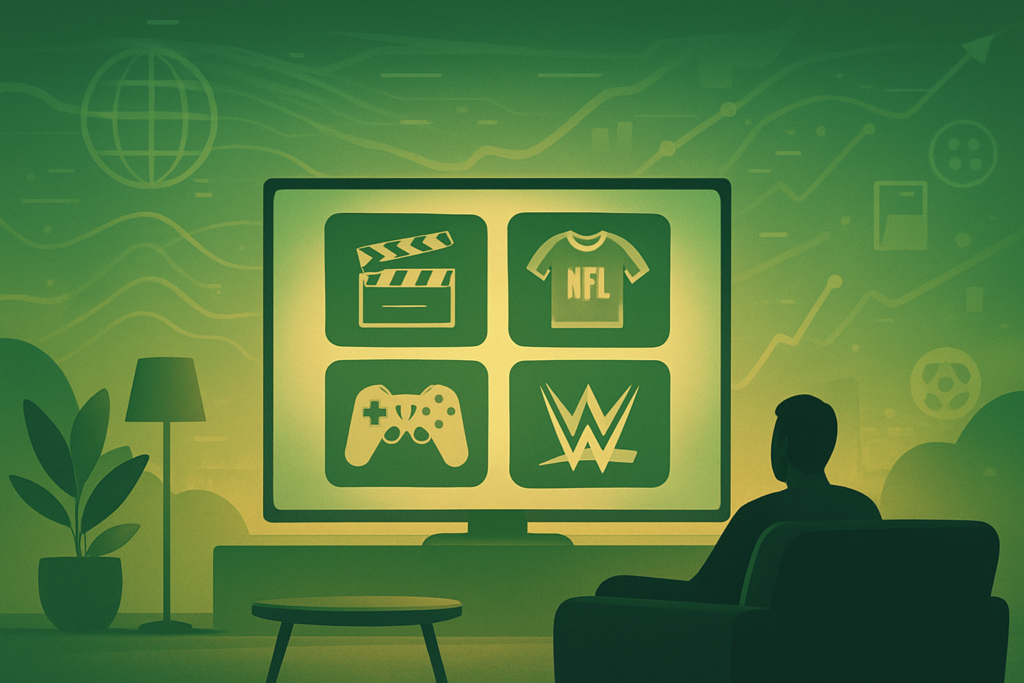
- Live Event Infrastructure: Following the successful broadcast of Christmas Day NFL games in 2024 and 2025, and the record-breaking 65 million concurrent streams for the Paul-Tyson fight, Netflix has built a proprietary live-streaming architecture that is now the envy of the industry.
- Netflix Games: The company’s foray into gaming has matured. By integrating titles like Grand Theft Auto and original games based on Squid Game, Netflix has turned "Games" from a curiosity into a legitimate retention tool.
- Ad-Tech Platform: In 2025, Netflix launched its own in-house advertising technology platform, reducing its reliance on partners like Microsoft and allowing for better targeting and higher ad margins.
Competitive Landscape
The "Streaming Wars" have shifted from a battle for subscribers to a battle for profitability.
- Disney (NYSE: DIS): Remains the primary rival. While Disney+ has achieved profitability, it still struggles with the decline of its linear assets.
- Amazon (NASDAQ: AMZN): Prime Video’s massive reach and bundling with e-commerce make it a formidable "ecosystem" competitor.
- YouTube: Often cited by Netflix management as their biggest competitor for "screen time," YouTube dominates the creator-led economy, though Netflix maintains a lead in premium long-form content.
- The "Consolidators": Smaller players like Paramount Global and Warner Bros. Discovery have faced intense pressure, leading to the ongoing industry consolidation that Netflix has largely chosen to watch from the sidelines.
Industry and Market Trends
The most dominant trend in 2026 is the "Re-bundling of Media." Streaming services are increasingly partnering or being offered as bundles (e.g., the Verizon "plusplay" bundles). Furthermore, the line between "Social Media," "Gaming," and "TV" is blurring.
Another significant trend is the "End of the Peak TV" bubble. Content budgets across the industry have rationalized. Netflix, however, has maintained its $17B–$20B spend, allowing it to out-produce rivals who are forced to cut costs to appease shareholders. Finally, Live Sports has become the final frontier for streaming, as leagues move away from regional sports networks (RSNs) to global digital platforms.
Risks and Challenges
Despite its dominance, Netflix faces several headwinds:
- Sports Rights Inflation: As Netflix moves into live sports (NFL, WWE, FIFA), it enters a high-cost environment where bidding wars with Amazon and Google could erode margins.
- Ad-Tier Churn: While the ad-tier grows, there is a risk that "cord-cutters" will become more price-sensitive, leading to higher churn rates if content quality dips.
- Market Saturation: In the U.S. and Canada (UCAN), Netflix has high penetration. Future growth must come from lower-ARPU international markets, which may pressure overall margins.
- Technical Risks: Live broadcasting is technically demanding. Any high-profile failure during a live NFL game or WWE event could damage the brand’s reliability in the eyes of advertisers.
Opportunities and Catalysts
- The "Ad-Tier Multiplier": If Netflix can grow its ad-supported MAUs to 250 million by 2027, the advertising revenue could eventually rival its subscription revenue, providing a massive boost to earnings.
- India and Emerging Markets: Netflix’s tailored pricing and local content strategy in India are finally paying off, with 2025 showing the highest growth rates in that region since its launch.
- Generative AI in Production: Netflix is an early adopter of AI for localization (dubbing), visual effects, and personalized marketing, which could significantly lower production costs over the next three years.
Investor Sentiment and Analyst Coverage
Wall Street is overwhelmingly bullish on Netflix as of April 2026.
- Goldman Sachs recently upgraded the stock to a "Strong Buy," highlighting the "lumpy but upward" trajectory of ad-revenue.
- J.P. Morgan analysts have praised the "return to organic discipline" following the WBD deal withdrawal.
- Retail Sentiment: On platforms like Reddit and X, sentiment is generally positive, focused on the quality of the live sports offerings and the perceived value of the ad-supported tier.
Regulatory, Policy, and Geopolitical Factors
Netflix faces a complex global regulatory map. In the European Union, the company must comply with strict local content quotas (requiring 30% of the catalog to be European). In South Korea, ongoing legal battles over "network usage fees" remain a concern for margins.
Furthermore, Data Privacy laws in the U.S. and EU (GDPR) are a constant focus, especially as Netflix scales its advertising business. Any mishandling of viewer data for ad-targeting could result in multi-billion dollar fines.
Conclusion
Netflix enters the mid-2026 period not as a tech startup, but as the new "Big Tech" of media. By successfully navigating the transition from a subscription-only model to an ad-supported, live-event destination, the company has insulated itself from the structural decline of traditional television.
Investors should watch two key metrics over the coming quarters: the conversion rate of new sign-ups to the ad-tier and the "per-user engagement" hours for live events. If Netflix can prove that it can own "appointment viewing" as effectively as it owned "binge-watching," its valuation may still have significant room to run. While the costs of entry into sports are high, the rewards of becoming the world's default television screen are higher.
Disclaimer: This content is intended for informational purposes only and is not financial advice. The author has no position in the stocks mentioned at the time of writing.