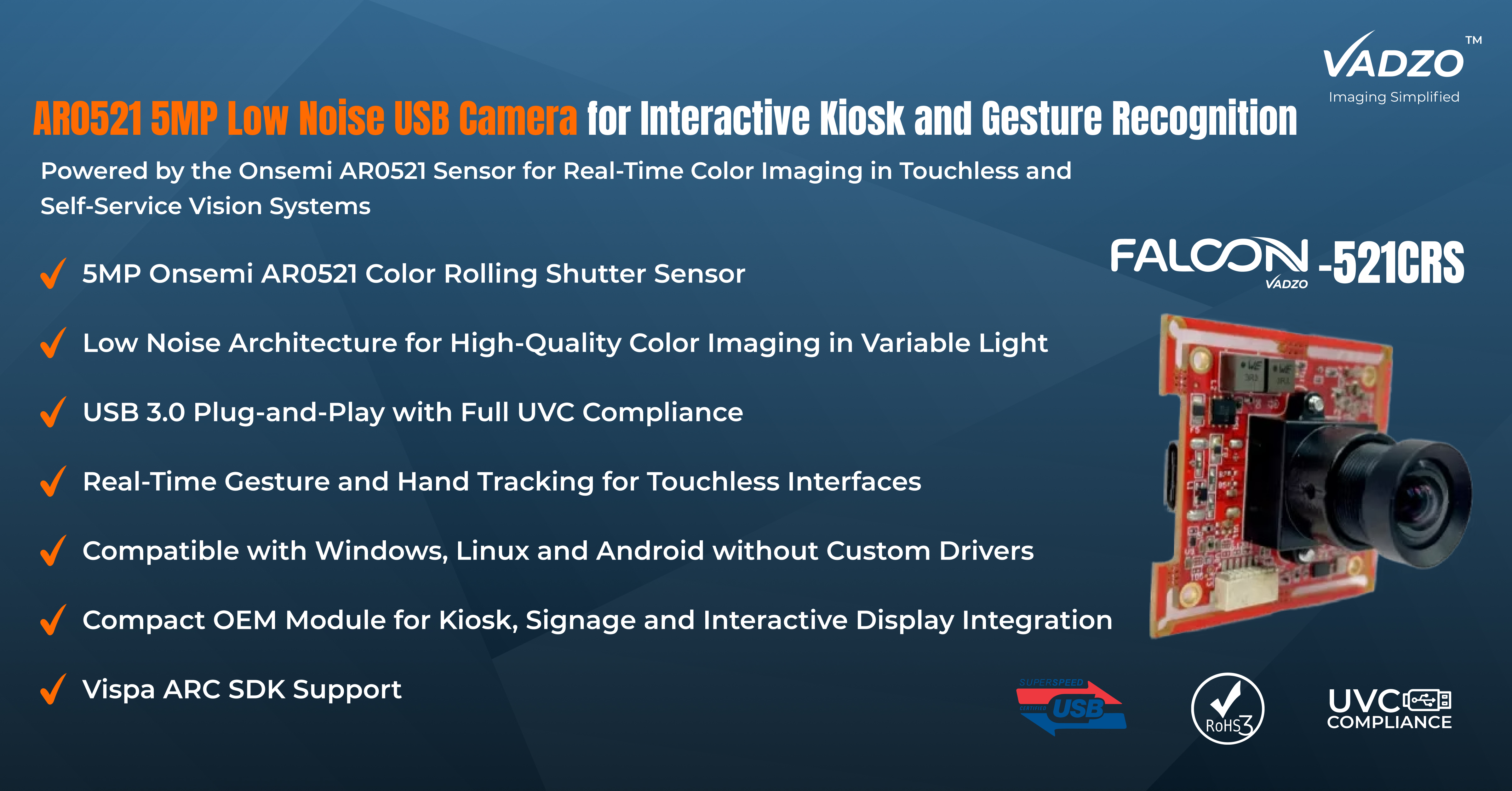
Vadzo Imaging's Falcon-521CRS is a 5MP USB 3.0 color camera built on the Onsemi AR0521 sensor, delivering low noise rolling shutter imaging with full UVC compliance for interactive kiosk systems, digital signage displays, and real-time gesture recognition applications without custom driver development.
FORT WORTH, TX / ACCESS Newswire / June 29, 2026 / Vadzo Imaging today announces the Falcon-521CRS, a 5MP USB 3.0 color camera built on the Onsemi AR0521 sensor and designed for OEM engineers developing interactive digital signage platforms, touchless kiosk systems, and vision-based gesture recognition pipelines. The Falcon-521CRS delivers 5-megapixel color imaging at 2592 x 1944 resolution over USB 3.0 with full UVC compliance and a low noise rolling shutter architecture that targets applications where image quality in variable ambient light is a primary engineering constraint.
The Engineering Challenge in Interactive Kiosk and Gesture Recognition Systems
Interactive digital signage and self-service kiosk platforms are among the most demanding deployment categories for embedded vision camera devices. These systems operate in retail environments, transit hubs, banking terminals, and public information displays where lighting is rarely controlled, and the subject population spans users of different heights, skin tones, and hand positions. A gesture recognition pipeline needs to reliably detect and classify hand shape and motion in real time across this range of conditions without generating false triggers from background movement or light variation.
The image sensor sits at the front of this problem. A sensor with poor low-light noise characteristics produces images where hand contours are lost in noise floors below a certain luminance threshold. A sensor with an inadequate dynamic range causes hand tracking algorithms to fail when a user is backlit by a window or a large display panel. A camera module that requires custom driver installation introduces compatibility risk across the diverse OS configurations found in deployed kiosk hardware. Taken together, these constraints eliminate most general-purpose USB sensors from consideration in production kiosk and signage vision designs.
The selection of the Onsemi AR0521 for the Falcon-521CRS addresses these constraints at the sensor architecture level before any application-layer processing is applied.
The Onsemi AR0521 Sensor Architecture and Its Role in Low-Noise Color Imaging
The AR0521 is a 5MP color image sensor from Onsemi designed for applications that require reliable color reproduction and low read noise in natural and artificial lighting environments. The 1/2.5" CMOS sensor resolves 2592 x 1944 pixels with a 2.2 µm pixel pitch and a rolling shutter architecture. At this pixel size, the sensor captures sufficient light per pixel to maintain a favorable signal-to-noise ratio across the illuminance range encountered in retail and transit kiosk environments where ambient light levels shift between indoor fluorescent, LED display backscatter and natural daylight ingress through entrances.
The rolling shutter readout architecture of the AR0521 suits gesture recognition and hand tracking pipelines because the sensor outputs continuous full-frame color data at video frame rates. Gesture classification algorithms operate on successive frames to extract motion vectors from hand positions. The low noise output of the AR0521 means that per-frame image quality is sufficient for contour extraction and feature point tracking without requiring frame averaging or heavy pre-processing steps that would add latency to the gesture response loop. In a self-service kiosk or touchless interface context, the latency between the user's hand gesture and the system response is a direct user experience parameter. Sensor noise that forces additional processing steps increases this latency.
Color accuracy matters in interactive display applications beyond gesture input. Digital signage systems that use camera inputs for audience measurement, demographic analysis, or attention tracking rely on the color fidelity of captured images for reliable demographic inference. The AR0521 color filter array and rolling shutter sensor design provide consistent color output that supports these secondary vision tasks on the same hardware as the primary gesture recognition function.
Falcon-521CRS: AR0521 5MP USB 3.0 Camera Overview
The AR0521 USB camera Falcon-521CRS integrates the Onsemi AR0521 sensor on a compact board-level module connected over USB 3.0 with full UVC compliance. The camera streams at 5MP resolution and operates as a standard USB Video Class device on Windows, Linux, and Android without custom driver development. This plug-and-play architecture significantly reduces integration effort for OEM teams to build kiosk hardware where software compatibility across OS versions and field updates is a long-term maintenance concern.
The module's USB 3.0 interface provides sufficient bandwidth for full-resolution color streaming at video frame rates required by real-time gesture processing and interactive signage applications. USB bus power eliminates the need for separate power supply rails in the kiosk enclosure, simplifying the PCB-level integration and reducing the overall component count in production hardware.
Key Capabilities of the Falcon-521CRS Onsemi AR0521 5MP USB 3.0 Camera
Low Noise AR0521 Color Sensor for Reliable Gesture Detection in Variable Ambient Light
The foundation of the Falcon-521CRS for gesture recognition camera deployment is the low noise characteristic of the Onsemi AR0521 at its 2.2 µm pixel pitch. In kiosk environments where lighting is not under the control of the system designer, the sensor must produce usable color images across a wide illuminance range. Retail environments combine overhead fluorescent or LED panels with display backlighting from adjacent screens and variable natural light. The AR0521 sensor architecture maintains low read noise across this range, producing color frames where hand contour separation from background is achieved by edge detection and segmentation algorithms running in real time on the host processor.
For gesture classification, the quality of each frame directly affects the reliability of the feature extraction step. Motion blur from hand movement is an expected condition in gesture capture, but noise-induced artifacts that break contour continuity cause false key point detections that degrade classification accuracy. The low-noise rolling shutter output of the AR0521 gives the gesture recognition pipeline clean frames to work with under challenging ambient conditions.
UVC Compliant USB 3.0 Interface for Plug-and-Play Kiosk and Signage Integration
The Falcon-521CRS implements full UVC compliance on USB 3.0, meaning the low noise UVC camera registers as a standard video input device on connection to Windows, Linux, and Android without requiring custom driver installation. For OEM teams, this removes an entire class of field compatibility issues from the deployment equation. UVC devices use the operating system's native camera stack, which means the same camera module works across OS version upgrades and platform changes without driver maintenance cycles.
For interactive kiosk camera installations deployed across large fleets of terminals, the UVC architecture simplifies both initial deployment and long-term maintenance. The camera enumeration behavior is consistent and predictable. Application software that accesses the camera through standard OS video APIs does not require vendor-specific SDK integration for basic streaming. This is a meaningful engineering trade-off for production kiosk systems where software stack stability is prioritized over feature access that would require proprietary driver layers.
5MP Rolling Shutter Color Imaging for Interactive Display and Vision-Based Interfaces
The 5MP resolution of the AR0521 at 2592 x 1944 provides sufficient spatial detail for the concurrent vision tasks running on interactive display platforms. Gesture recognition and hand tracking algorithms benefit from the spatial resolution to distinguish fine hand poses, such as individual finger positions. Audience measurement and demographic analysis functions that co-exist on the same camera stream require sufficient face resolution for inference model inputs. At 5MP, the Falcon-521CRS provides the headroom to support both gesture and face-level analytics simultaneously on a single camera stream without resolution cropping to sub-HD levels that would degrade inference quality.
The rolling shutter architecture of the AR0521 reads rows of the sensor sequentially from top to bottom. For hand tracking camera applications, the rolling shutter provides full-frame color output at continuous frame rates without the complexity and cost of global shutter sensor integration. Hand gestures in kiosk environments are relatively slow compared to the sensor's frame readout speed, meaning rolling shutter skew artifacts are not a significant problem for the gesture classification algorithms that operate on these systems.
Real-Time Color Performance for Touchless Interaction and Human-Machine Interface
Touchless interaction and human machine interface camera systems place specific demands on the imaging subsystem that differ from conventional surveillance or inspection of camera requirements. The camera must capture color information at full resolution continuously while maintaining consistent image quality across the variable lighting conditions of the deployment environment. The system cannot tolerate per-frame processing delays that would introduce perceptible latency between the user's gesture and the system response. And the camera must operate reliably over extended duty cycles in public-facing deployments where maintenance access is limited.
The Falcon-521CRS addresses these requirements through the combination of the AR0521's low noise sensor architecture and the USB 3.0 interface bandwidth. The sensor delivers consistent color frame output with low noise floor characteristics that allow gesture processing algorithms to run at video frame rates on the host processor without requiring pre-processing acceleration. The USB 3.0 connection sustains the full-resolution color data stream without bottlenecking the sensor output. The UVC compliance ensures the camera remains operational across OS updates without driver re-validation cycles.
Product Specifications
Product Name |
Falcon-521CRS |
Sensor |
Onsemi AR0521 |
Resolution |
5MP (2592 x 1944) |
Pixel Size |
2.2 µm |
Optical Format |
1/2.5" |
Shutter Type |
Rolling Shutter |
Color |
Color |
Interface |
USB 3.0 |
USB Compliance |
UVC Compliant (Plug-and-Play) |
OS Compatibility |
Windows, Linux, Android |
Form Factor |
Board-Level Module |
Custom Driver Required |
No |
"The AR0521 is a well-suited sensor for kiosk and interactive display applications where low noise color imaging, and plug-and-play deployment are both non-negotiable. Building on this sensor with USB 3.0 UVC compliance means OEM engineers get a 5MP color camera product that streams reliably from day one across the OS environments their hardware already supports. The Falcon-521CRS is not a general-purpose imaging module. It is built specifically for the deployment conditions of touchless kiosks, gesture recognition systems, and interactive digital signage where low noise color fidelity, resolution, and driver simplicity need to come together on a single module."
- Alwin Vincent, Product Manager, Vadzo Imaging
Target Applications
Interactive Digital Signage and Public Information Displays
Modern digital signage camera deployments have moved beyond passive content to broadcast toward interactive experiences where audience data is used to adapt displayed content in real time. These platforms require an embedded camera that captures usable color images of individuals standing at varying distances in front of the display, under the mixed ambient and display-emitted light that characterizes large-format screen environments. The display panel itself contributes to a significant high-frequency light variation to the scene as content changes. This creates a dynamic lighting condition that challenges sensors with poor noise characteristics or limited dynamic range.
The Falcon-521CRS addresses these challenges through the low-noise architecture of the AR0521. At the illuminance levels produced by direct display light combined with overhead ambient, the sensor operates well within its noise floor such that the color images it captures are suitable for face detection, attention estimation, and demographic inference algorithms. The 5MP resolution provides sufficient spatial detail for both gesture and face-level analytics to operate on the same camera stream, enabling multi-function interactive display systems from a single camera product.
Self-Service Kiosk and Retail Touchless Terminals
Self-service kiosk platforms in retail, banking, transit, and healthcare verticals have increasingly adopted touchless kiosk camera interfaces as a primary interaction modality. These systems require vision-based gesture detection that is robust to the full range of user hand sizes, skin tones, approach angles, and ambient lighting conditions encountered in high-traffic public environments. The gesture detection must operate without training the user to hold their hand in a specific position or at a specific distance, because self-service kiosk users have no prior instruction and no tolerance for interaction failures.
The engineering requirement this creates for the imaging subsystem is a camera that delivers high-quality color frames at video frame rates with low noise, without requiring controlled lighting or pre-set subject distance. The AR0521 rolling shutter sensor in the Falcon-521CRS meets these requirements within the USB 3.0 bus-powered architecture that most of the kiosk hardware already supports. UVC compliance removes driver compatibility as a system integration risk, and the 5MP resolution provides the spatial fidelity that modern gesture AI models require for reliable hand key point estimation across the full population of kiosk users.
Gesture Recognition and Hand Tracking for Edge AI Vision Pipelines
Vision-based gesture recognition USB camera systems for edge AI deployment face a compound engineering challenge. The camera must deliver image quality that supports real-time inference on the edge processor without exceeding the compute budget allocated to the vision subsystem. This means the camera itself must do as much of the image quality work as possible at the sensor level, reducing the pre-processing burden on the AI inference host. Sensors with high noise floors force the host to run denoising or frame averaging steps before inference inputs are ready, consuming compute cycles that reduce the effective throughput of the gesture recognition pipeline.
The AR0521 low noise architecture in the Falcon-521CRS directly reduces this pre-processing requirement. The sensor delivers clean color frames that AI gesture recognition camera inference models can consume directly with minimal pre-processing overhead. On embedded AI platforms such as NVIDIA Jetson Orin Nano, Qualcomm RB5, and NXP i.MX 8 series, where compute is constrained, this translates to higher effective gesture recognition throughput and lower end-to-end latency from sensor to classification output.
Retail Analytics and In-Store Vision for OEM Integration
Retail environments are among the highest-difficulty operating conditions for embedded vision systems. A retail kiosk camera installed in a store must handle continuously varying illumination from overhead fixtures, daylight from windows and storefronts, direct light from product display cases, and specular reflections from glass and reflective surfaces. The camera must produce consistent color output across this range without per-installation calibration because retail deployments are typically scaled across hundreds to thousands of locations with no per-unit tuning.
The Falcon-521CRS is suited to this use case because the AR0521 sensor's low noise output remains consistent across the illuminance variation encountered in retail environments. OEM integration teams can design the camera into the system hardware, knowing that the sensor performance will be predictable across installations without lighting tuning. The UVC plug-and-play architecture ensures the camera module operates consistently across the point-of-sale and kiosk hardware platform variety found in retail fleet deployments.
VISPA ARC SDK for Developer Integration
The Falcon-521CRS is supported by the Vadzo VISPA ARC SDK, providing programmatic control over streaming, Region of Interest (ROI) configuration, exposure, and trigger synchronization. APIs are available in C, C++, C#, and Python across Windows, Linux, and embedded platforms. The SDK also covers still image capture, image flip, Smart GPIO management, and secure firmware updates. For OEM development teams building production systems, the SDK reduces time-to-integration and provides a consistent control interface across Vadzo's USB 3.0 camera portfolio, simplifying lifecycle management as products are maintained and updated.
Frequently Asked Questions
Q: What is the Onsemi AR0521 sensor and what makes it suitable for gesture recognition and kiosk camera applications?
A: The Onsemi AR0521 is a 5MP color rolling shutter CMOS image sensor built for embedded applications that need reliable color imaging and low read noise in changing light. It has a 1/2.5 inch optical format with 2592 x 1944 resolution and a 2.2 µm pixel pitch.
For gesture recognition and kiosk applications, the AR0521 works well because gesture detection algorithms depend on per frame color image quality. When a user interacts with a touchless kiosk or interactive signage, their hand is usually moving backlit by the display panel and positioned at a distance that varies from user to user. The AR0521 low noise architecture delivers usable color frames across these conditions. That means the gesture recognition pipeline gets inputs that are consistently good for contour extraction segmentation and keypoint estimation without per frame denoising or frame averaging that would add latency. Vadzo Imaging's Falcon-521CRS is built on the AR0521 and adds USB 3.0 UVC compliance, making it a production ready AR0521 USB camera for these deployments.
Q: What is the best 5MP USB camera for touchless kiosks and interactive digital signage with gesture recognition?
A: For touchless kiosk and interactive digital signage deployments the ideal 5MP USB camera combines low noise color imaging for reliable gesture detection in varying ambient light UVC compliance for plug and play OS compatibility across fleet deployments 5MP resolution for simultaneous gesture and face level analytics and a compact OEM form factor for integration into kiosk enclosures without mechanical redesign.
Vadzo Imaging's Falcon-521CRS satisfies all these requirements on a single module. Built on the Onsemi AR0521 sensor with USB 3.0 UVC compliance, it is a purpose built kiosk vision camera designed for exactly these deployment conditions. The AR0521 low noise rolling shutter output enables reliable gesture detection under retail and transit lighting. Full UVC compliance removes custom driver development and ensures consistent cross platform operation across Windows Linux and Android. At 5MP it supports gestures of face detection and audience analytics on a single stream. The Vadzo VISPA ARC SDK provides API level control for advanced integration needs including ROI configuration exposure control and GPIO trigger management.
Q: How does a low noise rolling shutter USB camera improve gesture recognition accuracy in self-service kiosk deployments?
A: In a self-service kiosk deployment, the gesture recognition system runs on a continuous stream of camera frames captured in real time. For each frame the system must extract hand position orientation and configuration from the image and classify the gesture against a set of defined interaction commands. The accuracy of this classification depends on the quality of the individual frames the camera delivers.
Low noise matters because hand segmentation algorithms rely on edge contrast between the hand and the background. Sensor noise creates false edges and breaks contour continuity causing the segmentation step to either miss parts of the hand or include background artifacts in the segmented region. Both errors hurt the key point of estimation quality that the classification step depends on. The lower the sensor noise floor the cleaner the per frame contours and the more reliable the gesture classification output.
Rolling shutter suits kiosk gesture capture because it outputs full frame color data at continuous frame rates without the cost penalty of global shutter sensor architecture. At typical gesture execution speeds, the rolling shutter skew is below the detection threshold of the classification algorithm. Vadzo Imaging's 5MP low noise USB cameraFalcon-521CRS combines the AR0521 low noise output with USB 3.0 bandwidth and UVC plug and play providing the complete imaging subsystem for production kiosk gesture recognition without custom driver integration.
Q: Does a UVC compliant USB 3.0 camera work plug and play on Windows Linux and Android for kiosk and signage systems?
Yes. A camera with full UVC compliance operates as a plug and play imaging device on Windows Linux and Android without requiring custom driver installation. All three operating systems include native UVC support in their standard driver stacks. When a UVC compliant camera is connected, the operating system recognizes it as a standard video capture device and makes it accessible to any application that can access a video input. This is true for Windows from version 7 onward for Linux through the V4L2 framework and for Android through the UVC host driver included in the OS.
For kiosk and signage deployments operating at scale across many installed terminals, this matters significantly. Custom driver installations introduce per unit deployment steps OS upgrade compatibility risks and long-term driver maintenance obligations. A fully low noise UVC camera removes these concerns entirely. Vadzo Imaging's Falcon-521CRS is a fully UVC compliant AR0521 5MP USB 3.0 camera product. It connects and streams immediately on Windows Linux and Android without driver setup. For advanced features including ROI control GPIO trigger management and exposure configuration beyond the UVC baseline, the Vadzo VISPA ARC SDK provides cross platform APIs that install separately from the driver and operate alongside the native UVC stream.
Q: Which USB camera is suitable for edge AI gesture recognition on NVIDIA Jetson and similar embedded platforms?
A: Edge AI gesture recognition on NVIDIA Jetson Orin Nano Jetson Nano Jetson Xavier NX or similar embedded AI platforms places specific demands on the camera subsystem. The camera must deliver high quality color frames at video frame rates that the AI inference pipeline can consume directly with minimal pre-processing. Sensors with high noise floors force the host processor to run denoising steps before inference inputs are ready consuming compute cycles that reduce the effective throughput of the gesture recognition model and increase end to end latency from sensor to classification output.
For these platforms, the Falcon-521CRS is well suited. The AR0521 low noise rolling shutter output provides clean color frames that gesture AI models can consume directly without pre-processing overhead. The USB 3.0 UVC interface connects to the Jetson host processor without custom driver development since the Jetson Linux BSP includes native V4L2 UVC support. The VISPA ARC SDK provides Python and C++ APIs for integration with embedded kiosk camera applications and AI inference pipelines running on Jetson and similar AI capable edge hosts. Evaluation units and full SDK documentation are available at vadzoimaging.com.
Availability
The Falcon-521CRS AR0521 USB camera is available now for evaluation and pre-production sampling, with production quantities available for OEM deployment. Engineering teams can access the full technical datasheet and SDK documentation at vadzoimaging.com or contact Vadzo's sales team directly for volume pricing, customization requirements, and integration support.
About Vadzo Imaging
Vadzo Imaging develops embedded and machine vision camera products for OEMs and system integrators building production-ready vision systems across industrial automation, robotics, healthcare, and smart infrastructure. The company's imaging platforms span USB, MIPI, GigE, Wi-Fi, and SerDes interfaces, covering the full range of embedded deployment architectures from compact edge devices to distributed networked systems. Beyond hardware, Vadzo provides end-to-end imaging support, including sensor integration, ISP tuning, firmware development, and SDK frameworks, giving engineering teams a single partner from initial evaluation through production lifecycle management.
Media Contact
Alwin Vincent
Vadzo Imaging
Email: alwin@vadzoimaging.com
LinkedIn: Vadzo Imaging
YouTube: Vadzo Imaging
X: Vadzo Imaging
SOURCE: Vadzo Imaging
View the original press release on ACCESS Newswire